How to Throw a Legal Body Check in Hockey

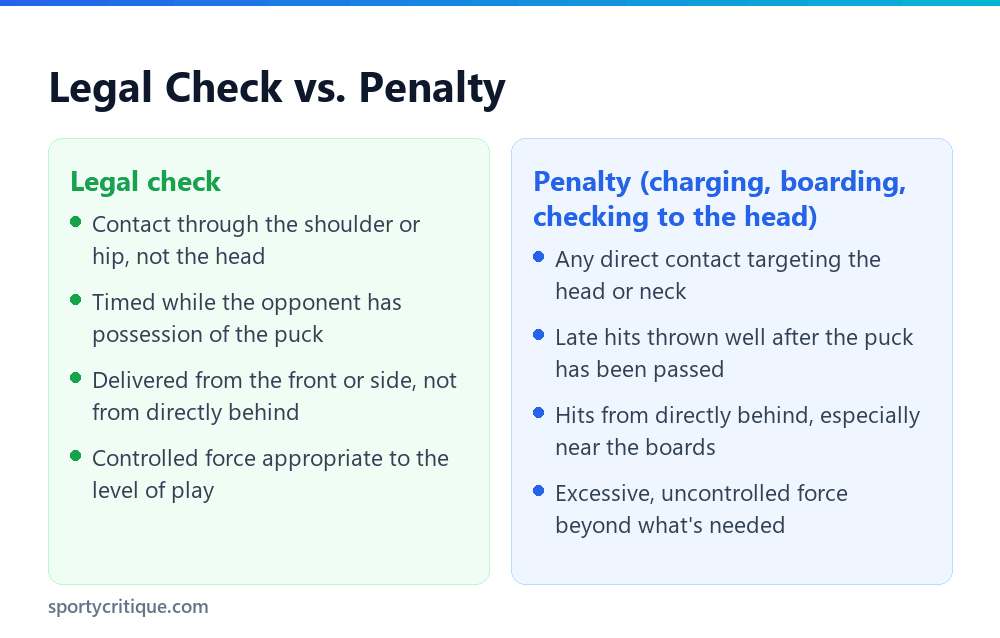
A legal body check in hockey makes contact through the shoulder or hip, targets an opponent who currently has possession of the puck, and comes from the front or side rather than directly from behind. Timing the hit to arrive as the opponent receives or controls the puck, angling the body to absorb and redirect contact rather than launching wildly, and keeping the check controlled rather than excessive are what separate a clean, legal check from a penalty.
Body checking is one of the more physically demanding and rules-sensitive skills in hockey, and the line between an effective, legal check and a costly penalty is narrower than it looks from the stands. Understanding exactly what officials are watching for turns checking from a risky, penalty-prone gamble into a controlled, repeatable tool a player can use confidently.
- →Legal contact goes through the shoulder or hip, never targeting the head or neck
- →The opponent must have possession of the puck at the moment of contact
- →Hits must come from the front or side, not directly from behind
- →Timing the check to the moment of puck reception is more effective than chasing a loose player
- →Controlled, appropriate force beats maximum-effort hits that risk injury and penalties alike
Table of Contents
Contact Point: Shoulder and Hip, Never the Head
A legal check delivers contact through the shoulder or hip, the two body parts built to absorb and transfer force safely in a way the head and neck simply aren’t. Any contact that targets or primarily strikes the head or neck area is a penalty regardless of intent, a rule that’s been enforced increasingly strictly across nearly all levels of organized hockey in recent years due to growing awareness of concussion risk.
⚠️ Watch out: Even an otherwise well-timed, well-angled check becomes an automatic penalty, and often a serious one, if the primary point of contact is the head. This rule applies regardless of whether the opponent ducked into the hit or changed position unexpectedly; officials are trained to assess primary contact point above intent in these situations.
The Puck Possession Requirement
A legal check requires the opponent to have possession of the puck, or to have had possession recently enough that the hit counts as a reasonable continuation of playing the puck carrier, depending on the specific league’s timing rules. Hitting a player well after they’ve passed or shot the puck away is a late hit, a penalty in nearly every rule set from youth leagues through professional play.
This timing window varies somewhat by league and level, with some youth and amateur organizations enforcing a stricter, more immediate window than professional leagues allow. Learning the specific standard used at a player’s own level of competition matters more than assuming a rule seen in professional games applies identically everywhere.
Angle of Approach: Front or Side, Not From Behind
Approaching and delivering contact from directly behind an opponent is prohibited in virtually every hockey rule set, since a player facing away has no ability to see or brace for the hit, creating serious injury risk, particularly near the boards where a hit from behind can drive a player face-first into the glass or boards with no ability to protect themselves.
Legal checks come from the front or side, where the opponent has at least some ability to see the check developing and brace their body accordingly. Angling an approach to arrive from the side, rather than trailing directly behind an opponent and only closing the gap at the last moment, is a specific skill that separates a safe, legal checker from one who draws frequent boarding or checking-from-behind penalties.
Timing the Hit to the Moment of Puck Reception
The most effective legal checks are timed to arrive as an opponent is receiving a pass or gaining possession, a moment when a player’s attention is naturally split between handling the puck and watching for incoming pressure. Reading the play early enough to anticipate this moment, rather than reacting only after the puck has already arrived, is what separates a well-timed check from a late, chasing hit.
💡 Pro tip: Watching the passer rather than only the intended receiver often reveals the timing of an incoming pass earlier, giving a defender more time to close the gap and arrive at the moment of reception rather than a beat too late.
Controlled Force vs. Maximum Effort
A check delivered with controlled, appropriate force for the level of play and the specific game situation is both safer and more effective than an uncontrolled, maximum-effort hit aimed purely at knocking an opponent down. Excessive force beyond what’s needed to legally separate a player from the puck increases both injury risk and the likelihood of a charging penalty for what officials judge as unnecessary or reckless force.
Younger and lower-level leagues in particular tend to enforce controlled-force standards more strictly, reflecting both player safety priorities and the reality that skill and technique, not raw physical force, should drive good checking at those developmental levels. A player learning to check should focus on precise positioning and timing well before emphasizing maximum physical force.
Common Checking Mistakes
- ✓Aim contact through the shoulder or hip, never the head or neck
- ✓Confirm the opponent has puck possession before delivering the check
- ✓Approach from the front or side, never directly from behind
- ✓Use controlled, appropriate force matched to the level of play
- ✕Making primary contact with an opponent’s head, regardless of intent
- ✕Hitting a player well after they’ve already passed or shot the puck away
- ✕Approaching and hitting a player from directly behind, especially near the boards
- ✕Using maximum, uncontrolled force beyond what’s needed to legally separate the puck
Body Position Before Contact
Staying low, with knees bent and weight centered, gives a checking player better balance and control at the moment of contact than approaching upright and off-balance. A low, stable position also reduces the checking player’s own injury risk, since a well-balanced hit absorbs and redirects force more safely than one delivered from an upright, unstable stance.
Keeping the head up and eyes on the opponent throughout the approach, rather than looking down at the puck or losing track of the opponent’s position in the final moment before contact, helps a player adjust their angle and timing in real time if the opponent changes direction or speed unexpectedly.
Rule Differences Across Levels of Play
Body checking rules vary meaningfully by age group and league, with many youth hockey organizations either prohibiting checking entirely below certain age divisions or introducing it gradually with stricter enforcement than adult or professional leagues use. A player moving up to a checking-permitted division for the first time needs specific instruction on legal technique rather than assuming casual observation of professional games has taught them the actual rules.
Even within adult and professional hockey, specific rule interpretations around what counts as boarding, charging, or an illegal hit to the head can vary somewhat between different leagues and officiating standards. Checking a specific league’s rulebook or asking a coach about local enforcement standards clarifies expectations better than assuming uniform rules across every level of the sport.
Gap Control Before the Check
Closing the distance, or gap, between a defender and an oncoming puck carrier at the right pace sets up nearly every well-executed check, since closing too early telegraphs the hit and lets the puck carrier adjust, while closing too late leaves no time to arrive at the correct angle and moment. Managing this gap deliberately, rather than skating purely on reaction, is a foundational skill that supports every other checking technique covered here.
Good gap control also keeps a defender in position to make a legal play even if a check doesn’t materialize, since a defender who has closed the gap correctly can still contest the puck, angle the attacker toward the boards, or force a rushed decision without ever needing to throw a physical hit at all. Checking should be one tool within a broader defensive skill set, not the only option a defender has available.
Reading the Play to Choose the Right Moment
Not every puck-possession moment is an equally good opportunity for a check; a player receiving a pass while already turning away from the boards presents a different, often safer checking opportunity than one receiving a pass with their back already exposed near the glass. Reading these situational differences helps a defender choose moments where a legal, controlled check is actually the right decision rather than forcing a hit into a situation better suited to a stick check or simple positioning.
Game situation matters too. A checking opportunity late in a game with a significant lead carries different risk-reward calculations than the same opportunity in a tied game’s final minute, since a resulting penalty has a bigger relative impact in some situations than others. Experienced players factor this context into their decision-making rather than checking purely on instinct whenever an opportunity technically presents itself.
Conditioning to Check and Absorb Contact Safely
Delivering and absorbing checks safely both depend on core and neck strength that isn’t always prioritized in general hockey conditioning programs focused mainly on skating speed and endurance. Neck strengthening exercises specifically help a player maintain head and neck stability during unexpected contact, reducing injury risk on both the giving and receiving end of a hit.
Practicing checking technique in controlled, coach-supervised drills before applying it in live game situations lets a player build the timing and body positioning skills covered throughout this guide without the added pressure and unpredictability of a full-speed game. Most organized programs that introduce checking include this kind of progressive, drill-based teaching specifically to reduce injury risk during the learning process.
Frequently Asked Questions
What makes a body check illegal in hockey?
The most common violations are contact primarily targeting the head or neck, hitting a player who doesn’t have puck possession, approaching from directly behind, and using excessive, uncontrolled force.
Is checking allowed at every level of hockey?
No. Many youth leagues prohibit or restrict checking below certain age divisions, introducing it gradually with stricter enforcement than adult or professional leagues typically use.
What’s the difference between charging and a legal check?
Charging generally involves excessive speed, distance, or force beyond what’s needed to legally separate a player from the puck. A legal check uses controlled, appropriate force for the situation and level of play.
Can I check a player who just passed the puck?
Only within a limited timing window that varies by league; hitting a player well after they’ve passed or shot the puck away is typically a late hit and penalized as such.
Why is checking from behind penalized so strictly?
Because a player facing away has no ability to see or brace for the hit, creating serious injury risk, particularly near the boards where the impact can drive them into the glass or boards without any chance to protect themselves.
How do I learn to check legally as a beginner?
Focus on positioning, timing, and controlled force before emphasizing physical power. Learning from a qualified coach who can correct technique in real time is far more effective than learning purely by watching professional games.
Checking well is a skill built on timing, angling, and control, not raw aggression. A player who masters the legal fundamentals covered here becomes a more effective and far less penalty-prone defensive presence than one relying purely on physical force without technical precision behind it.
Every element here, contact point, timing, angle, force, and gap control, works together as one connected skill rather than a checklist of separate rules to memorize in isolation. A player who internalizes the full picture checks with confidence instead of hesitation, which paradoxically makes for safer, more controlled contact than a tentative, uncertain approach ever produces.
As an Amazon Associate, we earn from qualifying purchases through links on this page.