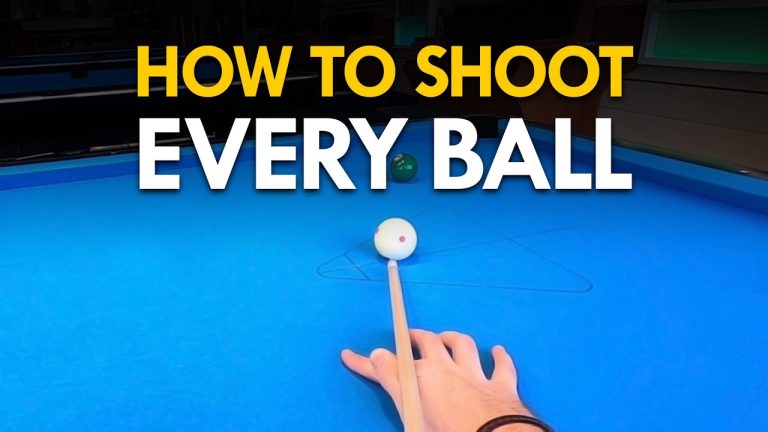
How to Play Bank Pool: Rules and Basic Strategy

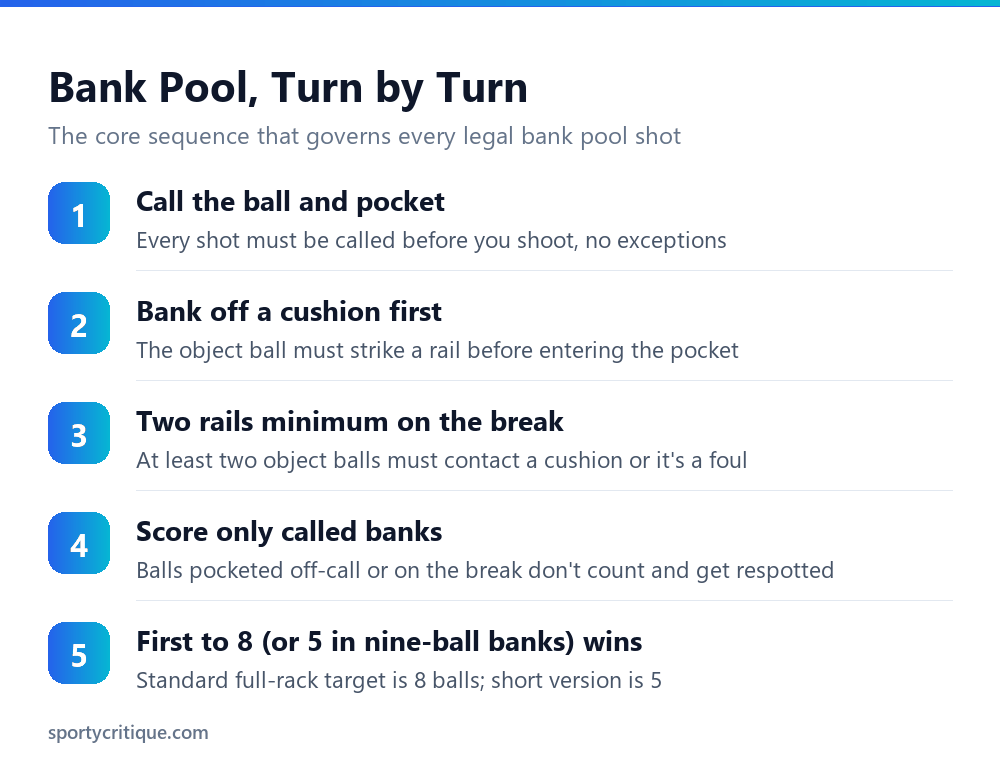
Learning how to play bank pool starts with one rule that changes everything else about the game: every object ball has to bank off a cushion before it drops, and you have to call both the ball and the pocket before you shoot. Miss the call, miss the bank, and the shot doesn’t count no matter how clean it looked.
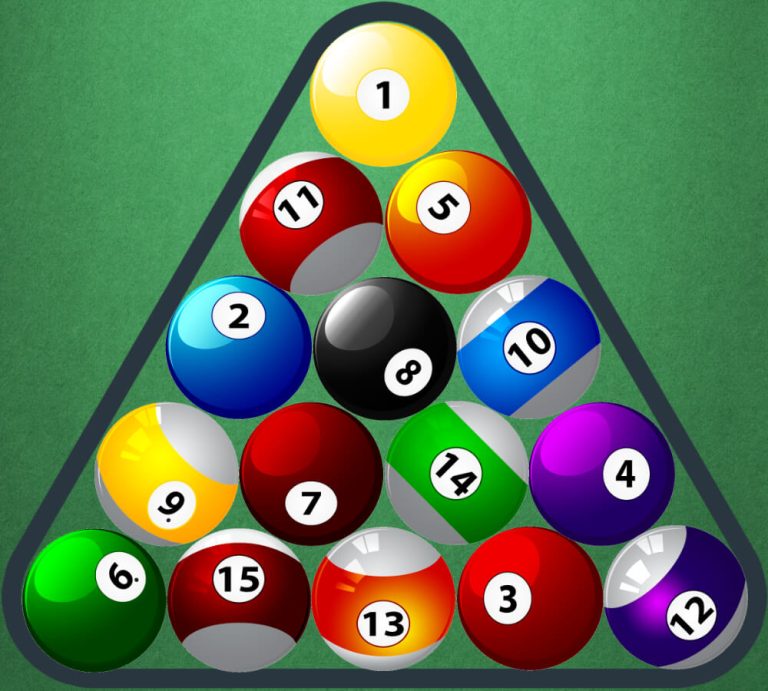
Bank pool is played with a full rack of 15 object balls racked in random order with no special pattern. Every shot must be called (both ball and pocket) and every pocketed ball must strike at least one cushion after contact before dropping. The first player to legally pocket 8 object balls (or 5 in the shortened nine-ball banks version) wins the game. Balls pocketed on the break or without a proper call don’t count and get respotted.
- →Every pocketed ball must bank off a cushion first; a direct shot into the pocket doesn’t count even if called
- →You must call both the ball and the pocket before shooting, every single shot
- →Standard full-rack bank pool is first to legally pocket 8 balls; nine-ball banks is first to 5
- →The break requires at least two object balls to contact a rail or it’s an illegal break
- →Balls pocketed during the break or off an uncalled shot are spotted, not scored
Table of Contents
Setting Up the Table
Bank pool uses all 15 object balls, racked in a standard triangle but in random ball order, unlike 8-ball or 9-ball where specific balls have to sit in specific spots. There’s no requirement for the 8-ball or any other ball to be positioned a certain way inside the rack, which is a detail new players sometimes get wrong by trying to apply 8-ball rack conventions to a game that doesn’t use them.
On the break, the shooter needs at least two object balls to make contact with a cushion, or it’s ruled an illegal break and the opponent gets options depending on your local rule set (commonly the choice to accept the table as-is or have the balls re-racked). Any ball pocketed on the break, legal or not, doesn’t count toward your score and gets spotted back on the table.
The Core Rule: Every Shot Banks and Every Shot Is Called
This is what actually defines bank pool as distinct from every other pool variant: the cue ball has to hit the called object ball first, that object ball then has to strike a rail cushion, and only after that cushion contact can it legally drop into the called pocket. A ball that goes straight into a pocket without touching a rail first doesn’t score, even if you called that exact ball and pocket. It’s spotted back, and your turn ends.
⚠️ Watch out: New players sometimes assume any ball that happens to touch a rail on its way to the pocket counts, even if the bank wasn’t the intended path. Most rule sets are stricter than that: the shot generally needs to be a genuine bank, not an incidental rail touch on a ball that was basically going straight in anyway. Check your local house or league rules, since this is one of the more commonly disputed calls in casual bank pool.
Calling the shot means specifying both which object ball you’re shooting and which pocket it’s headed for, before contact. Some casual games relax this to “obvious” shots not needing a verbal call, but competitive and league play generally expects an explicit call on every single shot, since bank shots are inherently less obvious in destination than a straight-in shot, and disputes over what counted as “obvious” are common without a clear call.
Scoring and Winning the Game
Standard bank pool with a full 15-ball rack goes to whoever legally pockets 8 object balls first. A shortened, faster version called nine-ball banks uses only the balls numbered 1 through 9 and requires just 5 legal pockets to win, which became popular specifically because it trims game length without changing the core banking rule that makes the game what it is.
Turns continue as long as a player keeps legally banking called balls. Miss a shot, foul, or fail to bank the ball off a cushion correctly, and the turn passes to your opponent. There’s no separate “safety” category the way some other pool variants use; every shot is either a legal called bank or it isn’t, though players absolutely can and do play deliberately defensive banks that are hard to pocket but leave the cue ball in a tough spot for the opponent.
Basic Strategy: Picking the Right Bank
Bank shots have a real percentage attached to them even for skilled players, generally lower than a comparable straight-in shot, which changes how you should think about shot selection compared to 8-ball or 9-ball. If you don’t have a genuinely high-percentage bank available on your turn, the stronger play is often to leave your opponent with a difficult bank instead of forcing a low-percentage attempt of your own.
Reading a bank angle correctly means finding the object ball’s mirror point on the rail, roughly where the angle of approach equals the angle of departure, adjusted for the object ball’s own size (the rail contact point is offset by the ball’s radius, not a true point reflection). New players tend to aim at the rail itself rather than accounting for this offset, which is one of the more common reasons an otherwise well-read bank misses just wide of the pocket.
💡 Pro tip: Practice cross-side and cross-corner banks from directly on the head string before attempting anything more complex. These are the most repeatable bank angles on a table and build the feel for rail speed and angle that harder multi-rail banks depend on.
Position Play After a Bank
Where the cue ball ends up after a bank shot matters just as much as making the shot itself, since a made bank that leaves you with no reasonable follow-up shot isn’t much of a win. Thinking one shot ahead, specifically about where your next bank angle will come from, separates players who consistently run multiple balls from those who make one bank and then stall out with nothing playable left on the table.
Multi-rail banks (two or three cushions before the pocket) open up more of these positional options than a simple one-rail bank, at the cost of being noticeably harder to execute cleanly. They’re worth learning once single-rail banks feel consistent, since they turn otherwise unplayable ball positions into legitimate scoring chances.
How Bank Pool Differs From 8-Ball and 9-Ball
Players coming from 8-ball or 9-ball tend to underestimate how much the mandatory bank changes shot selection. In 8-ball, a straight-in shot on an open ball is almost always the right call when available. In bank pool, that same straight-in shot simply isn’t a legal option, the ball has to go off a rail regardless of how open the direct line looks, which means the game rewards a completely different kind of table vision built around rail angles rather than direct lines.
There’s also no equivalent to calling your group (solids or stripes) the way 8-ball works. Every ball is available to either player at any time in bank pool, which keeps the game more open but also means you can’t play a purely defensive strategy around protecting “your” balls the way 8-ball sometimes allows. Every legal bank you leave on the table is fair game for your opponent on their next turn.
House Rule Variations Worth Knowing
Bank pool has more local rule variation than 8-ball or straight pool, particularly around what counts as a legitimate called bank versus an incidental rail touch, and around what happens after an illegal break. Some rooms play that the incoming player can simply take ball-in-hand after an illegal break; others require a re-rack. Before playing a serious match or entering a league, ask specifically how your venue handles these edge cases rather than assuming the rules match the last place you played.
Scratches (the cue ball itself going in a pocket) generally end your turn and hand the opponent ball-in-hand, similar to most other pool games, though the exact penalty can vary by house rules too. It’s worth clarifying scratch penalties alongside the bank-call rules before the first rack, since both tend to be where casual games run into disagreements.
A Simple Practice Drill
Set up an object ball and a cue ball for a straightforward cross-corner bank, make the shot ten times in a row before moving the balls, and track your success rate honestly. Once cross-corner banks feel reliable, move to cross-side banks, then start varying the distance and angle rather than always practicing from the same spot. Comfortable, repeatable single-rail banks from a range of angles are the actual foundation the rest of the game builds on, more than any amount of watching multi-rail trick shots.
Equipment That Actually Helps
Bank pool rewards precise, repeatable spin control more than most pool variants, since a slightly mis-hit bank angle compounds into a much bigger miss by the time the ball reaches the far rail. A finer, higher-friction chalk like Kamui 0.98 Beta pool cue chalk gives a larger effective sweet spot on off-center hits, which matters specifically on cut-heavy bank shots where a slight miscue changes the rail angle enough to blow the whole shot. It’s not going to fix a bad read on the angle, but it removes one source of error from shots that already have several ways to go wrong.
Common Beginner Mistakes
- ✓Calling both the ball and pocket clearly before every shot, even casual ones
- ✓Finding the rail’s mirror point and adjusting for the object ball’s radius before shooting
- ✓Playing a deliberate leave when no high-percentage bank is available
- ✓Practicing simple cross-corner and cross-side banks before attempting multi-rail shots
- ✕Assuming a ball that grazes a rail on the way to a pocket automatically counts as a legal bank
- ✕Aiming directly at the rail without accounting for the object ball’s own size
- ✕Forcing a low-percentage bank instead of playing a safer defensive shot
- ✕Jumping straight to multi-rail banks before single-rail shots are consistent
Common Myths About Bank Pool
How many balls do you need to pocket to win a game of bank pool?
Standard full-rack bank pool goes to 8 legally pocketed balls. The shortened nine-ball banks version, using balls 1 through 9, only requires 5 legal pockets to win.
Does a ball that touches the rail on the way to the pocket always count in bank pool?
Not automatically. Most rule sets require a genuine bank, meaning the shot’s actual path goes off a cushion before the pocket, rather than an incidental rail touch on a ball that was essentially going straight in. Check your specific house or league rules, since this is a commonly disputed call.
Do you have to call the pocket as well as the ball in bank pool?
Yes, in competitive and league play you call both the object ball and the intended pocket before every shot. Casual games sometimes relax this for obviously simple shots, but it leads to more disputes than just calling every shot explicitly.
What happens to balls pocketed on the break in bank pool?
They don’t count toward your score regardless of how they went in, and they’re spotted back on the table. The break’s only requirement is that at least two object balls contact a cushion, or it’s ruled an illegal break.
As an Amazon Associate, we earn from qualifying purchases through links on this page.