Best Pool Cue Tip for Breaking: Top Choices for Power Shots

The opening break shot is the most violent, high-impact collision in billiards. Striking a tightly packed rack of 15 balls at 20 to 30 mph demands immediate kinetic energy transfer. If you break with a standard soft or medium leather playing tip, the spongy leather compresses upon contact, absorbing stroke momentum and mushrooming out of shape. Dedicated break cue tips—engineered from ultra-hard phenolic resins, hybrid composites, or hardened multi-layer leather—transfer nearly 100% of your stroke speed straight into the head ball for explosive rack spread.
Affiliate Disclosure: SportyCritique is reader-supported. When you purchase through links on our site, we may earn an affiliate commission at no additional cost to you. Every break tip and tool reviewed below has been evaluated for Shore D impact hardness, chalk retention, mushroom resistance, and tournament league legality.
Table of Contents
Comparison Matrix: Best Pool Cue Tips for Heavy Breaking & Jumping
| Break Tip Model | Material Composition | Shore D Hardness | Chalk Adhesion Rating | League Compliance (BCA/APA) | Amazon Price Check |
|---|---|---|---|---|---|
| Tiger Icebreaker Phenolic/Leather | Phenolic Resin Core with Leather Base | 95 Shore D (Ultra-Hard) | High (Leather Texture Holds Chalk) | 100% Legal in All Sanctioned Leagues | Check Price on Amazon |
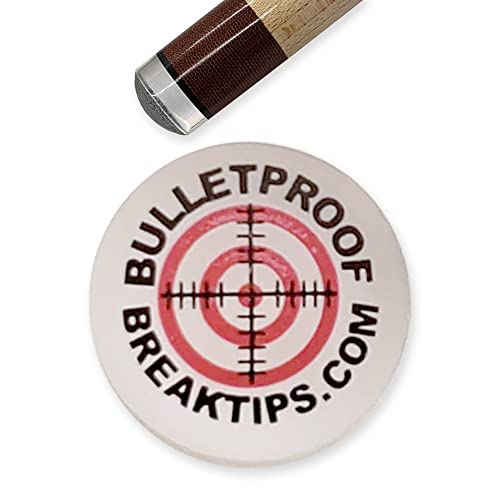
| Bulletproof Break Tips (Polymer) | High-Density Aerospace Polymer | 96 Shore D | High (Special Micro-Porous Surface) | Legal Where Non-Leather Is Permitted | Check Price on Amazon |
| Bulletproof Recoil Pool Cue Tip | Ultra-Durable Synthetic Polymer Blend | 94 Shore D | Moderate-High | Legal for Standard Tournament Play | Check Price on Amazon |
| Tiger Laminated Break Cue Tip | 100% Extra-Hard Vacuum-Tanned Leather | 88 Shore D | Maximum (Pure Leather Chalk Bite) | 100% Legal in All Strict Leather Leagues | Check Price on Amazon |
| AB Earth Monzo Heavy Break Cue | 3-Piece Jump/Break Stick with Phenolic Tip | 95 Shore D Tip Core | Standard | Complete High-Impact Break Setup | Check Price on Amazon |
| Kmise Break Cue Stick | Dedicated 2-Piece Hardwood Break Stick | 85 Shore D Hard Leather | Standard | Budget Dedicated Break Solution | Check Price on Amazon |
| GSE Games 3-in-1 Tip Tool | Machined Aluminum Scuffer/Shaper/Aerator | N/A (Accessory) | Essential for Chalking Hard Break Tips | Universal Maintenance Tool | Check Price on Amazon |
Break Tip Physics: Shore D Hardness & Energy Transfer
When selecting a break tip, understanding the relationship between material hardness and cue ball physics is critical:
- The Shore D Hardness Scale: Rubber and leather materials are measured on the Shore D durometer scale. Standard soft and medium playing tips register between 65D and 75D, providing maximum cue ball grip for side spin. Dedicated break tips register between 88D and 98D. Because an ultra-hard tip exhibits virtually zero elastic compression upon impact, it delivers a high coefficient of restitution—meaning all the kinetic energy built up in your backswing transfers instantaneously into the rack.
- The Mushroom Effect: Hitting a 6-ounce phenolic ball at full power with a soft leather tip flattens the leather outward, causing the tip to overhang the edges of the ferrule (mushrooming). Once a tip mushrooms, its contact surface deforms, ruining accuracy. High-density composite break tips are physically incapable of mushrooming, retaining their factory shape for years.
- League Rules & Material Legality: In international competition and some traditional league divisions, official rules stipulate that tips must contain leather. Pure phenolic resin tips (which feel like hard bowling ball material) are occasionally prohibited. The Tiger Icebreaker solved this regulatory hurdle by bonding a micro-layer of natural leather beneath an ultra-hard impregnated phenolic striking surface, making it 100% legal under BCA, APA, and WPA equipment standards.
- Why Break Tips Require Aeration: Because ultra-hard tips have dense, non-porous surfaces, chalk can slide off easily if the tip glazes over. Using a needle aerator (like the tool found in the GSE 3-in-1 Tip Tool) punches microscopic pockets into the tip face, allowing high-friction chalk like Predator 1080 Pure to anchor securely and prevent catastrophic break miscues.
Tiger Icebreaker Phenolic/Leather Pool Cue Tip

The Tiger Icebreaker is widely recognized as the premier break-and-jump tip in competitive cue sports. Manufactured in California by Tiger Products, the Icebreaker utilizes a patented hybrid architecture: a base layer of specially treated leather fused directly to an ultra-hard phenolic composite core. This unique construction delivers explosive 95 Shore D energy transfer while maintaining exceptional chalk adhesion.
Because the striking face grips chalk far better than slick monolithic phenolic balls, you can break with controlled draw or follow without fear of miscuing. When installed on a jump cue, the Icebreaker launches the cue ball effortlessly over obstacle balls with a short, compact stroke. It is 100% legal in all major amateur and professional leagues. Install it using our recommended rubber-toughened cue tip glue for a lifetime bond.
Pros:
- Hybrid phenolic-leather construction delivers explosive rack dispersion
- Holds chalk significantly better than pure glass-smooth phenolic tips
- 100% legal in all BCA, APA, and WPA league tournaments
- Dual-purpose design excels for both power breaks and high-clearance jump shots
Cons:
- Requires careful installation and proper clamping pressure
Bulletproof Break Tips – Polymer Break & Jump

Engineered from high-density aerospace polymer composites, Bulletproof Break Tips are built for players seeking maximum velocity without the chalk-slipping drawbacks of traditional plastics. Registering at an immense 96 Shore D hardness, Bulletproof tips produce a distinctive gunshot acoustic crack that sends object balls rocketing to the corners.
The micro-textured surface accepts chalk evenly, while its non-compressible molecular structure ensures it will never mushroom, delaminate, or flatten out, even after thousands of maximum-force breaks.
Pros:
- Immense 96 Shore D hardness generates maximum kinetic ball speed
- Zero mushrooming or deformation over years of heavy breaking
- Precision machined for flat, effortless gluing onto standard 13mm to 14mm ferrules
Cons:
- Hard synthetic feel requires thorough chalking before every break
Tiger Laminated Pool Billiard Break Cue Tip

For purists who compete in strict league divisions that mandate 100% genuine leather tips, the Tiger Laminated Break Tip is the highest-performing all-leather option available. Built from select heavy pigskin layers treated under high vacuum pressure, it achieves an impressive 88 Shore D hardness while retaining the natural grip and feel of genuine leather.
Because it is pure leather, it holds chalk with unmatched consistency, completely eliminating the fear of miscuing on controlled cut-breaks. If you play in APA leagues where synthetic tips are heavily scrutinized by opposing captains, this tip provides maximum break power with zero regulatory questions.
Pros:
- 100% natural laminated leather complies with every league and tournament rulebook
- Unmatched chalk retention eliminates break miscues
- Vacuum-tanned layers resist mushrooming far better than standard hard tips
Cons:
- Slightly less explosive energy transfer than 95D+ phenolic composites
GSE Games 3-in-1 Pool Cue Tip Tool

Maintaining an ultra-hard break tip requires a specialized tool. The GSE 3-in-1 Tool combines a nickel/dime radius shaper, a coarse abrasive scuffer, and a sharp needle aerator inside a sleek machined aluminum cylinder. Unthreading the tool reveals the needle cluster, which punches microscopic perforations into glazed phenolic or hardened leather tips, restoring instant chalk bite and preventing costly break scratches.
Pros:
- Machined needle cluster aerates glazed break tips to restore chalk grip
- Dual nickel and dime radius shapers maintain proper tip curvature
- Compact, indestructible aluminum case fits in any cue case pocket
Cons:
- Needles are sharp; cap must be threaded tightly when storing
Frequently Asked Questions
What is the best tip material for a break cue?
A hybrid phenolic-leather tip like the Tiger Icebreaker is the best overall choice. It delivers the rock-hard 95 Shore D energy transfer of pure phenolic resin to maximize ball spread, while its leather component holds chalk securely to prevent miscues and complies with all league rules.
What radius should a break cue tip be shaped to?
Break tips should be shaped to a nickel radius (roughly 10.5mm curvature) or slightly flatter. A flatter nickel radius provides a larger, wider surface area contact patch against the cue ball, ensuring maximum forward momentum transfer while minimizing deflection squirt on power breaks.
Why can’t I just break with my regular shooting cue?
Breaking with a primary shooting cue compresses your soft playing tip, causing it to mushroom outward and lose its precision dome. In addition, the violent 25+ mph shock can crack lightweight hollow ferrules and damage low-deflection shafts over time. A dedicated break cue with a hard tip protects your shooting investment.
Are phenolic break tips legal in APA league matches?
Under official APA rules, phenolic and composite break tips are fully permitted on dedicated break and jump cues, provided they do not damage the cue ball. However, in leagues that mandate 100% leather tips, a hybrid tip like the Tiger Icebreaker or an extra-hard leather tip like the Tiger Laminated Break Tip ensures complete regulatory compliance.
Final Verdict: Top Break Tip Recommendations
If you want the ultimate tournament break weapon that delivers explosive rack dispersion, exceptional chalk grip, and 100% league legality, the Tiger Icebreaker Phenolic/Leather Hybrid Tip is the undisputed champion. For players competing in strict traditional divisions requiring all-leather construction, the Tiger Laminated Leather Break Tip provides massive 88D power with zero regulatory questions.