How to Hit a Bunker Shot: Setup, Swing, and Common Mistakes


Most golfers try to hit a bunker shot like a chip and end up either skulling it across the green or leaving it in the sand. It’s a different shot with a different technique, and once you understand what you’re actually trying to strike, it gets a lot more predictable.
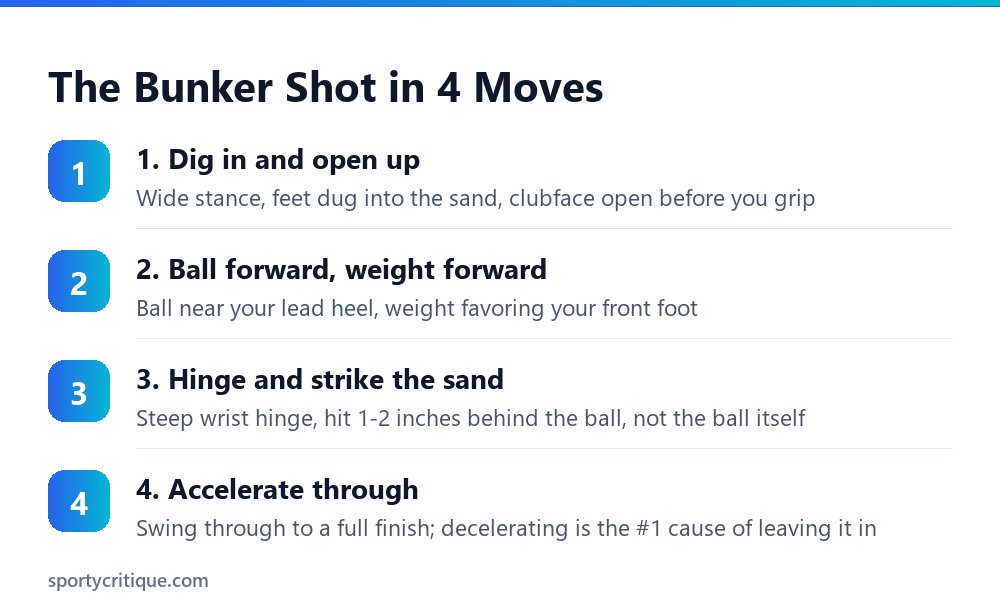
To hit a bunker shot, open your stance and clubface, dig your feet into the sand for stability, play the ball forward near your lead heel, and swing down to a spot one to two inches behind the ball rather than at the ball itself. Let the club’s bounce slide through the sand and carry the ball out on a cushion of sand, and swing all the way through to a finish. Most missed bunker shots come from decelerating into impact, not from bad technique elsewhere in the swing.
A bunker shot looks nothing like a normal chip, and trying to hit it like one is the most common reason golfers dread the sand. On a regular chip you’re trying to strike the ball first. On a bunker shot you’re trying to strike the sand first, an inch or two behind the ball, and let the sand itself lift the ball out. Once that clicks, the rest of the shot gets a lot less scary, even though it still takes real practice to control distance.
- →You’re hitting the sand, not the ball. Aim 1-2 inches behind the ball, every time.
- →Open your stance and clubface before you take your grip, not after.
- →Dig your feet into the sand for a stable base; rules allow this even though you can’t ground the club.
- →Deceleration is the #1 cause of leaving a ball in the bunker. Commit to a full finish.
- →A 56° sand wedge or higher with real bounce is the right tool; a pitching wedge fights you in soft sand.
Table of Contents
Setup: stance, ball position, and clubface
Start with your stance open to the target line, meaning your feet, hips, and shoulders aim slightly left of where the ball is actually going (for a right-handed golfer). Dig your feet in a little for stability; you’re allowed to work your feet into the sand for footing even though the rules don’t let you ground the club or touch the sand with it before your swing.
Open the clubface before you take your grip, not after. Set the face open, then build your grip around that open position. If you grip first and try to twist the face open afterward, it tends to close back down through impact without you noticing, which is one of the quiet reasons a lot of bunker shots come out low and thin instead of high and soft.
Play the ball forward in your stance, roughly off your lead heel, and set most of your weight on your front foot from the start. Keep that weight there through the swing; leaning back to try to “help” the ball into the air is a natural instinct and it’s almost always wrong, since it moves your low point behind the ball and leads to a thin, skulled shot across the green.
⚠️ Watch out: You cannot ground your club in the sand before starting your swing, including resting it behind the ball at address. Hover it slightly instead. Grounding the club in a hazard is a rules violation under the Rules of Golf and carries a penalty.
The swing: how to actually strike the sand correctly
A bunker shot needs a steeper angle of attack than a normal swing, and the easiest way to get that steepness is an early, aggressive wrist hinge on the backswing rather than a flatter, sweeping takeaway. Hinge the club up quickly, almost like you’re picking it straight up, then come down into the sand aiming for a spot one to two inches behind the ball.
The club’s bounce, the rounded ridge on the sole of a sand wedge, is what lets the clubhead slide through sand instead of digging into it. That only works with an open face. A square or closed face turns that same rounded bounce into a leading edge that digs in and stops the club dead, which is why a closed-face bunker shot so often comes up short or doesn’t get out of the bunker at all.
Commit to a full finish on every bunker shot, even short ones. Deceleration into impact is the single most common swing fault in the sand, and it’s almost always fear driven, golfers slow down because they’re worried about hitting it too far, and the clubhead stalls in the sand instead of carrying through. A shorter backswing with full acceleration through impact controls distance far better than a long backswing that decelerates.
Club selection and sand conditions
A dedicated sand wedge, 56 degrees of loft or higher, with a real bounce angle is the right tool here. Something like the Wilson Harmonized Golf Wedges at around $85.00 gives you the loft and bounce this shot depends on without needing a full custom wedge fitting to get started. A pitching wedge, with its lower bounce and loft, tends to dig into sand rather than slide through it, which is why bunker shots hit with the wrong club so often come out heavy.
Common mistakes that leave it in the bunker
- ✓Aim your swing at a spot behind the ball, consistently, every rep
- ✓Open the clubface before gripping, then keep it open through impact
- ✓Commit fully to the swing length you choose; no half-hearted swings
- ✓Practice from both good and bad lies, not just a perfectly raked spot
- ✕Try to pick the ball clean like a chip shot off short grass
- ✕Grip first and try to twist the face open afterward
- ✕Decelerate into impact out of fear of hitting it too far
- ✕Use a pitching wedge or low-bounce iron out of soft sand
💡 Pro tip: Draw a line in the practice bunker sand and work on splashing sand off that line before you ever put a ball down. Once you can consistently take a shallow, one to two inch divot of sand off the line, add the ball just in front of it and repeat the same motion. This isolates the one skill, striking sand at the right spot, that actually determines whether the ball gets out.
Distance control: the part most golfers skip
Once you can reliably get the ball out of the bunker, the next problem is controlling how far it goes, since a bunker shot that clears the lip but flies the green is barely better than one that stays in the sand. Distance in a bunker shot comes mostly from swing length and how much sand you take, not from how hard you swing. A longer backswing with a shallower sand entry carries farther; a shorter backswing with a slightly deeper entry carries less.
📊 Note: Most amateur golfers take too much sand on longer bunker shots, which kills speed and leaves the ball short. If you’re consistently coming up short from greenside bunkers, try taking less sand, closer to half an inch behind the ball, rather than swinging harder.
Practice drills that actually transfer to the course
The line drill above builds the core feel for striking sand correctly. A second useful drill is the two-tee gate: push two tees into the sand about a driver’s width apart, just behind where your ball would sit, and practice swinging through the gate without touching either tee. It forces the same shallow, sand-splashing entry the actual shot needs, and it gives you instant feedback when your swing gets too steep or too flat.
Practice from uneven lies too, not just flat sand. An uphill lie in the bunker adds loft and shortens the shot; a downhill lie takes loft off and needs an even more open face to compensate. Most public course practice bunkers are raked flat, which means most golfers never actually rehearse the lies they’ll face on the course, where a ball rarely settles perfectly level in the sand.
Long bunker shots: when the flag isn’t right next to you
Everything above describes a standard greenside bunker shot, but a fairway bunker shot or a long greenside bunker shot to a far pin works differently. You still need to hit the sand, but you can’t rely on a wide-open face and a short, steep swing to cover real distance. For longer bunker shots, use a slightly less lofted club, square the face closer to your target instead of leaving it wide open, and take a flatter, longer swing that catches less sand and more ball.
The lip height in front of you decides how much this changes. A low lip lets you play almost a normal iron shot off a clean lie, catching the ball first with minimal sand contact. A tall lip forces you back toward the standard technique regardless of distance, because clearing it has to come first, and you accept whatever roll-out happens once the ball lands.
The mental side of bunker shots
A lot of poor bunker shots start before the swing even begins. Golfers who dread bunkers tend to make a tentative, half-committed swing because they’re afraid of either skulling it over the green or leaving it in the sand, and that hesitation is exactly what causes deceleration, the single biggest technical fault in the shot. Committing to a shorter, fully accelerated swing beats a longer, tentative one almost every time, both for consistency and for actual distance control.
One practical fix: pick your swing length before you step into the bunker, based on the distance to the pin, and then commit to swinging that length at full speed. Second-guessing the length mid-swing is what produces the worst misses, far more often than picking the wrong length in the first place.
Bottom line
A bunker shot is a sand shot before it’s a golf shot: open stance, open face, ball forward, and a full swing that strikes sand an inch or two behind the ball and carries all the way through. Every common miss, thin, chunked, or left in the bunker entirely, traces back to one of those four things breaking down, which means the fix is almost always simpler than it feels standing over the ball.
What club should I use for a bunker shot?
A sand wedge with 54 to 58 degrees of loft and real bounce is the standard choice. The bounce lets the club slide through sand instead of digging in, which a lower-loft pitching wedge doesn’t do nearly as well.
Why do I keep hitting the ball thin out of bunkers?
Thin bunker shots usually come from leaning back away from the ball during the downswing, which moves your low point behind where you’re aiming and makes the club catch the ball’s equator instead of the sand beneath it. Keep your weight forward and committed through impact.
How far behind the ball should I hit the sand?
About one to two inches for a standard greenside bunker shot with a decent lie. Take less sand, closer to half an inch, if you need extra distance; take slightly more if you need the ball to come out soft and stop quickly.
Is it true you should never let the club touch the sand before swinging?
Yes. Grounding the club in a hazard before your swing, including bunkers, is a rules violation. You can work your feet into the sand for stability, but the club itself must stay hovering above the sand at address.
As an Amazon Associate, we earn from qualifying purchases through links on this page.