How to Sight in Open Water Swimming Without Breaking Stroke

Swimming without lane lines means you’re your own navigator, and the sighting glance that keeps you on course is also the fastest way to wreck a good stroke if you do it wrong. Here’s how to keep both working at once.
To sight in open water without breaking your stroke, lift just your eyes above the surface for a quick look, not your whole head, and keep sighting separate from breathing rather than combining them into one motion. Sight on a forward stroke, then roll to the side to breathe on the next one. Aim for a quick glance, not a long look, since the goal is a snapshot of your target, not a leisurely view of the course.
Open water swimming without pool lane lines means you’re responsible for your own navigation, and most swimmers new to it either sight so rarely that they zigzag badly off course, or sight so often and so clumsily that they wreck their stroke rhythm and burn extra energy on every single stroke. Both mistakes come from the same root cause: treating sighting as a separate task bolted onto swimming, instead of a small, practiced adjustment inside the stroke you already have.
- →Lift your eyes, not your whole head, once you’re comfortable with the skill.
- →Separate sighting from breathing; look forward, then roll to breathe on the next stroke.
- →Sight briefly, a quick snapshot, not a long look that stalls your rhythm.
- →Sight more often in rough water, less often in calm water.
- →Practice the motion in a pool before race day; open water is the wrong place to learn a new skill.
Table of Contents
The basic sighting motion
Start the lift right as your arm enters the water on the stroke you’re using to sight. Raise your eyes just enough to break the surface, look forward for a fraction of a second, then drop your head back down into your normal head position before your next stroke. The whole motion should feel quick, almost like a glance rather than a look, because the longer your head stays up, the more your hips and legs drop and the more drag you create.
A common beginner habit is lifting the head too early or holding it up too long, which flattens the body position and turns an efficient swimmer into someone fighting their own legs sinking. If you notice your legs feel heavy or your kick feels labored right after sighting, that’s usually a sign your head came up too high or stayed up too long, not a fitness problem.
Two sighting techniques, and which one to use
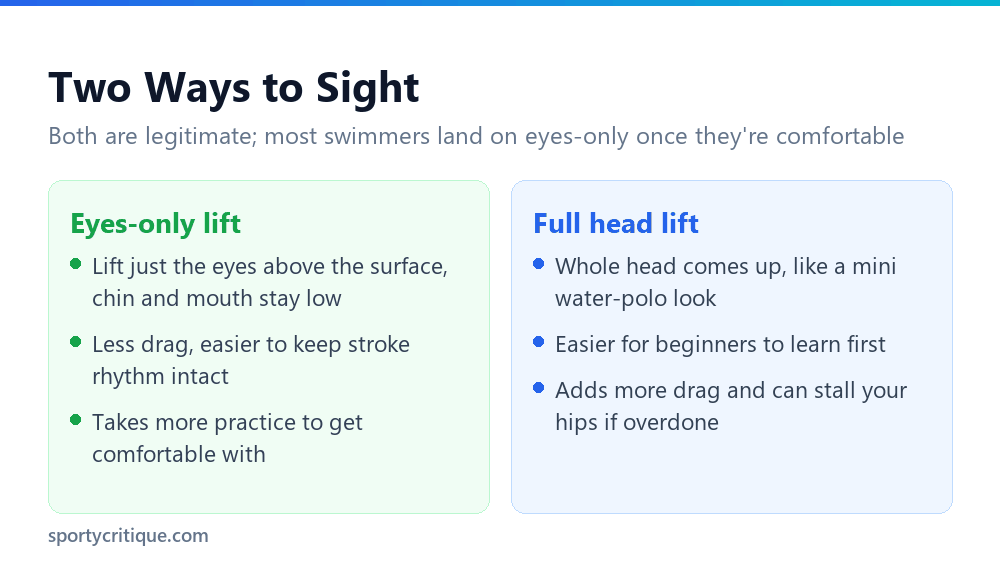
There are two accepted approaches. The eyes-only lift, sometimes called “crocodile eyes,” keeps your mouth and chin low in the water and only your eyes break the surface. It’s the more efficient option once you’ve got it down, since it adds the least drag. The full head lift, where your whole head comes up like a brief water-polo look, is easier for beginners to learn first because it’s a bigger, more obvious motion, but it costs more in drag and rhythm if you rely on it long-term.
Most swimmers start with the full head lift because it’s simpler to feel and see results with, then transition to eyes-only as their comfort and body awareness improve. There’s no rule that says you have to pick one forever; plenty of experienced open water swimmers use a fuller lift in rough conditions and drop to eyes-only in calm water where a smaller glance is enough.
Timing: separate sighting from breathing
The biggest technique mistake is trying to sight and breathe in the same motion. Turning your head forward and up to look, then immediately trying to also get air, asks your neck to do two different jobs at once and usually does both badly: a shallow, panicked breath and a sighting glance that’s too brief to actually see anything useful. Separate the two. Sight forward on one stroke, keeping the bottom half of your face in the water, then roll to the side and breathe normally on the next stroke.
⚠️ Watch out: Don’t hold your sighting breath. Some swimmers unconsciously pause their exhale while sighting, which throws off breathing rhythm on the very next breath and can trigger a mild panic response in choppy water. Keep exhaling normally through the sighting stroke, the same as any other stroke.
How often should you sight
In rough water, time your sighting lift to the top of a swell rather than the trough between waves. Sighting in a trough often means you can’t see past the next wave at all, which wastes the effort and forces you to sight again almost immediately. Feeling your body rise on a swell and sighting right at that peak gives you a real look at the course instead of a wall of water.
Picking a target worth sighting on
Buoys move, sway, and disappear behind swimmers and waves, which makes them a frustrating primary target in a crowded race. A tall, fixed shoreline landmark, a building, a tree line, a flagpole, gives you a more stable reference that doesn’t bob out of view every few seconds. Use the buoy to confirm you’re generally on the right line, but lean on a fixed landmark behind or beyond it for your main sighting target whenever the course allows it.
💡 Pro tip: Before you start, pick and memorize your sighting target from the beach or dock, not just from the water. It’s much harder to identify a distant landmark for the first time while you’re already swimming than to spot it once beforehand and simply confirm it during the swim.
Training gear that helps
Most sighting problems get fixed with practice, not gear, but a New Wave Swim Buoy Safety Float and Drybag (15L) at around $34.95 is worth having for open water training sessions regardless of your sighting level. It doubles as a visibility aid for boats and other water traffic and as a rest float if you misjudge a swim’s distance, and using one regularly gets you comfortable with the choppier conditions where sighting actually gets hard, rather than only practicing in a calm pool.
Pool drills that build the sighting habit
You don’t need open water to build this skill; a pool works fine for the raw motion even without real navigation to practice. Swim a length while sighting every 4 strokes on a fixed object at the far end, like a clock or a specific tile pattern, and pay attention to whether your hips drop or your stroke rate changes when you sight. If either happens, you’re lifting too high or holding the look too long.
The mirror check
If your pool has an underwater viewing window or a coach who can film you from the side, compare your body position during a normal stroke to your body position during a sighting stroke. A well-executed sight barely changes your silhouette in the water. A poorly executed one shows an obvious head-up, hips-down break in the line, which is exactly the drag-adding pattern you’re trying to train out.
Goggles and glare: the sighting problem nobody warns you about
Tinted or mirrored goggles help with glare off the water’s surface, which matters more for sighting than most swimmers expect until they’ve tried to sight directly into a low morning sun and seen nothing but white glare. Clear or lightly tinted lenses work fine on an overcast day or in a shaded course, but a bright, low-angle sun washes out detail fast, and that’s exactly when a swimmer without the right lenses starts drifting off course simply because they can’t see where they’re going.
Check the sun’s position relative to your swim direction before the start if you can. A course that has you swimming straight into a rising or setting sun for part of the route is worth extra sighting practice with your actual race goggles beforehand, since that’s a very different visual problem than sighting in a pool under even indoor lighting.
Troubleshooting a sighting habit that isn’t working
If you keep drifting off course despite sighting regularly, the problem is usually timing, not frequency. A sighting glance that happens at the wrong point in your stroke, for instance right as your face turns to breathe instead of on a separate stroke, tends to produce a rushed, low-quality look that doesn’t actually register useful information, even though you technically “sighted.” Slow the whole motion down in a pool until you can clearly tell yourself what you saw.
If sighting consistently makes you feel dizzy or disoriented, you’re likely lifting too high or turning your head too far, which pulls your inner ear out of its normal horizontal plane. Dropping to a smaller eyes-only lift usually resolves this faster than trying to push through it, since the disorientation is a mechanical side effect of the motion, not something you need to tough out.
Common mistakes
Bottom line
Sighting is a small, specific skill layered onto a stroke you already know, not a separate task that has to disrupt your swimming. Keep the lift brief, keep it separate from your breath, and match how often you do it to how rough the water actually is. Practiced in a pool first, it becomes close to automatic by the time you need it in open water, which is really the only test that matters: can you still hold your normal stroke rate and body position while checking your line, without thinking about it as a separate task bolted onto your swimming.
How often should I sight in open water?
Roughly every 6-10 strokes in calm water, and every 3-5 strokes in choppy conditions or crowded starts. Adjust based on how well you’re actually staying on your line rather than sticking to a fixed count.
Should I sight and breathe at the same time?
No. Combining them usually produces a shallow, rushed breath and a sighting glance too brief to be useful. Sight on one stroke with your mouth still in the water, then roll to the side and breathe on the next stroke.
Why does my sighting throw off my stroke rhythm?
Most often because you’re lifting your head too high or holding it up too long, which drops your hips and legs and adds drag. Practice the eyes-only lift in a pool until the motion is quick enough that it barely changes your body position.
What should I sight on if the buoys are hard to see?
A tall, fixed landmark on shore, a building, tree line, or flagpole, tends to be more reliable than a buoy, since buoys sway and disappear behind waves and other swimmers. Pick your landmark from the beach before you start.
As an Amazon Associate, we earn from qualifying purchases through links on this page.