Best Paddock Boots for Everyday Riding

Ask ten riders what the best paddock boots for riding actually are and you will get ten different brand names, but the ones worth buying share the same three traits: a defined heel, a slim profile that fits under half chaps, and leather or synthetic that can actually take barn conditions. Here are four real, currently listed options across the price range and what separates them.
The best paddock boots for everyday riding balance ankle support, a slim profile that fits under half chaps, and a sole with real grip in the stirrup. For daily barn use on a budget, the TuffRider Starter Front Zip (about $45) covers the basics reliably. For a step up in leather quality and long-term durability, Ariat’s Heritage line, including the Heritage IV and Heritage Breeze, is the most consistently recommended option among instructors, and the premium Heritage Zip runs around $170 with a stabilizing footbed built specifically for stirrup work.
A paddock boot has one job that a sneaker or a hiking boot cannot do safely: it needs a slim enough profile to sit correctly in a stirrup, a heel that actually stops your foot from sliding through, and a low-cut design that layers under half chaps or tall boots without bunching. Everyday riding boots also take a beating that show boots do not, mud, manure, repeated wetting and drying, so durability matters more here than polish.
This guide covers four real, currently listed paddock boots spanning entry level to premium, plus the sizing and material details that actually separate a boot that lasts one season from one that lasts five.
- →A proper paddock boot has a defined heel and a slim, low-cut shaft that fits under half chaps; sneakers and hiking boots do not do this safely
- →Full-grain leather costs more but outlasts synthetic uppers by years under regular barn conditions
- →Size true to your street shoe size in most brands, but expect a break-in period of a few rides regardless of brand
- →A stabilizing footbed (branded as ATS on Ariat) reduces fatigue on long days but is not essential for occasional riders
- →Budget boots ($40-60) are fine for lesson programs and casual riding; step up once you are riding several times a week
Table of Contents
What actually makes a boot a paddock boot
Three things define the category regardless of price: a low-cut shaft that stops around or just above the ankle, a defined heel of roughly half an inch to an inch that keeps your foot from sliding forward through the stirrup, and a slim enough overall profile to tuck under half chaps or tall boots without bulging. A hiking boot or sneaker fails on the heel specifically, and that is not a minor gap. Without a defined heel, your foot can slide too far into the stirrup, which is a genuine safety issue if you come off and a foot gets caught.
Leather versus synthetic: what the price difference buys
Full-grain leather costs more upfront and takes longer to break in, but it holds its shape, resists cracking, and can be conditioned back to life for years under regular barn conditions, mud, manure, repeated wet-dry cycles included. Synthetic uppers are lighter on the wallet and need zero break-in time, which is a real advantage for a growing kid or a rider who is not sure riding will stick. The tradeoff is that synthetic materials tend to crack or delaminate at the flex points within a season or two of regular use, especially around the ankle where the boot bends constantly.
The budget pick: TuffRider Starter Front Zip
The TuffRider Starter Front Zip is the boot most lesson barns end up recommending to beginners, and it has a confirmed price around $45 with a current in-stock listing. It uses a water-resistant synthetic upper rather than leather, which means no break-in period and easy cleanup after a muddy lesson, at the cost of shorter overall lifespan than a leather boot under daily use. Spur rests and elastic gussets are included, which is more than some budget boots bother with. For a lesson program, a first pair for a kid, or anyone testing whether riding is going to be a regular thing, this is a sensible starting point.
The mid tier: Ariat Heritage IV and Heritage Breeze
The Ariat Heritage IV Zip is the boot most instructors mention by name when a student asks what to buy next. It uses full-grain leather over Ariat’s ATS stabilizing footbed, a cushioned insole system built specifically for standing and riding for hours at a time, which is a genuine comfort upgrade over a flat, unsupported insole on cheaper boots. It has a confirmed current in-stock listing, though live pricing was not available through our data feed at the time of writing, so check the current listing price directly.
The Ariat Heritage Breeze Zip uses the same general construction with perforated leather in the upper for airflow, which matters more than it sounds like once you are wearing full-grain leather boots through a hot, humid summer of daily barn chores. It is also currently listed and in stock, with the same note on checking live pricing directly on the listing.
The premium pick: Ariat Heritage Zip
The Ariat Heritage Zip has a confirmed price around $170 and a current in-stock listing, though availability was limited at the time of writing, so buy sooner rather than later if this is the one you want. It uses full-grain leather, a Duratread traction sole built with rider-tested grip zones, and a shock-absorbing heel cushion engineered around how a rider’s foot actually lands in the stirrup rather than a generic shoe heel. For someone riding several times a week or working a barn job on their feet all day, that difference in heel and sole construction is where the extra money genuinely goes, not just into branding.
Sizing and break-in
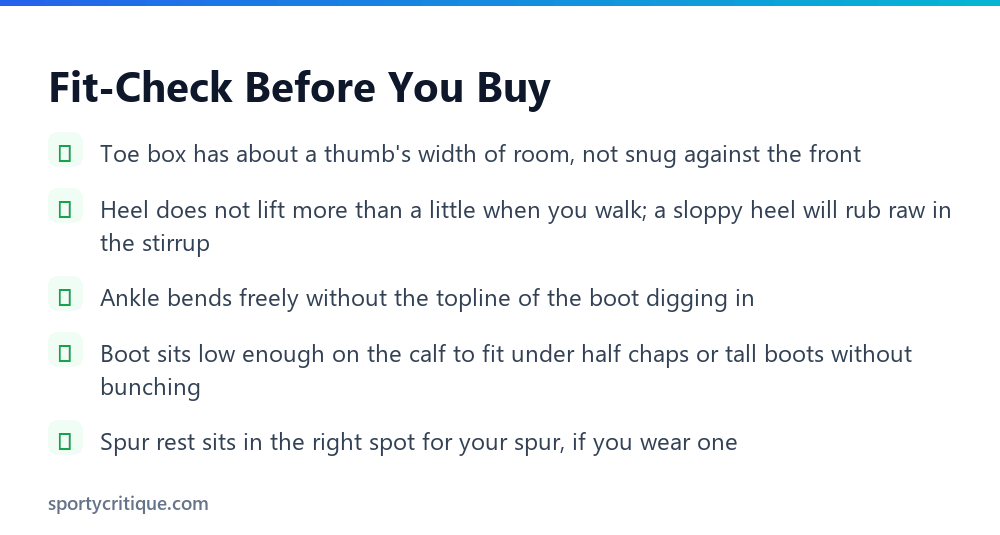
Most paddock boot brands, Ariat included, size true to your regular street shoe size, though riders with a wider foot often go up half a size or look for a wide-width option where the brand offers one. Expect a break-in period even on a correctly sized leather boot: full-grain leather needs several rides to soften around the ankle and stop feeling stiff through the flex point. Wearing new leather paddock boots around the house or barn for short stretches before a full ride speeds that process up without forcing a blister-inducing all-day break-in on horseback.
⚠️ Watch out: Do not buy a size up expecting to “break it in looser.” An oversized paddock boot lets your heel lift inside the boot with every step, which causes blistering fast and, more importantly, means the boot is not gripping your foot the way it needs to for the heel to do its actual job of stopping your foot from sliding through the stirrup.
Zip versus lace-up
Zip paddock boots go on and off faster, which matters most for kids, lesson programs, or anyone changing in and out of boots multiple times a day for barn chores between rides. Lace-up boots let you fine-tune tightness across the instep more precisely, which some riders with a narrower or higher-arched foot prefer, and laces are generally simpler and cheaper to replace than a broken zipper years down the line. Neither is objectively better; it comes down to how often you are getting in and out of them and whether a broken zipper mid-season would actually bother you.
💡 Pro tip: Condition leather paddock boots every few weeks with a basic leather conditioner, not just when they start looking dry. Barn conditions, ammonia from manure and repeated wetting, break down leather faster than normal daily wear does, and regular conditioning is the single biggest thing that separates a leather boot that lasts five years from one that cracks after one.
Resoling versus replacing
A full-grain leather paddock boot with a worn-out sole is usually worth resoling rather than replacing, since the leather upper is the expensive part and it typically outlasts two or three soles with proper care. Most local cobblers can resole a paddock boot for a fraction of the cost of a new premium pair, and doing it before the sole wears through completely protects the stitching and the leather upper from water damage that comes with a compromised sole. Synthetic budget boots are usually not worth resoling; by the time the sole wears out, the upper has typically started cracking too, and replacement is the more practical option.
Common myths about paddock boots
Who should buy which tier
- ✓Choose the budget synthetic option for lesson programs, kids, or anyone still deciding if riding will stick
- ✓Move to a mid-tier leather boot once you are riding multiple times a week
- ✓Choose the premium tier if you are on your feet in the barn all day, not just riding
- ✓Buy true to your street shoe size and expect a short break-in period on leather
- ✕Buying a size up expecting the boot to break in looser over time
- ✕Skipping leather conditioning because the boots still look fine on the surface
- ✕Wearing a sneaker or hiking boot in the stirrup because it feels more comfortable
- ✕Assuming the priciest boot on the wall is automatically the most durable without care
Bottom line
For everyday riding, a defined heel and a slim, low-cut profile matter more than brand name. The TuffRider Starter Front Zip covers casual and lesson-program riding for around $45. Ariat’s Heritage line is the consistent mid-to-premium recommendation once you are riding regularly, with the Heritage Breeze adding airflow for hot climates and the full Heritage Zip adding the most refined sole and heel construction in this list. Get the fit right first; a boot that lets your heel lift inside it will not serve you well regardless of price.
Do paddock boots need to be a specific size, or do they run true to size?
Most brands, including Ariat and TuffRider, size close to your regular street shoe size. Riders with wider feet sometimes go up half a size or look for a wide-width option. Try the boot on with the socks you actually ride in, since sock thickness changes fit more than people expect.
What is the difference between paddock boots and tall riding boots?
Paddock boots are low-cut, ankle-height boots typically worn with half chaps for schooling and everyday riding. Tall boots cover the full lower leg and are usually reserved for showing or riders who prefer not to wear half chaps. Paddock boots are generally more affordable and easier to size correctly.
Are synthetic paddock boots good enough for regular riding?
Yes, for casual or lesson-level riding. Synthetic uppers resist water well and need no break-in time, but they typically crack or delaminate at flex points sooner than full-grain leather under daily use. For riding several times a week over multiple years, leather is the more durable long-term investment.
How long should a good pair of paddock boots last?
A well-cared-for full-grain leather pair can last several years of regular riding with periodic conditioning and resoling as needed. Synthetic boots typically last one to two seasons of regular use before the upper starts cracking at the ankle flex point.
As an Amazon Associate, we earn from qualifying purchases through links on this page.