How to Win Equestrian Competitions: The Scoring Reality


How to win equestrian competitions depends entirely on which discipline you’re asking about, since dressage, show jumping, and eventing are judged in distinctly different ways with different things that actually cost you points. There’s no single trick that applies across all three. What does carry across them is this: judges and scoring systems reward clean, accurate, controlled performances far more consistently than they reward ambition or difficulty for its own sake. This page breaks down what each discipline’s scoring actually measures and where training time is best spent to move the score, not just the horse’s ability.
🐎 Equestrian Hub: Explore all 32 riding tutorials, gear reviews, and horsemanship guides in our Complete Equestrian Resource Hub.
- →Dressage awards points per movement, then adds collective marks for the whole test
- →Show jumping and eventing start at zero and add faults for mistakes and time
- →Accuracy and consistency beat difficulty and flash in every discipline covered here
- →Cross-country faults carry more weight in eventing than an equivalent dressage mistake
- →Course walking and test-accuracy practice are consistently high-value training habits
Table of Contents
Dressage: scored on what you do right, movement by movement
Dressage is scored positively, meaning judges award points for what you do well rather than starting at a perfect score and subtracting. Each movement in a test, a specific transition, a circle, a lateral movement, gets scored on a 0 to 10 scale, with half points allowed, and those scores get averaged into a final percentage. On top of the individual movements, judges also award collective marks covering the horse’s paces, its impulsion, its submission to the rider’s aids, and the rider’s own position and effectiveness.
The collective marks matter more than new competitors usually realize. A test full of technically correct individual movements can still score modestly if the horse looks tense or resistant throughout, since submission and the quality of the paces are judged across the whole test, not just within individual movements. Riders chasing a higher percentage often get more out of fixing a horse’s overall relaxation and throughness than perfecting one specific movement in isolation.
Accuracy costs points constantly and quietly. Riding a circle that’s slightly the wrong size, missing a transition marker by a stride or two, or letting the horse drift off a straight line during a movement all chip away at scores even when nothing looks dramatically wrong to a casual spectator. An error of course, going off the prescribed test pattern entirely, carries a specific point penalty and gets worse with repeated errors, which is why riders who compete regularly tend to know their test cold rather than relying on a reader calling directions.

Show jumping: everyone starts clean, mistakes add up
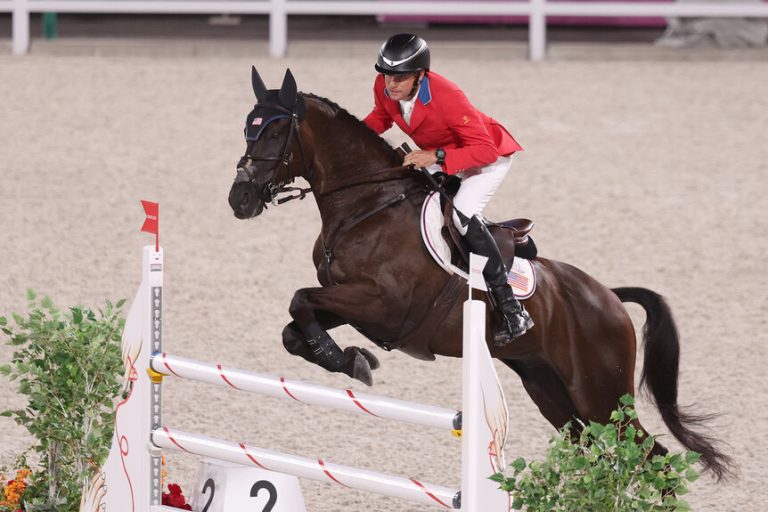
Show jumping runs on the opposite logic: everyone starts at zero, and faults get added. A knocked-down rail typically costs four faults, and a stop or refusal at a fence usually costs four as well, with a second refusal at the same fence often ending the round entirely under most rule sets, though exact refusal limits vary by level and governing body. Riders who finish outside the time allowed pick up additional time faults, and when riders are tied on faults, the tiebreaker in most formats comes down to time, not a subjective judgment call.
That time element pushes competitive riders toward calculated efficiency rather than raw speed. A rider who takes tight, accurate turns and holds a consistent, controlled canter rhythm between fences usually beats one who gallops recklessly between jumps and pays for it with a rail down from poor positioning. Knowing a course’s related distances, the specific number of strides between certain fences, in advance matters more to the final score than raw jumping ability alone.
Eventing: why consistency beats brilliance in one phase
Eventing combines dressage, cross-country, and show jumping into one running total, and it uses penalty points throughout, with the lowest total winning rather than the highest. The dressage phase gets converted from its usual percentage into penalty points, cross-country and show jumping add faults for knockdowns, refusals, and time, and everything accumulates across all three phases into a single final score.
This structure rewards consistency over brilliance in any one phase. A rider who posts a solid, unspectacular dressage score and then jumps two clean, careful rounds typically beats a rider who scores brilliantly in dressage but takes a costly fall or knockdown on cross-country. Cross-country specifically carries the highest stakes, since faults there tend to be steeper than an equivalent mistake in the show jumping phase, and a fall usually means elimination outright rather than a fault added to the total.
Cross-country also has its own time pressure separate from jumping faults: riders are set an optimum time to complete the course, and finishing either too slow or, at some levels, unnecessarily far under that time can add penalties of its own. Pacing a cross-country round correctly, neither rushing fences nor dawdling between them, is a specific skill riders train deliberately, often by walking the course multiple times and rehearsing the planned pace section by section before ever riding it at speed.
Where training time actually moves the score
Training time spent on accuracy tends to move a dressage score faster than training time spent trying to make individual movements flashier. Riding your actual test pattern repeatedly, with correct geometry rather than approximate circles and transitions, closes more of the gap to a higher percentage than adding difficulty the judge never specifically asked for. Filming test run-throughs and comparing the horse’s actual line to the diagram is a concrete way to catch geometry errors that feel fine from the saddle but read as sloppy from a judge’s booth.
For show jumping, walking the course carefully before you ride it, counting strides between related fences rather than guessing in the moment, is one of the highest-value habits a competitive rider can build. Riders who walk a course methodically and commit to a specific striding plan for each combination tend to have fewer rails down than riders relying on feel alone, since a horse arriving at the wrong distance to a fence is one of the more common reasons for a knockdown.
For eventing, cross-country fitness training, building a horse’s stamina and a rider’s own pace judgment at speed, pays off more than polishing any single phase in isolation, since a horse that’s undertrained for cross-country’s physical demands is a much bigger risk factor for faults or a dangerous fall than a slightly imperfect dressage test.
- ✓Know your dressage test well enough to ride it without a reader
- ✓Walk every jumping course and commit to a striding plan
- ✓Train cross-country fitness specifically, not just arena fitness
- ✓Watch video of your own rounds against the judged standard
- ✕Add difficulty to a test or course you haven’t mastered at a lower level
- ✕Guess at striding between related fences instead of counting it
- ✕Treat a solid dressage score as wasted effort if cross-country goes well
- ✕Assume a talented horse makes up for inconsistent riding on the day
Reading your results instead of just your placing
A dressage scoresheet is one of the more underused tools competitive riders have. It lists the score for every individual movement alongside the judge’s written comment, plus the separate collective marks, which means it tells you specifically where points were lost rather than just the final percentage. Riders who request and actually review scoresheets after every test, instead of just checking the placing, tend to fix real problems faster than riders training based on how a ride felt from the saddle.
Jumping and eventing results are less detailed by comparison, typically just the fault total and time, but the pattern still matters. A rider who keeps losing the same combination or the same type of distance across multiple shows has a specific, fixable problem, not bad luck, and results reviewed over several competitions in a row tend to reveal that pattern more clearly than any single round does on its own.
⚠️ Watch out: Nerves cost real points, and not just through obvious mistakes. Riders under pressure tend to rush transitions, over-ride lines they’d normally give the horse more room to handle, and grip up in ways that make the horse tense in exactly the collective marks judges are watching. Practicing your actual test or course in front of even a small audience before a real competition is a legitimate way to train for that pressure specifically, not just the technical skill.
Scoring at a glance
💡 Pro tip: Still building the fundamentals before competing seriously? Our guide to progressing as a rider covers lesson frequency and moving up competition levels.
Frequently asked questions
Which equestrian discipline is easiest to win in as a beginner?
None of them are truly easy to win at competitively, but dressage and show jumping both have lower-level classes designed specifically for newer combinations, with simpler tests or smaller fences, where consistency and accuracy matter more than raw talent. That makes them more approachable starting points than eventing, which asks a horse and rider to be competent across three different skill sets at once.
Does a more expensive or talented horse guarantee better scores?
No. A talented horse raises the ceiling of what’s possible, but riding accuracy, training consistency, and course or test preparation determine whether that ceiling actually gets reached on a given day. Plenty of modestly bred horses with well-prepared riders consistently beat more expensive horses ridden inconsistently.
How much does the judge’s personal taste affect dressage scores?
Some subjectivity exists in how a judge weighs qualities like harmony or expression, which is part of why riders sometimes get noticeably different scores from different judges at the same show. But the core framework, the 0 to 10 scale per movement and the specific collective marks, keeps that subjectivity within a fairly narrow band rather than making scores arbitrary.
Is it better to ride cautiously or aggressively in show jumping?
Controlled and accurate beats both extremes. Overly cautious riding tends to produce awkward distances to fences, which causes rails, while overly aggressive riding causes the same problem from the other direction. The riders who score best are typically the ones riding a consistent, rhythmic pace they can adjust in small ways, not the fastest or the most conservative ones in the ring.
What single change helps a competitive score the most?
There’s no universal answer, since it depends on where your specific weak points are, but course walking and striding preparation for jumping riders, and test accuracy work for dressage riders, are consistently among the highest-value, lowest-cost changes competitive riders at any level can make.
Should I review my scoresheet even after a good result?
Yes, and it’s often more useful than reviewing a bad one. A good result with a low mark buried in one specific movement or a fault on an otherwise clean course still points to something worth fixing before it costs you a placing at a tougher level. Riders who only dig into scoresheets after a disappointing round miss half the useful information available to them over a season.