How to Improve Body Rotation in Freestyle Swimming

Body rotation freestyle swimming drills exist for a reason: a stroke powered by your whole torso beats one powered by an overworked shoulder every time. Here is why rotation matters mechanically, how much is actually enough, and the drills that build it into muscle memory rather than something you have to think about mid-lap.
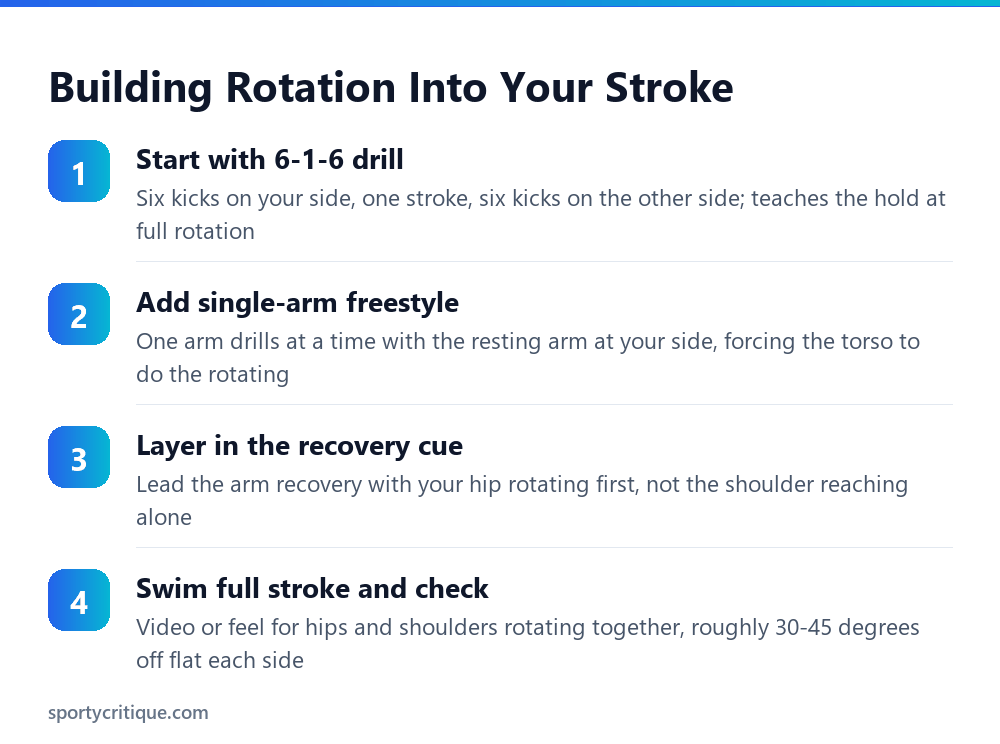
Body rotation in freestyle swimming means rotating your hips, torso, and shoulders together around your body’s long axis as you stroke, roughly 30 to 45 degrees off flat to each side. Without it, your shoulder has to reach for the recovery on its own, which is a smaller range of motion and a common source of shoulder strain. Drills like 6-1-6 and single-arm freestyle isolate the rotation so you can feel it happening before you try to hold it through a full stroke.
If you searched body rotation freestyle swimming because your shoulder aches after every practice or your stroke just feels stuck, flat swimming is the usual culprit. Flat freestyle, swimming with your hips and shoulders staying mostly square to the bottom of the pool, is one of the most common technique flaws at every level below competitive. It looks fine from the pool deck and it still gets you down the lane, which is exactly why so many swimmers never fix it. The cost shows up as wasted energy per stroke and, over enough yardage, shoulder strain from asking a joint with limited range of motion to do work that the torso should be sharing.
This guide covers why rotation actually matters mechanically, how much is enough, and the specific drills that build the feeling into muscle memory rather than something you have to consciously think about mid-stroke.
- →Rotate hips, torso, and shoulders together, roughly 30-45 degrees off flat to each side, not the shoulders alone
- →Rotation gives your arm recovery room to work with a bent elbow instead of forcing an awkward straight-arm reach
- →A flat body position asks the shoulder to do work the torso should share, which is a common source of swimmer’s shoulder
- →6-1-6 and single-arm freestyle are the two drills that isolate rotation most directly
- →Over-rotating past about 45 degrees wastes as much energy as staying flat; more is not automatically better
Table of Contents
Why rotation matters mechanically
Your shoulder joint has a limited range of motion when your torso stays square to the pool bottom. Try lifting your arm straight up and back without rotating your torso at all, it stops well short of a full, relaxed recovery. Rotating your body toward the recovering arm opens up that range dramatically, which lets the elbow lead the recovery in a relaxed bent-arm position instead of forcing a straight-arm reach that puts unnecessary strain on the front of the shoulder.
Rotation also connects your pull to your core rather than isolating it to your arm. As you rotate toward your pulling arm during the catch and pull phase, your back, chest, and core muscles, which are considerably stronger than the shoulder alone, contribute to the power of that pull. Swimmers who stay flat are pulling almost entirely with the arm and shoulder, which is both less powerful per stroke and more fatiguing over a long set.
How much rotation is actually enough
Somewhere around 30 to 45 degrees off flat to each side is the practical target for most swimmers, measured as how far your shoulders and hips tilt away from square to the pool bottom. Elite distance freestylers often sit toward the lower end of that range with a quicker stroke tempo, while sprinters and swimmers with a more gliding style tend toward the higher end. Neither extreme, staying flat or rotating past 45 degrees onto nearly your side, is efficient. Over-rotating wastes energy fighting to rotate back for the next stroke and can throw off a straight kick line, which adds drag instead of removing it.
Drill 1: 6-1-6
Kick six times on your side with one arm extended forward and the other at your side, take one stroke to switch sides, then kick six more times on the new side. The six kicks on each side are the point of the drill: they force you to actually hold a rotated position instead of rolling through it in a fraction of a second the way a full stroke does. Most swimmers discover during this drill that their “rotation” during normal swimming is really just a quick wobble rather than a held position, which is exactly the gap this drill closes.
Drill 2: single-arm freestyle
Swim freestyle using only one arm at a time, with the resting arm extended forward along the surface or held at your side depending on which variation your coach prefers. With only one arm doing the pulling and recovering, your torso has to supply the rotation on its own if the stroke is going to feel balanced at all, which makes this drill excellent for isolating the exact muscles and timing that full-stroke rotation depends on. Alternate arms every 25 yards or so and pay attention to which side rotates more naturally; most swimmers have a noticeably weaker rotation side that this drill exposes quickly.
Removing the breathing variable to isolate rotation
Breathing technique and rotation technique tangle together for a lot of swimmers, since a head turn to breathe often gets confused with, or substituted for, actual torso rotation. A front-mounted swim training snorkel removes that variable entirely by letting you breathe without turning your head at all, which makes it much easier to feel whether your hips and shoulders are genuinely rotating or whether you have been relying on the breathing turn to fake the sensation of rotation. Swimming drill sets with a snorkel on is a common technique-isolation tool at the club and college level for exactly this reason.
⚠️ Watch out: Do not lead a stroke’s recovery with your head. Turning your head to initiate rotation throws off your body’s alignment and usually causes the hips to lag behind or barely rotate at all. Rotation should start from the hips and core, with the head staying relatively still and in line with the spine except during the breath itself.
💡 Pro tip: Film yourself from directly above or from the side of the pool, even on a phone propped on the pool deck. Rotation almost always feels bigger to the swimmer than it looks on video, and a quick clip will tell you faster than any drill whether you are actually hitting 30 to 45 degrees or just believe you are.
What actually causes flat swimming
A weak or disengaged core is the most common root cause. Rotation is generated through the core and hips, and a swimmer who has not built that connection tends to compensate by reaching harder with the shoulder instead, which looks like effort but produces very little actual rotation. Breathing habits are the second common cause: swimmers who breathe by lifting the head straight up rather than rotating the whole body to the side often flatten their entire stroke around that breath, not just the breathing side.
Kick timing plays a role too, though it gets less attention than it deserves. A two-beat kick, where one kick corresponds to each arm stroke, naturally supports rotation because the kick and the rotation happen on the same rhythm. A kick that is out of sync with the stroke, too fast or disconnected from the arms, can actually work against rotation by pulling the hips back toward flat before the torso finishes rolling. If drills are not fixing a stubborn flat stroke on their own, checking kick timing against stroke rhythm is worth a look before assuming the problem is purely in the upper body.
Common myths about rotation
Putting it into a full stroke
- ✓Practice 6-1-6 and single-arm freestyle as a regular part of warm-up, not a one-time fix
- ✓Let rotation start from the hips and core, with the shoulders following
- ✓Check your rotation with video every few weeks to catch drift back toward flat swimming
- ✓Match rotation amount to your stroke tempo rather than chasing a fixed number
- ✕Turning your head to initiate rotation instead of using your hips and core
- ✕Over-rotating past about 45 degrees in an attempt to generate more power
- ✕Doing rotation drills once and expecting the change to stick in full-stroke swimming without repetition
- ✕Ignoring a weaker rotation side that shows up clearly during single-arm drills
How long it takes to feel automatic
Most swimmers feel the mechanics of proper rotation within a session or two of focused drill work, but it takes weeks of repetition before it holds up without conscious effort during a hard set or a race. That gap between understanding a drill and owning it under fatigue is normal, not a sign the drill is not working. Keep the drills in your regular warm-up rotation for at least a month rather than dropping them once the feeling clicks once.
Bottom line
Body rotation in freestyle swimming is not a cosmetic detail, it changes how much of your body is actually doing the work of pulling and recovering. A flat stroke leans entirely on the shoulder, which is both weaker and more injury-prone than a stroke that shares the load through a rotated torso and core. Drills like 6-1-6 and single-arm freestyle build the feeling deliberately rather than leaving it to chance, and checking yourself on video is the fastest way to know whether the change has actually carried over into your full stroke.
How many degrees should my body rotate in freestyle?
Roughly 30 to 45 degrees off flat to each side is the practical target for most swimmers. Sprinters and swimmers with a longer glide often sit toward the higher end of that range, while high-tempo distance swimmers often rotate slightly less per stroke.
What is the fastest way to fix flat freestyle?
The 6-1-6 drill, six kicks on your side, one stroke, six kicks on the other side, is usually the quickest way to feel what a held rotated position actually feels like, since normal swimming rotates and recovers too quickly to notice a flat stroke in the moment.
Can too much body rotation slow you down?
Yes. Rotating past roughly 45 to 60 degrees, close to rolling onto your side, wastes energy fighting to rotate back for the next stroke and can disrupt a straight kick line, which adds drag instead of reducing it.
Does body rotation help prevent shoulder injuries?
Yes. A flat body position forces the shoulder to reach through recovery on its own, which is a smaller, more strained range of motion. Rotating the torso opens up that range and lets the elbow lead a relaxed bent-arm recovery instead, which is one of the more common fixes coaches recommend for recurring swimmer’s shoulder.
As an Amazon Associate, we earn from qualifying purchases through links on this page.