Best Lacrosse Arm Pads and Guards

Best lacrosse arm pads and guards are not a single category, coverage and mobility trade off directly against each other, and the right balance depends on your position more than your budget. Here are five real, currently listed options across the price range and how to match them to how you actually play.
The best lacrosse arm pads and guards depend heavily on position. Attackmen and box players who take constant checks want closer to a full arm guard, like the Maverik Max ($75), for bicep-to-wrist coverage. Midfielders generally land in the arm pad middle ground, where the Maverik MX 2025 ($59.99) balances protection with mobility. Defensemen prioritizing range of motion over coverage often prefer a low-profile option like G-Form’s Unhinged pads ($79.99), which trade some coverage for a noticeably lighter, more flexible feel.
Arm protection in lacrosse is not one product category, it is three: full arm guards, arm pads, and low-profile elbow pads, and picking the wrong one for your position wastes money on protection you do not need or leaves you undersized for the checks you actually take. Attack and box players eat constant slashes and should size up toward full coverage. Defensemen who need to move freely and rarely take direct arm shots can go lighter without meaningfully increasing injury risk.
This guide covers five real, currently listed options spanning entry-level to premium, sorted by where they land on the coverage-versus-mobility spectrum, plus what actually changes as the price goes up.
- →Match protection level to position: attack/box players want more coverage, defensemen usually want more mobility
- →Full arm guards run bicep to wrist; arm pads cover less; low-profile elbow pads cover the least but move the most
- →Foam technology (dual-density, targeted zones) matters more than raw foam thickness for actual protection
- →Budget options ($40-60) are fine for youth and rec league; step up once checks get harder and more frequent
- →A pad that slides out of place during play protects worse than a cheaper one that stays put; fit beats spec sheet
Table of Contents
Arm guards, arm pads, and elbow pads are not the same thing
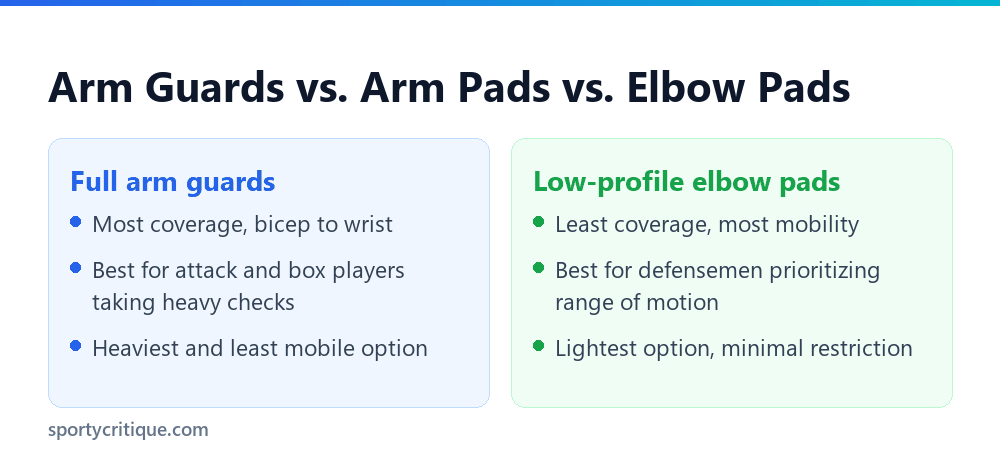
Full arm guards cover from the bicep down to the wrist and offer the most protection, which is why attack and box lacrosse players, who take the heaviest and most frequent slashes, generally wear them. Arm pads cover a middle ground, usually the forearm and elbow with partial bicep coverage, and are the most common choice for midfielders who need a blend of protection and mobility across a full game of transition play. Low-profile elbow pads cover the least, focusing mainly on the elbow joint itself, and are the standard choice for defensemen who prioritize stick speed and range of motion over maximum coverage.
The budget pick: Maverik Charger
The Maverik Charger Arm Pad is built with younger and newer players in mind, which shows up in a simpler foam construction and an easier break-in period than the stiffer foams used in premium pads. It is a real, currently listed product, though live pricing was not available through our data feed at the time of writing, so confirm the current price on the listing. For rec league, youth programs, or a first pair of arm pads before you know what position or level you will settle into, this is a sensible low-risk starting point.
The mid tier: Maverik MX 2025 and Warrior Evo
The Maverik MX 2025 has a confirmed price around $60 and a current in-stock listing. It uses a Durastretch sleeve with an anatomical fit and 360-degree straps, aimed specifically at youth and intermediate players who need the pad to move naturally with the arm rather than restrict it. For a midfielder who needs a genuine blend of coverage and mobility rather than maximum protection at either extreme, this is the most balanced option on this list.
The Warrior Evo Arm Guard is built at an attack-sized length with Warrior’s Wartech FLX sleeve underneath the pad itself, aimed at players who want closer to full-guard coverage without the weight of a top-tier armored option. It is a real, currently listed product without live pricing available through our feed, so check the listing directly for current cost.
The premium tier: Maverik Max and G-Form Unhinged
The Maverik Max has a confirmed price around $75 and a current in-stock listing. It uses Maverik’s Air Core Foam for impact absorption alongside an Aerate Venting System built to keep the pad from turning into a sweat trap during a long game. This is the pad built specifically for experienced attackmen taking constant, heavy checks, and the foam and venting technology is where the extra cost over the mid tier actually goes.
The G-Form Unhinged has a confirmed price around $80, though stock was limited at the time of writing. It takes a different approach than the other premium option here, trading some raw coverage for a genuinely flexible, breathable, machine-washable design. For a player who wants premium comfort and mobility over maximum bulk coverage, particularly a defenseman or midfielder who values range of motion, this is the pick over the Maverik Max.
Picking by position
- ✓Choose closer to full arm guards if you play attack or box lacrosse and take frequent slashes
- ✓Choose arm pads (the middle ground) if you play midfield and need a mobility-protection balance
- ✓Choose low-profile elbow pads if you play defense and prioritize stick speed and range of motion
- ✓Buy budget for youth or rec league; step up once checks get harder and more frequent
- ✕Wearing full arm guards as a defenseman and sacrificing mobility you do not need to give up
- ✕Wearing low-profile elbow pads as an attackman taking constant slashes, which under-protects for the position
- ✕Assuming the priciest pad on the list is automatically right for your position
- ✕Ignoring fit in favor of foam specs; a pad that slides during play protects worse regardless of foam quality
⚠️ Watch out: A pad that shifts or slides during play is a real protection gap, not a minor annoyance. Straps and sleeve grip matter as much as foam density, since a pad that has migrated off the actual impact zone by the time a check lands is not protecting anything.
Foam technology, briefly
Dual-density foam, layering a softer foam against the skin with a firmer foam on the outer impact surface, spreads and absorbs impact more effectively than a single uniform foam block of the same thickness. Targeted zone construction, adding extra material specifically over the bicep and forearm bones rather than uniformly across the whole pad, is the other real technology difference between budget and premium pads. Thickness alone is a weak predictor of actual protection; a well-engineered thinner pad with targeted zones often outperforms a thicker, uniformly padded budget option.
💡 Pro tip: Try the pad on with the shoulder pads and gloves you actually play in before buying, not just on their own. Gaps between arm pads and gloves, or between arm pads and shoulder pads, are a common real-world protection failure that a pad looks fine solving in isolation but does not solve once your full kit is on.
Sizing arm pads correctly
Most lacrosse arm pad brands size by age range or by arm length rather than a single universal chart, so check the specific listing rather than assuming a small, medium, or large translates the same way across Maverik, Warrior, and G-Form. A pad that is too long restricts elbow bend and can catch awkwardly during a stick check; one that is too short leaves a gap of exposed forearm right where slashes land most often. When between two sizes, sizing down usually preserves mobility better than sizing up preserves coverage, since a slightly snug pad still moves with the joint while an oversized one bunches and shifts.
Care and how long these actually last
Foam padding compresses and loses some of its impact absorption over a season or two of regular contact, which is normal wear rather than a defect. Rinse sweat and grass residue off after games rather than letting pads sit in a bag between practices, since trapped moisture breaks down foam and strap elastic faster than use alone. The G-Form Unhinged is explicitly machine washable, which is a genuine convenience advantage over pads that need hand cleaning or air-drying only. For most players, a pad worn several times a week through a season holds up for one to two years before the foam noticeably softens and it is time to replace it.
Common myths about arm protection
📊 Note: Youth players moving up an age division mid-season often outgrow arm pads faster than shoulder pads or gloves, since forearm length changes quickly during growth spurts. Check fit at the start of each season rather than assuming last year’s pair still fits correctly.
Bottom line
Start with your position, not the price tag. Attack and box players should lean toward the Maverik Max or a comparable full-coverage guard. Midfielders generally do best with a balanced arm pad like the Maverik MX 2025. Defensemen who prioritize mobility over maximum coverage should look at something like the G-Form Unhinged. Whatever tier you land on, check fit with your full kit on before assuming a pad that looks right on its own will actually stay in place during a real game.
What is the difference between lacrosse arm guards and arm pads?
Arm guards offer the most coverage, running from the bicep to the wrist, and are typically worn by attack and box players who take heavy, frequent checks. Arm pads cover less, usually the forearm and elbow with partial bicep coverage, and are the common choice for midfielders who need a blend of protection and mobility.
What arm protection should a defenseman wear?
Most defensemen prefer low-profile elbow pads or a lighter arm pad over a full arm guard, since the position relies more on stick speed and range of motion than absorbing direct arm contact. Trading some coverage for mobility is a legitimate tradeoff for this position, not a safety shortcut.
Do more expensive lacrosse arm pads actually protect better?
Generally yes, but the difference usually comes from foam engineering, dual-density layering and targeted zones over bone, rather than raw thickness. A well-designed mid-tier pad can outperform a bulkier, cheaper option while also costing you less mobility.
How do I know if my arm pads fit correctly?
Try them on with the shoulder pads and gloves you actually play in, not on their own. Check for gaps at the wrist and bicep where the pad meets your gloves and shoulder pads, and make sure the straps hold the pad in place through a full range of arm motion without sliding.
As an Amazon Associate, we earn from qualifying purchases through links on this page.