How to Take a Backhand Shot in Hockey

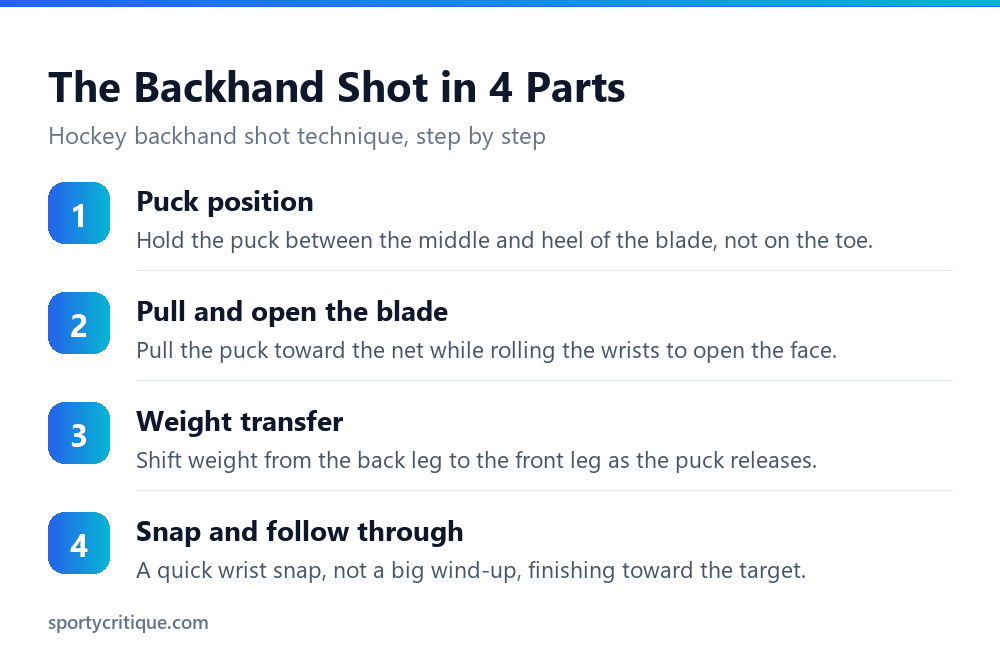
To take a backhand shot in hockey, hold the puck between the middle and heel of the blade, not the toe, then pull it toward the net while rolling the wrists to open the blade face and lift the puck. Weight shifts from the back leg to the front leg as the puck releases, and the motion should be a quick wrist snap rather than a big wind-up. Most backhand problems, no power or no lift, trace back to puck position and blade angle before anything else.
The backhand gets treated as the awkward, weaker cousin of the wrist shot, and for a lot of players it genuinely is weaker, but not because the shot itself is inherently less powerful. It’s because most players never drill it with the same attention they give their forehand shots, so the puck position and wrist mechanics that make a forehand shot work never get built on the backhand side.
The underlying mechanics aren’t actually that different from a wrist shot. The same principles apply: weight transfer from the back leg to the front leg, and a pull-and-snap motion rather than muscling the puck with the arms. What changes is the blade angle and puck position, since the back of the blade is a different shape and feel than the front.
- →Puck position matters most: hold it between the middle and heel of the blade, never the toe
- →Rolling the wrists to open the blade face is what lifts the puck; a closed blade keeps it flat
- →Weight transfer from the back leg to the front leg powers the shot the same way it does on a wrist shot
- →It’s a quick pull-and-snap motion, not a big wind-up; over-swinging is a common power-killing mistake
- →Keep the head up to read the goaltender rather than watching the puck through the release
Table of Contents
Puck Position: Where It Actually Matters
The puck should sit between the middle and heel of the blade for a backhand shot, on the flattest part of the blade’s curve. Toward the toe, the blade’s curve works against a clean release and makes it far harder to generate any real power. This single detail explains most backhand shots that feel weak or unpredictable even when the rest of the motion looks correct.
Starting position matters too. The puck should begin slightly behind the body, not out in front, since starting too far forward removes the pulling motion that actually generates power. A backhand that starts with the puck already even with or ahead of the body has nowhere left to pull from, which is one of the most common setup mistakes.
Blade Angle: Why Backhand Shots Don’t Lift
Getting the puck up off the ice on a backhand comes down almost entirely to rolling the wrists through the release to open the blade face. A blade that stays closed, facing flat toward the ice, keeps the shot low no matter how hard it’s struck. Players who can’t lift a backhand are almost always simply not opening the blade enough at the moment of release, not lacking strength.
💡 Pro tip: Practice the wrist roll separately from the full shot first. Standing still, cradle a puck on the backhand and roll the wrists to open and close the blade face without shooting. Feeling that motion in isolation makes it much easier to add back into a full shot at speed.
The blade should stay closed through the pulling phase of the shot and open only at the very end, right as the puck releases. Opening it too early spills the puck off the blade before the pull has generated any speed; opening it too late keeps the shot flat along the ice even with a strong pull behind it.
Weight Transfer and Where the Power Comes From
A backhand shot uses the same power source as a wrist shot: weight shifting from the back leg to the front leg as the puck is pulled and released, not arm strength alone. A player shooting off their back foot, weight still loaded backward at the moment of release, loses most of the power the motion is capable of generating, regardless of how hard the arms and wrists work.
Squaring the shoulders to the target and bending the knees before starting the pull sets up that weight transfer correctly. Bottom hand should sit roughly halfway down the shaft, top hand near the knob, the same general grip used for a wrist shot, since the two shots share most of their underlying mechanics.
⚠️ Watch out: Over-swinging is a common backhand mistake that looks like it should add power but actually costs it. A backhand is a quick snap, not a big wind-up; a longer backswing gives the puck more time to slide off the blade’s flat spot before the shot ever releases.
Backhand vs. Forehand Wrist Shot: What Changes
That power gap between forehand and backhand is real but not fixed. Players who drill the backhand as deliberately as the forehand close most of that gap over time; the shot simply gets less practice by default for most players, not because the mechanics cap out at a lower ceiling.
Common Backhand Shot Mistakes
- ✓Keep the puck between the middle and heel of the blade
- ✓Start with the puck slightly behind the body, not in front
- ✓Roll the wrists to open the blade face right at release
- ✓Keep the head up to read the goaltender through the shot
- ✕Letting the puck drift toward the toe of the blade
- ✕Over-swinging with a big wind-up instead of a quick snap
- ✕Keeping the blade closed through the entire motion
- ✕Watching the puck instead of the net through the release
The In-Tight Backhand: Deke and Top-Shelf Finish
A different version of the backhand shows up in close, when a player deking a goaltender pulls the puck to their backhand at the last second and needs to finish quickly, often called the backhand shelf or the tuck. This version relies less on the pull-and-snap power mechanics used farther out and more on a short, precise wrist roll, since the goal at close range is placement over the goaltender’s shoulder, not velocity.
The same blade-opening principle still applies: without rolling the wrists to open the face, the puck stays low and gets stopped by a goaltender’s pads instead of lifting over them. What changes in-tight is timing. The move typically happens off a lateral deke or a quick toe-drag, and the backhand release has to happen almost immediately after the puck reaches the backhand side, with very little time to reset the puck position the way a player could on a shot from distance.
📊 Note: In-tight backhand finishes are worth practicing separately from the longer-range backhand shot described above, since the puck position, timing, and power requirements are different enough that treating them as one skill slows down progress on both.
Adjustments for Younger or Newer Players
Younger players and beginners often benefit from slowing the whole motion down and isolating the wrist roll before adding speed or a full pulling motion. Standing still, rolling a puck back and forth on the backhand blade face while consciously opening and closing it builds the specific feel needed to lift the puck, without the added complexity of weight transfer and full-speed timing happening at the same time.
It’s also common for newer players to avoid the backhand shot almost entirely, defaulting to repositioning the puck to their forehand even in situations where a quick backhand release would be the better play. That habit becomes harder to break the longer it goes unaddressed, since the backhand never gets the repetitions needed to become a comfortable option. Coaches and practice plans that deliberately force backhand-only shooting drills, even briefly, tend to produce players who use the shot as a real option in games rather than avoiding it by reflex.
Building It With Practice
Off-ice reps on a synthetic shooting pad work well for grooving the wrist-roll and puck position pieces specifically, since the flat-spot puck position and blade-opening motion are the same on any hard, slick surface. What’s harder to replicate off-ice is the actual feel of lifting the puck under game speed, so pairing dry-land reps with on-ice shooting drills builds the full skill faster than either alone.
A consistent top-hand grip matters more on the backhand than most players realize, since the wrist roll that opens the blade depends on the top hand staying planted through the release rather than sliding on the shaft mid-shot. Grip tape, something like Howies Hockey Stretch Grip Tape ($9.99), keeps that top-hand position consistent rep after rep, which removes one variable while the wrist mechanics themselves are still being learned.
Repetition matters more here than on most shots, simply because the backhand gets a fraction of the practice reps most players give their forehand over a season. Dedicating specific practice time to backhand shooting, rather than treating it as something that improves incidentally through general skating and stickhandling, is what actually closes the gap.
Tracking progress with something concrete, like counting how many out of ten backhand attempts actually lift off the ice cleanly during a practice session, gives a more useful signal than how the shot feels in the moment. A player often feels like their backhand has improved before the results actually show it, or the reverse, so a simple count keeps the self-assessment honest rather than relying purely on impression.
Frequently Asked Questions
Why can’t I lift my backhand shot?
The most common cause is not rolling the wrists enough to open the blade face at release, which keeps the shot flat along the ice regardless of how hard it’s struck. Puck position toward the toe of the blade instead of the middle-to-heel area is the second most common cause.
Is the backhand shot weaker than the wrist shot?
On average, yes, for most players, but mostly because it gets practiced far less rather than because of a hard mechanical limit. Players who drill it specifically close most of that gap over time.
Where should the puck be positioned for a backhand shot?
Between the middle and heel of the blade, on the flattest part of the curve. Toward the toe, the blade’s curve makes a clean, powerful release much harder to achieve.
Should I use a different stick curve for a better backhand?
Blade curve does affect backhand feel somewhat, with a more open, less aggressive curve generally easier to shoot backhand with than a deep, closed curve optimized purely for forehand shots. Most players don’t need to change their stick specifically for this, though; puck position and wrist mechanics matter more than curve choice for most skill levels.
What’s the difference between a regular backhand shot and a backhand shelf move?
A regular backhand shot uses a full pull-and-snap motion for power from distance, while a backhand shelf or tuck is a short, quick wrist roll used in tight to the net, usually right after a deke, where placement over the goaltender’s shoulder matters more than shot velocity. They share the same blade-opening principle but different timing and setup.
As an Amazon Associate, we earn from qualifying purchases through links on this page.