How to Swim Backstroke: Technique Breakdown

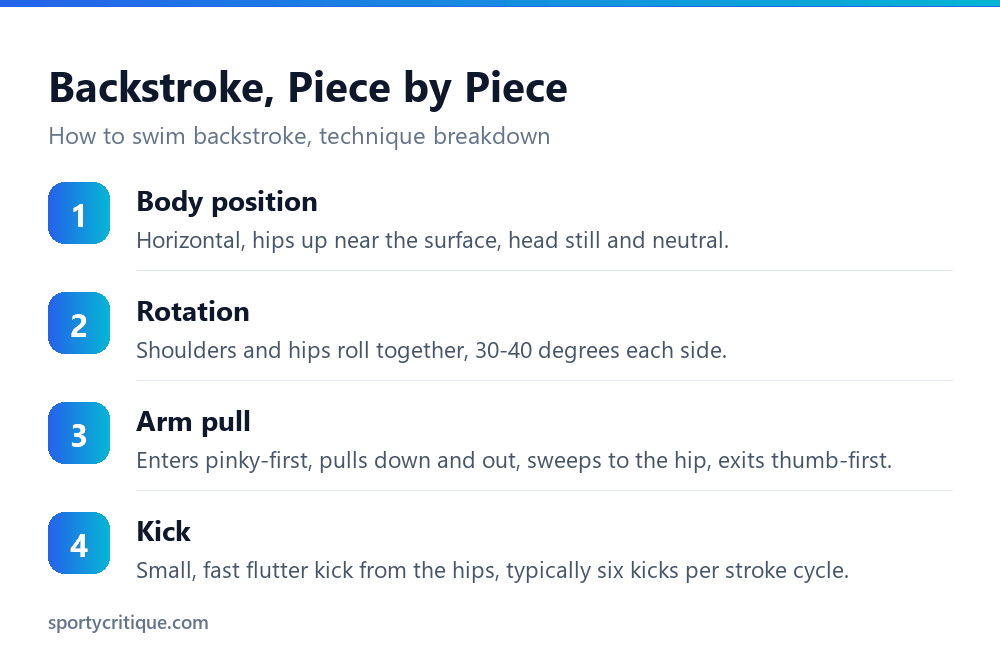
To swim backstroke, keep the body horizontal with the hips near the surface and the head still, looking straight up. Rotate the shoulders and hips together as one unit, roughly 30 to 40 degrees to each side, letting that rotation power the arm pull rather than pulling with the arm alone. Each arm enters the water above the head, pulls down and out before sweeping in toward the hip, and exits thumb-first. A small, fast flutter kick driven from the hips, typically six kicks per two-arm stroke cycle, rounds out the stroke.
Backstroke gets less deliberate practice than freestyle for most swimmers, partly because not being able to see where you’re going feels disorienting at first. That unfamiliarity often produces a flat, disconnected stroke: shoulders rotating without the hips following, a head that bobs or tilts to check position, and a kick that comes from the knees instead of the hips. Every one of those habits is fixable with the same four fundamentals that drive an efficient stroke.
- →Rotation is the engine of the stroke; shoulders and hips should roll together, not independently
- →The head stays still and neutral, eyes on the ceiling, throughout the entire stroke
- →Arms enter above the head and exit thumb-first at the hip after a down-and-out then in-sweep pull
- →The kick comes from the hips with a slight knee bend, not a big knee-driven kick
- →A six-beat kick (six kicks per two-arm cycle) is the common rhythm, though it varies by swimmer
Table of Contents
Body Position: Staying Horizontal
The body should sit as close to horizontal as possible, with the hips riding near the surface rather than sinking. A common beginner problem is letting the hips and thighs drop, which increases drag and forces the legs to work harder just to keep the body from sinking further, rather than contributing to actual propulsion.
The head stays still and neutral, in line with the spine, eyes looking straight up rather than toward the feet or craning to check position. Lifting the head to look forward, a common instinct for a swimmer used to sighting in freestyle, immediately drops the hips and disrupts the whole body’s horizontal line, since the body pivots around wherever the head goes.
⚠️ Watch out: Checking position by lifting the head to look down the pool is one of the most common habits that quietly wrecks backstroke technique. It feels natural, especially early on, but it directly causes the hip-dropping, increased-drag problem described above every single time.
Rotation: The Engine of the Stroke
Body rotation, roughly 30 to 40 degrees to each side, is what actually connects body position to an effective arm pull and kick. Shoulders and hips need to rotate together as one unit; rotating the shoulders while the hips stay flat disconnects the pull from the body’s larger muscles and core, forcing the shoulder alone to generate power it isn’t well suited to provide on its own, which is also a common contributor to shoulder strain over time.
Without adequate rotation, the stroke goes flat: less reach on the pull, less hip drive on the kick, and a shorter, less powerful stroke overall. Swimming too flat is one of the most common technical limiters in backstroke, and it’s often the actual root cause behind a stroke that feels effortful without covering much distance.
The Arm Pull
Each stroke begins with the recovering arm entering the water above the head, pinky-first (palm facing slightly outward), setting up a clean catch. From there the arm pulls downward and outward before bending at the elbow and sweeping inward toward the hip, then extends fully with the palm turned toward the body so the hand exits the water thumb-first.
Entry position matters specifically because crossing the midline on entry, reaching the hand in toward the centerline of the body instead of in line with the shoulder, forces the hand to push water outward before it can even begin an effective catch, wasting the first part of every stroke on correcting a bad entry rather than generating propulsion.
💡 Pro tip: A useful self-check: the entering hand should land roughly in line with the shoulder, not closer to the head’s centerline. If the recovering arm consistently enters wide or crosses over, that’s usually a rotation problem more than an arm-path problem specifically, since full rotation naturally sets up a properly aligned entry.
“Catch-up” backstroke, where both arms momentarily meet at the sides at the same time rather than one arm always pulling while the other recovers, kills momentum and wastes energy. The stroke should feel continuous, with one arm always working while the other travels through recovery, not a pause-and-restart pattern.
The Kick
Backstroke uses essentially the same flutter kick as freestyle, just performed on the back. The kick should be driven from the hips, with only a slight bend at the knee and relatively straight, pointed-toe legs, rather than a big kick generated mainly from bending and straightening the knee. Small, fast kicks are more effective and more streamlined than big, slow ones, which tend to create more drag than propulsion.
Most backstrokers use a six-beat rhythm, six kicks for every two-arm stroke cycle (one full cycle of both arms pulling once each), though the exact ratio varies by swimmer and distance. The kick’s job isn’t purely propulsion; it also helps maintain the hip-high body position described earlier, which is part of why a kick that comes from a high, sunk-hip position never works as well as one starting from a properly horizontal body.
Common Backstroke Mistakes
- ✓Rotate shoulders and hips together as one connected unit
- ✓Keep the head still and neutral, eyes on the ceiling
- ✓Enter each hand in line with the shoulder, not across the midline
- ✓Drive the kick from the hips with a small, fast tempo
- ✕Rotating only the shoulders while the hips stay flat
- ✕Lifting the head to check position, which drops the hips
- ✕Crossing the entering hand over the body’s centerline
- ✕Kicking mainly from the knee with big, slow leg movements
Staying Straight Without Being Able to See Forward
Swimming a straight line without a visual reference in front of you is one of backstroke’s genuinely unique challenges among the four competitive strokes. Most pools with dedicated backstroke lanes install flags a set distance from each wall specifically so swimmers can count strokes from the flags to judge wall proximity without needing to look. In a pool without flags, counting strokes from the wall on a warm-up length and remembering that count for subsequent lengths serves the same purpose.
Uneven rotation is a more common cause of drifting off a straight line than people expect. A swimmer who rotates further or more forcefully to one side than the other gradually curves toward the weaker side over the course of a length, even in a pool with lane lines to bump against as a rough guide. Checking whether rotation actually feels even side to side, not just assuming it is, catches this before it becomes an ingrained habit.
Starts and Flip Turns
A backstroke start begins in the water, gripping the wall or starting blocks with both hands and feet planted against the wall below the surface, rather than diving in from a standing start the way freestyle does. The pull happens explosively off the wall, driving the body into a streamlined position before the first stroke begins, with a strong initial kick carrying much of the early speed before the arms take over.
Backstroke’s flip turn at the wall works differently from freestyle’s, since the swimmer is already facing away from the direction of travel. Modern competitive backstroke allows a roll onto the stomach just before the wall, turning it into a freestyle-style flip turn, then pushing off back on the back. This technique takes real practice to time correctly and is generally learned separately from the core stroke mechanics covered above, once basic backstroke swimming itself feels comfortable.
How Backstroke Rotation Compares to Freestyle
Freestyle and backstroke share the same underlying principle: rotation, not arm strength alone, drives the stroke. The practical difference is that freestyle rotation also has to coordinate with breathing timing, turning the head to one side at a specific point in the rotation cycle to breathe. Backstroke removes that constraint entirely, since the face stays out of the water the whole time, which paradoxically makes some swimmers rotate less consciously in backstroke simply because there’s no breathing cue forcing them to notice whether rotation is happening at all.
That’s part of why flat, under-rotated backstroke is such a common problem even among swimmers who rotate reasonably well in freestyle. Without breathing as an built-in reminder to rotate, the habit has to be built and checked deliberately, through drills and conscious attention, rather than developing automatically alongside basic stroke competence.
Drills and a Useful Training Tool
Isolating rotation with a single-arm drill, pulling with one arm while the other stays extended at the side, builds the shoulder-hip connection described above without the complexity of coordinating both arms and the kick simultaneously. Kicking on the back with a kickboard, or with no board at all and arms extended overhead, isolates the kick and body position pieces the same way.
📊 Note: Short-blade training fins, something like FINIS Zoomers Gold Swim Training Fins (check current price on the listing), encourage a faster, hip-driven kick tempo rather than the bigger, slower kick a swimmer might default to without them. They’re a particularly useful drill tool for backstroke work specifically, since the kick contributes more to maintaining body position on the back than it does in most other strokes.
Frequently Asked Questions
Why do my hips sink when I swim backstroke?
Usually one of two causes: lifting the head to check position, which drops the hips immediately, or a kick that isn’t providing enough support because it’s being driven from the knee instead of the hips. Fixing head position first is the more common and more impactful fix.
How many kicks per stroke should I do in backstroke?
Six kicks per two-arm cycle is the common standard, though some swimmers use fewer (a two-beat or four-beat kick) depending on distance and personal style. Consistency in rhythm matters more than hitting an exact universal number.
Is it normal to feel disoriented swimming backstroke without seeing where I’m going?
Yes, especially early on. Counting strokes from the wall, using overhead backstroke flags where available, and simply building repetition all help develop the spatial awareness that eventually makes the lack of forward visibility feel much less disorienting.
Should I breathe on a specific stroke count in backstroke?
Unlike freestyle, backstroke doesn’t require timing breaths with rotation since the face stays out of the water throughout. Many swimmers still settle into a rhythmic breathing pattern tied to stroke count simply because it feels more controlled, but it isn’t a mechanical requirement the way breath timing is in freestyle.
How do backstroke flip turns work if I’m facing away from the wall?
Competitive backstroke rules allow a roll onto the stomach just before reaching the wall, turning the approach into a standard freestyle-style flip turn, then pushing off again on the back. It takes dedicated practice to time the roll correctly and is usually learned after basic backstroke swimming already feels comfortable.
None of these fundamentals require exceptional strength or flexibility to learn. What they require is deliberate attention, since backstroke’s lack of a visual forward reference means problems that would be obvious in freestyle can go unnoticed for a long time without someone actively checking for them.
As an Amazon Associate, we earn from qualifying purchases through links on this page.