How to Shoot on the Run in Lacrosse

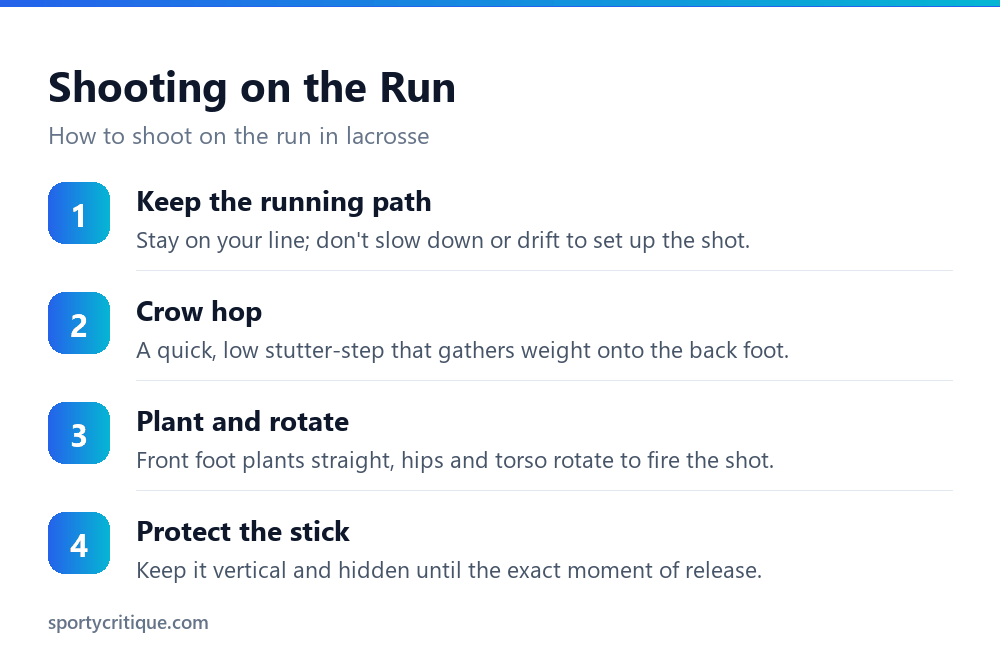
To shoot on the run in lacrosse, keep your running path and speed instead of slowing down to set up the shot, use a quick, low crow hop right before release to gather your weight onto your back foot, plant your front foot straight rather than stepping across your body, and let your hips and torso rotate to power a compact release. Keep the stick vertical and hidden behind your helmet until the exact moment of release to protect it from a trail check.
Shooting on the run is a fundamentally different skill from a standing or set shot, not just a faster version of the same motion. The whole point is generating power and accuracy without sacrificing the running speed that got you into a scoring position in the first place; a player who has to stop or slow significantly to shoot has given the defense and goaltender time to recover that a true running shot never allows.
- →Maintain your running path and speed; slowing down to set up the shot defeats the purpose
- →The crow hop is a quick, low, explosive stutter-step, not a pause or a float into the air
- →Plant the lead foot straight, not across your body, to let the hips rotate freely
- →Keep the stick vertical and hidden behind your helmet until the moment of release
- →Timing the release with your forward stride, not a separate windup, is what keeps the shot compact and fast
Table of Contents
Maintaining Your Running Path
The best shooters on the run keep the same running path and speed straight through the shot rather than deviating to create a more comfortable setup. Slowing down, even briefly, gives the defense and the goaltender extra time to react and recover position, undoing the advantage a player worked to create by beating a defender or finding space in the first place.
This is the core discipline that separates shooting on the run from a standing shot adapted awkwardly to movement. The technique described below has to work within continuous forward motion, not as a pause built into the middle of a run.
The Crow Hop
Right before releasing the shot, a quick, explosive crow hop, a stutter-step that gathers weight onto the back foot, loads the legs for the power transfer that follows. The motion needs to stay low and quick; floating up into the air during the hop bleeds power out of the shot instead of storing it, which defeats the entire purpose of the technique.
⚠️ Watch out: A common mistake is slowing down entirely to execute the crow hop, treating it like a brake rather than an accelerator. The crow hop should add to forward momentum, not interrupt it; done correctly, it barely breaks stride at all.
Foot Plant and Hip Rotation
The lead foot should plant straight ahead, in line with the direction of the shot, not stepping across the body toward the opposite side. Stepping across blocks the hips from rotating freely through the shot, which is a specific, common cause of shots missing wide to the far post rather than finding the intended target.
Driving off the legs and planting the lead foot creates the momentum that the hips then convert into rotational power, which finally reaches the hands and the stick at release. This sequence, legs to hips to hands, has to fire in order; when the hips, hands, and follow through happen out of sequence, the energy from each phase never stacks together into one powerful release.
💡 Pro tip: Regaining a “downhill” angle toward the goal, squaring the hips and shoulders toward the cage even while still moving laterally from a dodge, improves both accuracy and power on a running shot. A shot taken with the body still angled away from the goal rarely has the alignment needed for a clean, accurate release.
The Release: Compact, Not a Big Wind-Up
The actual release should be compact, relying on wrist snap and the core rotation already built up through the crow hop and hip turn, rather than a big, separate wind-up motion. A large wind-up telegraphs the shot to the defense and goaltender and slows down the overall release, undoing the speed advantage that shooting on the run is supposed to provide over a standing shot.
Timing the release with the forward stride, rather than treating the shot as a separate action layered on top of running, is what keeps the whole motion efficient. The stick should fire as a natural extension of the running and rotating motion already in progress, not as an interruption to it.
Protecting the Stick From a Trail Check
Keeping the stick completely vertical and tucked behind the helmet through the running and crow hop phases protects it from a trailing defender’s check attempt until the exact moment of release. Dropping the hands or the stick down toward waist level too early, especially once a defensive slide arrives, exposes it to a check that can strip the ball entirely before the shot ever happens.
📊 Note: This stick protection detail matters more specifically when shooting on the run than on a standing shot, since a running shot usually happens with a defender closing distance rather than standing back at range. The extra vulnerability window is exactly why the vertical, hidden stick position is emphasized so consistently in running-shot instruction specifically.
Common Running-Shot Mistakes
- ✓Maintain running speed and path straight through the shot
- ✓Keep the crow hop low and quick, not a slow float or a full stop
- ✓Plant the lead foot straight, not stepping across the body
- ✓Keep the stick vertical and hidden until the exact moment of release
- ✕Slowing down or stopping to set up a more comfortable shot
- ✕Floating up into the air during the crow hop, bleeding power from the motion
- ✕Stepping across the body, which blocks hip rotation and misses wide
- ✕Dropping the stick to waist level too early and exposing it to a check
Practicing the Motion
Running shot drills that specifically prohibit slowing down, forcing a player to maintain full speed through the crow hop and release, build the habit far more effectively than isolated standing-shot repetition ever will. The skill has to be trained at game speed and in motion, since the mechanics genuinely change once running speed and momentum enter the equation.
A Lacrosse Rebounder for Backyard (7×4 Ft) ($89.99) lets a player run repeated shooting reps solo, approaching at speed and firing without needing a partner or goaltender available for every rep. Solo volume matters here specifically because the running-shot sequence, crow hop, plant, rotation, release, needs enough total repetitions to become automatic under speed, not just understood conceptually.
Reading the Goaltender for Placement
A technically perfect running shot still needs a target, and reading the goaltender’s positioning in the split second before release matters as much as the mechanics themselves. A goaltender cheating toward one side of the cage, or one whose stick or body has drifted out of position tracking the shooter’s angle, gives away an opening that a shooter watching for it can actually use.
This is harder to do while also managing footwork, timing, and stick protection, which is exactly why shot placement tends to improve only after the underlying mechanics have become automatic enough to free up attention for reading the goal. A player still consciously thinking through their crow hop and foot plant has little spare attention left for picking a precise corner.
Shooting Off Different Dodges
A shot coming out of a roll dodge arrives with different body positioning than one coming out of a split dodge or a straight dodge past a defender, since each dodge leaves the shooter’s hips and shoulders oriented differently relative to the goal at the moment the shot needs to happen. Regaining a downhill angle, squaring back toward the cage, matters more immediately after a roll dodge specifically, since that move naturally turns the body away from goal mid-motion.
Practicing the running shot specifically off each type of dodge a player actually uses in games, rather than only drilling it from a straight, uncontested approach, closes the gap between practice execution and what a real defended possession actually demands. A shot that looks clean coming out of an open-field sprint doesn’t automatically transfer to the same quality coming out of a tightly defended roll dodge.
Adjustments for Younger Players
Younger or newer players often benefit from learning the crow hop and foot plant in isolation, walking through the motion at a jog before adding full sprint speed, since the sequencing itself, legs to hips to hands, takes real repetition to internalize before speed gets layered on top of it. Rushing straight to full-speed running shots before the sequence feels natural tends to reinforce exactly the out-of-order timing fault that kills power in the first place.
Coaches commonly use a walk-through, then jog, then sprint progression specifically for this reason, treating running-shot technique as a skill that has to be built in layers rather than taught once at full game speed and expected to stick immediately. That patience early on pays off in a shot that holds up once real defensive pressure and full sprint speed enter the picture.
Frequently Asked Questions
Why do my running shots keep missing wide to the far post?
Stepping across the body with the lead foot instead of planting straight is the most common cause, since it blocks the hips from rotating freely through the shot and sends the release off-line toward the far side of the goal.
What exactly is a crow hop in lacrosse?
A quick, low, explosive stutter-step taken right before releasing a shot, which gathers weight onto the back foot to load power into the shot. It should stay low and fast, not a slow float into the air or a pause in the running motion.
Should I slow down to get a cleaner shot off?
No. Slowing down defeats the core purpose of shooting on the run, giving the defense and goaltender time to recover position. The whole technique is built to generate power and accuracy while maintaining full running speed.
How do I keep my stick safe from a check while shooting on the run?
Keep it completely vertical and tucked behind your helmet through the crow hop and running phases, only bringing it down and through at the exact moment of release. Dropping it early exposes it to a trail check that can strip the ball before the shot happens.
Does the running shot change depending on which dodge I just used?
The core mechanics stay the same, but body orientation coming out of the dodge differs. A roll dodge specifically turns the body away from goal, so regaining a squared, downhill angle toward the cage matters more immediately after that move than after a straight sprint past a defender.
At what age should young players start learning to shoot on the run?
There’s no strict age requirement, but most coaches introduce it once a player has a solid standing shot and basic running coordination, progressing from a walk-through to a jog to full sprint speed rather than teaching it at game speed from the start.
Every piece of this, footwork, timing, stick protection, and eventually placement, builds directly on the one before it, which is exactly why rushing straight to full-speed game shots before the fundamentals feel automatic tends to produce a shot that looks fine in practice and falls apart under real defensive pressure.
As an Amazon Associate, we earn from qualifying purchases through links on this page.