How Cue Ball Squirt and Deflection Affect Your Aim

Cue deflection squirt explained simply: it’s the sideways push on the cue ball that happens when a player strikes it off-center to apply English, sidespin. Instead of traveling exactly along the cue’s aimed line, the cue ball initially veers slightly in the opposite direction of the spin before the spin itself takes over and curves the ball back. Shaft stiffness and tip weight directly affect how much squirt occurs, which is why low-deflection shafts exist and why compensating for squirt is a learnable, physics-based skill rather than guesswork.
Squirt is one of the more counterintuitive concepts in pool, since it means the cue ball doesn’t travel exactly where the cue was aimed whenever English is applied, even with a technically perfect stroke. Understanding why this happens, and how to compensate for it, separates players who can reliably use English for position play from those who avoid it because it seems unpredictable.
- →Squirt is the initial sideways deflection of the cue ball caused by an off-center hit
- →It happens in the opposite direction of the applied English before spin curves the ball back
- →Shaft stiffness and tip mass directly affect how much squirt a cue produces
- →Low-deflection shafts reduce squirt through engineered internal construction, not magic
- →Compensating for squirt means aiming slightly differently, not changing the amount of English applied
Table of Contents
What Actually Causes Squirt
When a cue tip strikes the cue ball off-center to apply English, the impact isn’t perfectly aligned with the cue’s centerline, and the reactive force from that impact pushes the tip end of the cue very slightly sideways during contact. This tiny sideways cue movement transfers a small sideways push to the cue ball itself, sending it off in a direction slightly different from where the cue was actually pointed.
This happens in the opposite direction from the spin being applied: striking the right side of the cue ball to apply right English actually pushes the cue ball’s initial direction slightly left of the aimed line, before the right-hand spin eventually takes hold and curves the ball’s path back toward and sometimes past the original aim line, depending on distance and table conditions.
⚠️ Watch out: A common beginner mistake is aiming as if squirt doesn’t exist, then blaming missed shots on poor stroke mechanics when the actual cause is simply not accounting for this real, physical deflection. Squirt happens on every single off-center hit; it isn’t a flaw that better fundamentals alone eliminate.
Shaft Stiffness and Tip Mass
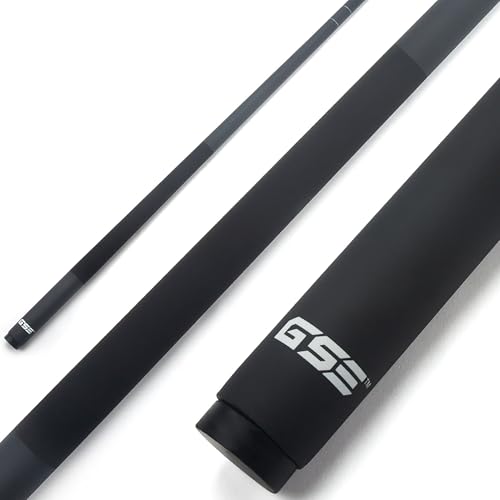
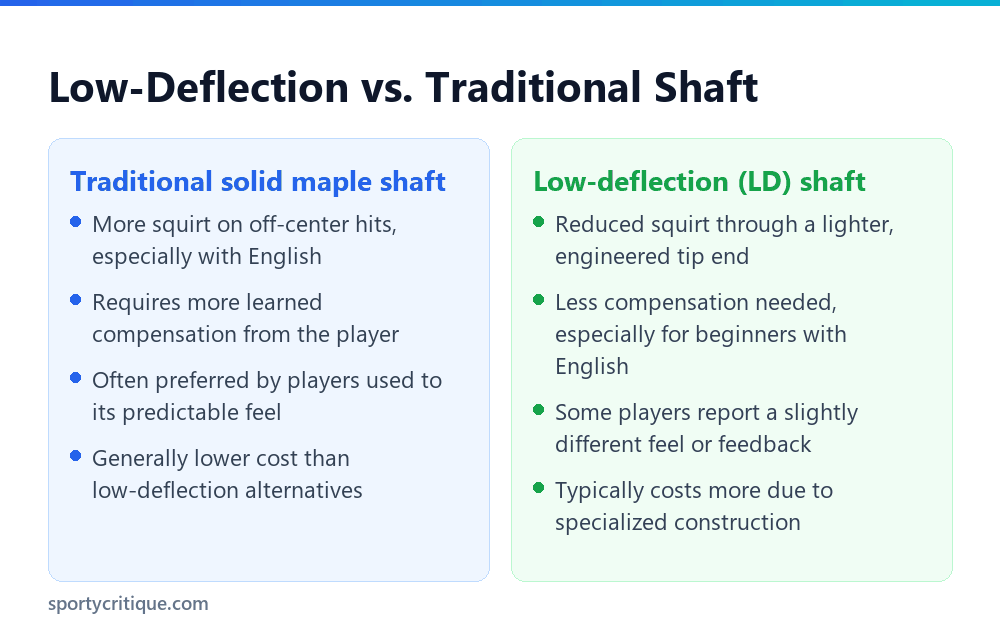
A stiffer, heavier shaft resists that sideways reactive movement less effectively than a shaft engineered specifically to minimize it, which is why shaft construction directly determines how much squirt a given cue produces on an identical off-center hit. This isn’t about overall cue weight; two cues of the same total weight can produce noticeably different squirt amounts based purely on how the shaft itself is built.
Low-deflection shafts typically use a hollowed or segmented internal construction near the tip end, sometimes combined with a lighter ferrule and tip assembly, specifically to reduce the mass that has to move sideways during an off-center hit. Less moving mass at that critical point in the shaft translates directly into less sideways push transferred to the cue ball.
How Squirt Gets Measured
Cue manufacturers and equipment reviewers sometimes quantify squirt using a “pivot point” or “pivot length” measurement, essentially the distance along the cue where, if a player pivoted the cue around that exact point while keeping the tip on the same spot on the cue ball, squirt would be effectively cancelled out. A shorter pivot length generally corresponds to less real, measurable squirt in actual play.
📊 Note: Pivot length numbers are useful for comparing shafts on paper, but translating that number into consistent, accurate compensation at the table still requires practice and feel, not just knowing the specification. The number is a starting reference point, not a substitute for actual table time.
Compensating for Squirt at the Table
Compensating for squirt means adjusting the cue’s aim line slightly in the direction the spin will eventually curve the ball toward, rather than aiming as though the shot will travel in a perfectly straight line the moment it leaves the tip. This adjustment amount scales with how much English is applied and with the specific shaft’s deflection characteristics, which is why players switching cues sometimes need a short adjustment period.
💡 Pro tip: Practicing the same English-applied shot repeatedly with a single cue, at a fixed distance, and noting exactly how much aim adjustment produces a consistently accurate result builds an intuitive feel for that specific cue’s squirt behavior faster than trying to calculate the exact physics in the middle of a match.
This compensation becomes a learned, largely unconscious adjustment for experienced players using a familiar cue, similar to how a basketball player unconsciously adjusts their shot arc for distance without consciously calculating trajectory each time. New players simply haven’t built up that same table-time-based intuition yet.
Common Squirt-Related Mistakes
- ✓Account for squirt direction when aiming any shot using English
- ✓Practice the same English shot repeatedly to build accurate compensation feel
- ✓Consider a low-deflection shaft if switching cues frequently disrupts your feel
- ✓Recognize that squirt scales with how much English is applied
- ✕Aiming as though squirt doesn’t exist and blaming stroke mechanics for the miss
- ✕Assuming a low-deflection shaft eliminates the need for any compensation at all
- ✕Switching cues frequently without adjusting for each cue’s distinct squirt behavior
- ✕Overcompensating dramatically rather than making small, practiced adjustments
Squirt vs. Swerve: Two Different Effects
Squirt is often confused with swerve, or curve, which is a separate effect caused by the cue ball’s spin gripping the cloth as forward speed decreases, bending its path even without any contact from another ball or rail. Swerve tends to show up more on slower-speed shots with significant English, particularly when the cue is elevated for a masse-style shot, while squirt happens instantly at the moment of contact regardless of shot speed.
Both effects can occur on the same shot and their combined influence on the cue ball’s actual path is part of what makes high-level position play with English genuinely difficult to master. Separating the two conceptually, squirt as an instant contact effect and swerve as a cloth-interaction effect that develops over distance, helps a player diagnose which one is actually causing a specific missed shot.
When Squirt Matters Most
Squirt has the biggest practical impact on longer shots using significant English, since even a small initial deflection angle translates into a larger total distance off the intended line the farther the cue ball travels before contact. Short, close-range shots using English are far more forgiving of small aiming errors caused by squirt, simply because there’s less distance for the deflection to compound.
This distance sensitivity is exactly why serious players who frequently need long-distance position shots with English are the ones most likely to invest in a low-deflection shaft, while players whose game rarely calls for that specific combination of distance and spin see far less practical benefit from the upgrade.
Testing Your Own Cue’s Squirt Behavior
A simple way to gauge a specific cue’s squirt without any special equipment is to set up a straight-in shot at a consistent distance, apply a fixed amount of English, aim dead straight with no compensation, and observe how far off-line the cue ball travels. Repeating this several times at the same distance and English amount gives a rough but useful personal baseline for how much that particular cue deflects.
Comparing this baseline test across a few different cues, a house cue, a personal cue, a friend’s low-deflection shaft, highlights just how much shaft construction actually changes squirt in practice rather than relying purely on manufacturer specifications or marketing claims. Feeling the difference directly tends to make the concept click faster than reading about it alone.
Does Squirt Matter for Break and Jump Cues?
Break cues are used almost exclusively for center-ball hits on the opening break, where no English is applied and therefore squirt isn’t a practical concern regardless of that cue’s shaft construction. Manufacturers generally prioritize stiffness and power transfer for break cues over squirt reduction, since the two goals rarely need to coexist in that specific use case.
Jump cues present a different situation, since players do sometimes apply English while executing a legal jump shot, but the far more dominant technical challenge in a jump shot, getting the cue ball airborne cleanly over an obstructing ball, tends to overshadow squirt as the primary concern most players focus on. Squirt still technically applies to jump shots with English, just as a secondary consideration behind the jump mechanics themselves.
Where Squirt Fits in a Player’s Learning Progression
Beginners are generally better served focusing on fundamentals, stance, bridge, and a straight stroke, before spending much energy consciously compensating for squirt, since English itself is typically introduced only after center-ball shots become consistently reliable. Trying to master squirt compensation before basic stroke mechanics are solid tends to add confusion rather than useful skill at that early stage.
Once English becomes a regular part of a player’s game, usually for position play rather than pure showmanship, squirt compensation naturally becomes a skill worth deliberately practicing rather than an abstract concept read about once and forgotten. This progression, straight shots first, then spin, then compensation, mirrors how most instructors sequence pool instruction generally.
Frequently Asked Questions
Why does my ball miss wide when I use English?
Squirt is pushing the cue ball’s initial direction opposite to the spin applied. Not compensating for this by adjusting the aim line slightly is the most common cause of missing wide specifically on shots using English.
Does squirt happen on every shot with English?
Yes, on every off-center hit, though the amount varies with shaft construction, tip mass, and how much English is applied. It’s a consistent physical effect, not an occasional glitch.
Is a low-deflection shaft worth the extra cost?
It depends on how often a player’s game requires long-distance shots with significant English. For that specific situation, the reduced compensation needed can be genuinely valuable; for shorter, less English-heavy play, the benefit is much smaller.
What’s the difference between squirt and swerve?
Squirt happens instantly at contact due to the off-center hit; swerve develops gradually over distance as spin interacts with the cloth, especially on slower shots or an elevated cue.
Can I feel squirt happening during the shot?
Not directly in real time, but its effects are visible in where the cue ball actually ends up relative to the aimed line. Consistent practice builds an intuitive feel for compensating without consciously perceiving the deflection itself.
Does squirt affect shots without English?
No. A perfectly centered hit produces no squirt at all, since the reactive sideways force only occurs when the tip contacts the cue ball off-center.
Squirt isn’t a flaw to eliminate through better fundamentals alone; it’s a real physical effect built into every off-center hit that every player using English has to account for, whether through equipment choice, learned compensation, or some combination of both. Understanding why it happens turns a mysterious, frustrating miss into a predictable, correctable part of the game, and that shift in understanding alone often does more for a player’s confidence with English than any single piece of new equipment could.
Whether the fix ends up being a shaft upgrade, a longer practice routine, or simply a better mental model of what’s actually happening at contact, the underlying goal is the same: turning an effect that once felt random into one that’s accounted for before the cue ever leaves the bridge hand.
As an Amazon Associate, we earn from qualifying purchases through links on this page.