Best Pool Table Covers to Protect Your Table


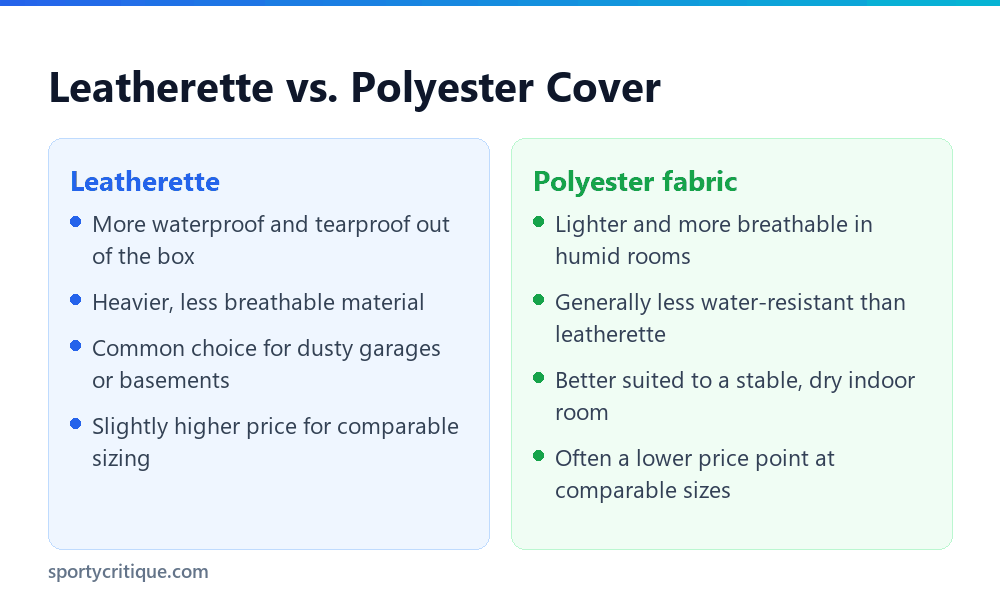
The best pool table cover for most home tables is a fitted leatherette option like the BEARCOVER or K-Musculo, both waterproof and tearproof at a similar price point around $43. Rooms that stay consistently dry benefit from a lighter, more breathable polyester cover like the GEMITTO instead. Budget-conscious buyers can get genuine waterproof protection from the amberr cover at under $17, though it’s worth checking seam-quality reviews before committing to heavy, daily-use protection at that price point.
A pool table cover is one of the cheapest, most overlooked ways to protect a meaningful home investment between sessions. Dust, incidental spills, pet hair, and stray sunlight all take a slow toll on cloth and rails that a simple, well-fitted cover largely prevents, at a fraction of the cost of re-felting or repairing damaged rails later.
- →A fitted cover reduces shifting and gaps compared to a loose, generic drape cover
- →Leatherette covers offer better water resistance; polyester covers offer better breathability
- →A cover protects against dust, spills, and sun fading, not against structural table damage
- →Sizing correctly to the table (7, 8, or 9ft) matters more than material choice alone
- →A budget cover under $20 can still offer genuine waterproofing if seam quality holds up
Table of Contents
What a Cover Actually Protects Against
A pool table cover’s main job is keeping dust, pet hair, and airborne debris off the cloth between sessions, since felt cloth attracts and holds this kind of debris more readily than a hard surface would. Over months of exposure, uncovered cloth visibly dulls and can develop a slightly rougher feel that affects ball roll, an effect a simple cover prevents almost entirely.
A waterproof cover also guards against incidental spills, a knocked-over drink at a party or a leak from a nearby window or pipe, that would otherwise soak directly into the cloth and potentially warp the slate bed underneath in serious cases. This protection matters most for tables kept in multi-use rooms where drinks and food are common, rather than a dedicated, isolated game room.
⚠️ Watch out: A cover does not protect against structural damage from moving the table incorrectly, extreme temperature and humidity swings in an uncontrolled space, or heavy objects placed directly on top of a covered table. It’s a dust and spill barrier, not a substitute for proper table placement and handling.
4 Real Options, Compared
📊 Note: The two leatherette options above are priced identically and both fitted specifically to size rather than a loose universal drape, making the choice between them mostly a matter of brand preference and current review sentiment rather than a meaningful functional difference.
Fitted Covers vs. Loose Drape Covers
A fitted cover, cut and sized to match a specific table’s dimensions closely, stays in place far better than a generic, loose drape-style cover that simply hangs over the table without matching its exact shape. A loose cover is more prone to sliding off partially, especially in a room with foot traffic or pets, which defeats much of its protective purpose.
Matching the cover size correctly to a table’s actual dimensions, 7, 8, or 9 feet being the most common home sizes, matters more for a snug fit than choosing between leatherette and polyester material. A correctly sized cover in either material outperforms an incorrectly sized one regardless of the fabric choice.
Choosing the Right Cover
- ✓Confirm exact table dimensions before ordering a specific cover size
- ✓Choose leatherette for rooms with any real water or spill exposure risk
- ✓Choose polyester for a stable, dry, climate-controlled room
- ✓Check seam-quality reviews specifically on lower-cost options
- ✕Assuming a universal or loosely-fitted drape protects as well as a sized, fitted cover
- ✕Buying the cheapest available cover without checking any seam-durability feedback
- ✕Placing heavy items directly on top of a covered table
- ✕Expecting a cover to prevent damage from humidity swings or improper table placement
Covers for Garages and Basements Specifically
Tables kept in garages or unfinished basements face more dust, temperature swings, and occasional moisture exposure than one kept in a finished, climate-controlled living space, making a waterproof leatherette cover the more sensible default choice for these locations. The extra water resistance matters more in a space where humidity and incidental leaks are a realistic possibility.
Even with a quality cover, a table in a genuinely damp basement or an uninsulated garage still faces the underlying humidity and temperature risks discussed in broader table-maintenance content; a cover manages surface-level dust and spill protection, but it doesn’t solve a location’s fundamental climate problems. Addressing ventilation or considering a dehumidifier in these spaces complements, rather than replaces, the protection a cover provides.
Cleaning and Maintaining the Cover Itself
Wiping down a leatherette cover with a damp cloth periodically removes accumulated dust before it has a chance to work its way underneath during removal and replacement. Polyester covers often tolerate a gentle machine wash on a cold, delicate cycle, though checking the specific product’s care instructions first avoids accidentally damaging waterproof coatings some fabric covers rely on.
Letting a cover fully air dry before storing it folded, if it’s removed for an extended period rather than kept on the table continuously, prevents mildew or odor buildup that can develop in a cover stored damp. This small habit extends the cover’s own useful life alongside the protection it provides to the table underneath.
When to Replace a Pool Table Cover
Visible cracking or peeling in a leatherette cover’s surface, or fraying and thinning fabric on a polyester cover, are clear signs a cover has reached the end of its useful protective life regardless of how recently it was purchased. A degraded cover that no longer forms a solid barrier isn’t meaningfully better than no cover at all for its core dust and spill protection purpose.
For a cover used daily on a frequently played table, expecting to replace it every one to three years is reasonable, while a cover on a lightly used table in a stable room can often last considerably longer before showing meaningful wear. Given the relatively low cost of most covers compared to the table they protect, replacing one proactively at the first sign of real wear is an easy, low-cost decision.
Putting the Cover On and Taking It Off
Removing and replacing a cover before and after every session is the ideal habit for maximum protection, but realistically, many households leave the cover on except during active play and put it back on immediately afterward rather than treating removal as a multi-step production each time. A cover that’s genuinely quick and easy to put on and take off gets used consistently; one that’s awkward or time-consuming tends to get skipped after the first few uses.
Fitted covers with elastic edges or drawstring closures tend to go on and off faster than a cover secured with multiple separate straps or ties, which is worth factoring into a purchase decision for a household that plays frequently and values quick setup and teardown over marginal gains in fit precision.
Covers vs. Other Table Protection Measures
A cover works alongside other protective measures rather than replacing them entirely. Keeping the table out of direct sunlight, avoiding placing drinks directly on the rails even when the table isn’t covered, and maintaining stable room humidity all reduce the underlying risks a cover alone can’t fully address, particularly the slower, cumulative damage from UV exposure and humidity swings.
Table brushes and proper cloth-cleaning tools, used periodically even on a well-covered table, address the dust and chalk residue that accumulates during actual play sessions, a different maintenance need than what a cover addresses between sessions. Treating cover use and regular cloth cleaning as complementary habits, not substitutes for each other, keeps a table in better condition longer than relying on either one alone.
Covers for Multi-Use Rooms
A pool table that doubles as a buffet or card table for parties and gatherings faces meaningfully higher spill and scratch risk than one kept in a dedicated, single-purpose game room. For this kind of shared-use setup, a durable, waterproof cover isn’t just a nice extra; it’s a practical necessity that lets the table safely serve double duty without the owner needing to police every drink and plate placed near it during a gathering.
Some cover manufacturers specifically market thicker, padded cover variants designed to double as a usable flat surface for exactly this kind of multi-use scenario, distinct from a purely protective, form-fitted cover meant only for storage between sessions. Checking whether a specific listing supports this kind of surface use, rather than assuming any cover works safely as a tabletop, avoids potential damage to both the cover and the table underneath.
Frequently Asked Questions
Do I really need a pool table cover?
It’s not strictly required, but it’s a low-cost way to prevent dust buildup, spill damage, and sun fading on the cloth, all of which are more expensive to fix later than a cover costs upfront.
Should I choose leatherette or polyester?
Leatherette offers better water resistance and suits garages, basements, or multi-use rooms with spill risk. Polyester is lighter and more breathable, better suited to a stable, dry indoor room.
Does a cover protect against slate warping?
Only indirectly, by preventing water from reaching the cloth and potentially the slate bed underneath in a serious spill. It doesn’t address humidity or temperature-related structural risks on its own.
How do I know what size cover to buy?
Measure your table’s actual dimensions and match them to the cover’s listed sizing, typically 7, 8, or 9 feet for standard home tables, rather than assuming a generic ‘one size fits most’ option will fit snugly.
Can I wash a pool table cover?
Many polyester covers tolerate a gentle, cold machine wash; leatherette covers are usually best wiped down with a damp cloth instead. Checking the specific product’s care instructions avoids damaging any waterproof coating.
How often should I replace a pool table cover?
Roughly every one to three years for daily use, though a lightly used table in a stable room can go considerably longer. Visible cracking, peeling, or fraying are the clearest signs it’s time to replace.
A well-fitted, correctly matched cover is one of the cheapest, most effective ways to protect a pool table between sessions, and the choice between the options above comes down mainly to a room’s specific moisture exposure and budget rather than any dramatic difference in core protective quality.
Whichever option ends up on the table, the underlying goal stays the same: keep dust, spills, and sun exposure away from the cloth between sessions, so the more expensive parts of the table, the felt and the slate beneath it, stay in good condition for years longer than they would uncovered.
As an Amazon Associate, we earn from qualifying purchases through links on this page.