How to Do a Racing Dive Start for Swimming

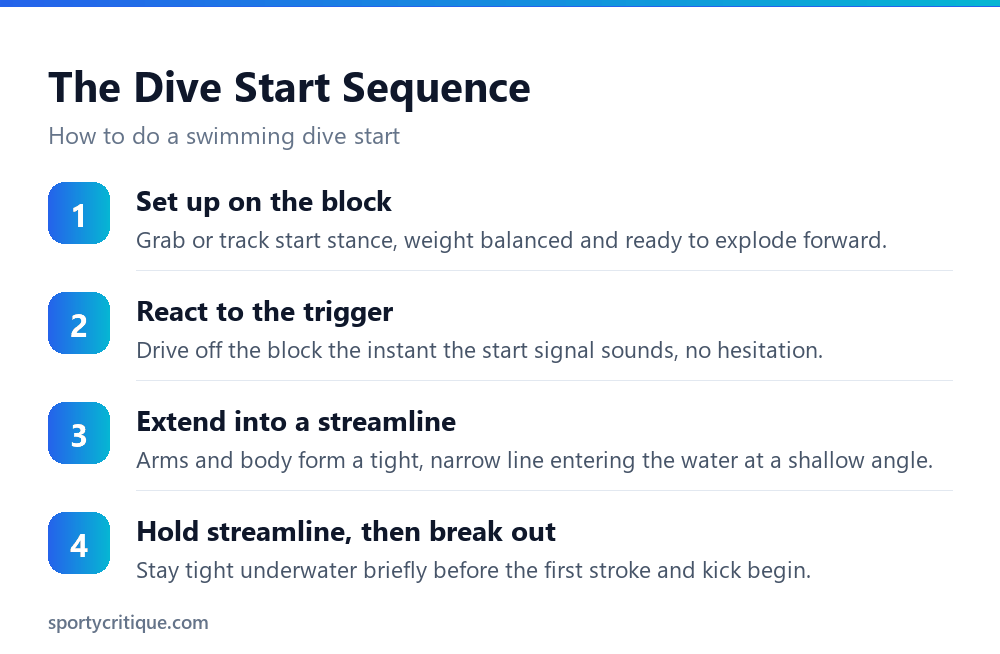
Learning how to do a swimming dive start begins with a stable stance on the block, either a grab start or a track start, reacting explosively to the starting signal, and extending into a tight streamline position that enters the water at a shallow angle rather than diving too steep or too flat. Holding that streamline briefly underwater before breaking out into the first stroke preserves the speed the dive generated rather than losing it to unnecessary drag or an early, premature stroke.
The dive start is often the fastest a swimmer moves during an entire race, faster than any swimming stroke itself, which makes it a disproportionately important skill relative to how little time it actually takes. A clean, well-executed start can meaningfully affect a race’s outcome before a swimmer has even taken their first stroke.
- →The dive start is typically the fastest phase of an entire race, faster than swimming itself
- →Track start and grab start are the two main stance options, with track generally reacting faster
- →Entry angle matters more than raw jump height for preserving speed into the water
- →Holding a tight streamline underwater before breaking out extends the start’s speed advantage
- →Reaction time to the starting signal is a trainable skill, not purely fixed reflexes
Table of Contents
Grab Start vs. Track Start
A grab start positions both feet at the front edge of the block, side by side, with hands gripping the block’s front edge between or outside the feet, a stance that was standard for decades before largely being overtaken by the track start at competitive levels. A track start instead staggers one foot forward at the block’s edge and one foot back, similar to a sprinter’s starting stance in track and field.
The track start generally allows a faster initial reaction and more powerful forward drive for most swimmers, since the staggered foot position mimics a natural sprinting motion more closely than the grab start’s parallel foot placement. This is why the track start has become the dominant choice at competitive levels, though some swimmers still prefer and successfully use a grab start based on individual body mechanics and comfort.
💡 Pro tip: Trying both stances during practice starts, rather than assuming the more popular track start automatically suits every swimmer, helps identify which stance actually produces better reaction time and power for a specific individual’s body and strength profile.
Reacting to the Starting Signal
The moment between the starting signal and the swimmer’s first movement off the block is pure reaction time, and while some of this ability is influenced by natural reflexes, dedicated practice specifically drilling the reaction-to-movement sequence does measurably improve response speed over time for most swimmers.
⚠️ Watch out: A false start, moving before the actual signal, results in disqualification under most competitive rules, and this risk is exactly why practicing controlled, disciplined reaction rather than trying to anticipate or guess the timing of the signal matters more than shaving fractions of a second through risky anticipation.
Entry Angle: Not Too Steep, Not Too Flat
Entering the water at too steep an angle drives a swimmer too deep, wasting time and energy returning to a proper swimming depth, while entering too flat, essentially a belly-flop-style entry, creates excessive drag and surface disturbance that slows the swimmer immediately on contact with the water. The ideal entry angle threads between these two extremes, entering at a relatively shallow but controlled angle that carries forward momentum smoothly into the water.
This entry angle is controlled primarily through body position and arm extension at the moment of leaving the block, not through a separate, conscious adjustment made mid-air during the brief flight phase. Getting the takeoff angle right from the block is what actually determines entry angle, since there’s very little time or ability to meaningfully adjust body position once airborne.
Holding the Streamline
A tight streamline position, arms fully extended overhead with hands stacked and head tucked between the arms, minimizes drag as the body travels underwater immediately after entry, preserving the speed generated by the dive itself for as long as possible before that speed naturally decays and a swimmer needs to begin their first stroke and kick.
Breaking the streamline too early, starting to stroke or kick before the dive’s forward momentum has meaningfully decayed, wastes the speed advantage the dive created in the first place. Breaking out too late, holding the streamline well past the point where its speed has already dropped below normal swimming speed, costs time in the opposite direction. Finding the correct timing for a specific swimmer’s dive power and body type takes deliberate practice and often coaching feedback.
Common Dive Start Mistakes
- ✓React to the actual starting signal, not an anticipated guess at its timing
- ✓Enter the water at a controlled, shallow angle rather than too steep or too flat
- ✓Hold a tight, fully extended streamline immediately after entry
- ✓Time the breakout from streamline to when dive speed has decayed to normal swimming speed
- ✕Anticipating the start signal and risking a disqualifying false start
- ✕Diving too steep, wasting time returning from excessive depth
- ✕Entering too flat, creating a belly-flop-style entry with excessive drag
- ✕Breaking streamline too early or holding it well past its useful speed advantage
Relay Starts: A Different Timing Challenge
A relay start, where a swimmer launches off the block based on their incoming teammate’s approach rather than an external starting signal, requires an entirely different kind of timing skill, anticipating exactly when the incoming swimmer will touch the wall rather than reacting to a fixed, external cue.
This timing carries real risk in the opposite direction from a standard start’s false-start risk: leaving too early results in disqualification for an early takeoff, while leaving too late wastes valuable time waiting unnecessarily after the incoming teammate has already touched. Relay-specific practice, timing takeoffs against a teammate’s actual approach repeatedly, develops this distinct skill separately from standard individual race starts.
Building Start Practice Into Training
Dedicated start practice, repeating the full sequence from block setup through streamline breakout repeatedly in isolation, develops this skill far more effectively than only practicing starts as an incidental part of full-race simulations. Since the start happens only once per race, it gets proportionally less repetition than actual swimming technique unless a coach specifically schedules dedicated start-focused practice sessions.
Video review of start practice, watching recorded footage specifically for entry angle, streamline tightness, and breakout timing, helps identify technical issues that are difficult for a swimmer to feel or assess in real time during the actual execution of a fast, brief movement sequence.
Arm and Hand Position on the Block
In a track start, hands typically grip the front edge of the block or rest just behind it, positioned to drive the arms forward explosively the instant the signal sounds rather than needing to first swing them into position from a resting stance. This head start on arm movement contributes meaningfully to the track start’s generally faster overall reaction compared to some grab start variations.
The arms should swing forward and up in coordination with the legs driving off the block, arriving at full extension right around the moment of water entry rather than fully extending too early mid-flight or too late after entry has already begun. This coordination between arm swing and leg drive is a specific timing detail that separates a smooth, efficient start from one that looks rushed or disjointed.
Backstroke Starts: A Different Setup Entirely
Backstroke starts happen from the water rather than a standing dive off the block, with swimmers gripping the wall or specialized backstroke starting handles before pushing off explosively at the signal. This start shares the same underlying principles of explosive power and a controlled entry angle, but the starting position and initial movement mechanics are different enough that they require separate, dedicated practice rather than assuming skills from a standing dive start transfer directly.
The underwater phase following a backstroke start, including a dolphin kick sequence before surfacing, has its own specific rules limiting how far a swimmer can travel underwater before breaking the surface, a regulation that doesn’t apply in the same way to starts in other strokes. Understanding this distinct rule set matters for any swimmer training backstroke starts specifically.
Introducing Dive Starts to Younger Swimmers
Many youth swim programs delay teaching a full racing dive start until a swimmer demonstrates solid water comfort and basic swimming competency, since diving into water, especially in shallower competition pools, carries real safety considerations that need to be respected before introducing the full-speed, competitive version of the skill.
Progressive teaching methods, starting with a seated or kneeling entry before advancing to a standing dive, and practicing in appropriately deep water under close supervision, build the skill safely over time rather than rushing a younger or less experienced swimmer directly into a full-speed standing dive start before they’re physically and mentally ready for it.
Starting Block Features Worth Understanding
Modern competition starting blocks often include an adjustable rear kick plate or wedge, specifically supporting the back foot in a track start stance and allowing a swimmer to push off with more power than a flat block surface alone would provide. Not every pool or facility has this feature, so a swimmer training primarily at a facility with kick plates should specifically practice starts without one before competing at a venue that lacks this equipment.
Some blocks also include built-in electronic timing and false-start detection systems, sensitive enough to detect a swimmer’s weight shifting off the block before the actual signal, which is a specific reason why disciplined, non-anticipatory reaction matters even more at competitive levels using this kind of sensitive detection technology.
Frequently Asked Questions
What’s the difference between a grab start and a track start?
A grab start places both feet parallel at the block’s edge; a track start staggers one foot forward and one back, similar to a sprinter’s stance. Track starts generally allow faster reaction and more powerful drive for most swimmers.
How do I avoid diving too deep off the block?
Control your entry angle through body position and arm extension at takeoff rather than a steep, high jump. A shallower, more controlled trajectory prevents excessive depth on entry.
How long should I hold my streamline after diving in?
Until your dive-generated speed decays to roughly your normal swimming speed, at which point breaking out into your first stroke and kick becomes the faster option. This timing takes practice to feel accurately.
Can I improve my reaction time to the starting signal?
Yes. While some reaction ability is influenced by natural reflexes, dedicated practice drilling the reaction-to-movement sequence measurably improves response speed for most swimmers over time.
What happens if I false start?
Moving before the actual starting signal typically results in disqualification under most competitive rules, which is why disciplined reaction rather than anticipation matters more than shaving fractions of a second.
Is a relay start different from a regular race start?
Yes, significantly. A relay start requires timing your takeoff to an incoming teammate’s approach rather than reacting to an external signal, a distinct skill that needs separate, dedicated practice.
The dive start rewards precise technique and dedicated practice far more than raw athleticism alone, and swimmers who invest specific attention into block stance, reaction, entry angle, and streamline timing consistently gain a real, measurable edge before a single stroke of the actual race has even happened.
None of these details need to feel overwhelming when practiced one at a time. Working through block stance, reaction, entry angle, and streamline separately, then combining them gradually, builds a start that holds up reliably under real race pressure rather than falling apart the first time nerves or unfamiliar equipment enter the picture.
As an Amazon Associate, we earn from qualifying purchases through links on this page.