Best Indoor Basketballs for Hardwood Gym Floors: Composite Leather Grip Chemistry, Channel Depth, Cushion Core Technology, and Air Retention

Stepping onto a freshly buffed maple hardwood gym court reveals the massive tactile disparity between cheap recreational rubber balls and championship-tier indoor basketballs. A high-performance indoor ball feels soft yet responsive, conforms slightly to the pads of your shooting fingers, produces an unmistakable muted thud against the hardwood, and rewards crisp jump shots with consistent backspin rotation. In contrast, improper basketballs slip through sweat-slicked fingers, bounce erratically off the back iron, and lose their shape through uneven carcass winding.
Selecting the best indoor basketball for gym use requires evaluating composite leather polymer chemistry, carcass winding tension, channel depth mechanics, and bladder pressure stability. When handling competitive play under gymnasium lights, understanding the exact structural layers that separate recreation balls from high school and collegiate competition equipment transforms your dribble rhythm and shooting consistency.
Table of Contents
Material Chemistry: Microfiber Composite vs Genuine Horween Leather
For decades, professional leagues insisted on genuine full-grain leather game balls made from premium steerhide. While traditional leather develops exceptional tack after months of rigorous oiling, sweat absorption, and mechanical pounding, raw leather arrives from the factory slick, stiff, and slippery. This reality caused leagues worldwide to adopt engineered microfiber composite covers for high school, collegiate, and recreational play:
Microfiber Matrix Structure: Advanced composites consist of woven microfiber matrices impregnated with flexible polyurethane resins. These microfibers create microscopic capillary networks that channel moisture away from the surface during intense gym sessions. When players’ palms become drenched in sweat during fourth-quarter play, the composite cover absorbs the moisture into its upper matrix rather than allowing slick liquid barriers to coat the surface.
Pebble Embossing Geometry: The exterior surface of a top-tier basketball features thousands of uniform micro-pebbles per square inch. Premium balls employ thermo-embossed, high-definition pebble patterns that maximize mechanical friction against the epidermal ridges of the shooter’s fingers. Substandard balls feature shallow, stamped pebbling that quickly wears down to slick patches at the primary touch points.
Instant Out-of-the-Box Grip: Unlike genuine leather that requires a prolonged conditioning period, composite covers deliver game-ready touch on day one. Microfiber leather offers uniform density and elasticity across all panels, ensuring identical rebound dynamics regardless of which panel contacts the court floor.
Top Indoor Basketballs for Hardwood Courts: Technical Comparison Matrix
| Basketball Model | Cover Material & Chemistry | Carcass & Core Architecture | Channel Design & Width | Bladder & Pressure Retention | Amazon Recommendation |
|---|---|---|---|---|---|
| Wilson Evolution Game Ball | Microfiber composite with moisture-wicking channels | Cushion Core carcass with low-density sponge rubber | Laid-in composite pebbling channels (wide spec) | Butyl rubber bladder with pressure-lock valve | Check Wilson Evolution Price (Best Overall Indoor Game Ball) |
| Spalding TF-1000 Legacy | Exclusive ZK microfiber composite leather | Advanced sponge rubber carcass with nylon winding | Deep-grooved pebble channels for finger indexing | Rotational balanced butyl bladder | Check Spalding TF-1000 Price (Best High School Competition Ball) |
| Molten BG4500 FIBA | Premium polyurethane synthetic leather with textured grain | Dual-layer foam cushioning backing structure | 12-panel FIBA signature flat-seam layout | High-density butyl bladder with nylon reinforcement | Check Molten BG4500 Price (Best International Standard Ball) |
| Baden Elite Pro | Top-grade microfiber composite with stealth valve system | Cushion Control Technology with symmetrical carcass | Wide recessed channels with continuous pebbling | Pure butyl bladder with balanced weight distribution | Check Baden Elite Price (Smoothest True-Spherical Bounce) |
| The Rock by Anaconda Sports | C3 composite leather with deeply embossed pebble | Multi-ply poly-cotton carcass reinforcement | Patented deep double-grooved channel system | Heavy-duty butyl bladder with vulcanized core | Check The Rock Price (Longest Lasting Hardwood Grip) |
Internal Architecture: Carcass Windings and Cushion Core Layers
The external cover of a basketball accounts for only a fraction of its handling characteristics. Beneath the composite skin lies a multi-layer engineering system responsible for structural integrity, rebound dampening, and true spherical shape retention:
The Air Bladder: The central bladder contains the pressurized air volume. High-end indoor balls use butyl rubber bladders formulated with high chemical density. Butyl bladders display dramatically lower air permeation rates than natural latex bladders, holding target pressure (7.5 to 8.5 PSI) for months without noticeable pressure loss. To eliminate wobble during flight, manufacturers like Baden and Wilson integrate counter-balanced valve housings that offset the minor mass imbalance of the inflation needle stem.
Filament Windings: Surrounding the bladder are thousands of yards of high-tensile nylon and polyester filaments wound in overlapping radial patterns. These carcass windings restrict bladder expansion, maintaining exact spherical circumference tolerances (29.5 inches for official Size 7 men’s balls) under repetitive impact loads. Proper winding tension ensures that the ball does not distort into an egg-shaped ellipsoid when bounced hard against the floor or backboard.
Cushion Core Sponge Rubber Layer: Pioneered by Wilson in the Evolution series, the Cushion Core layer introduces a low-density cellular sponge rubber casing between the nylon filament windings and the outer composite panels. This foam stratum gives the ball its signature soft feel upon catch-and-shoot transitions. When a shooter drives their fingers into the ball during the gather, the cushion compresses beneath the grip, enlarging the contact zone and giving the shooter greater rotational leverage for rapid flick releases.
Channel Depth and Seam Dynamics: Release Mechanics and Ball Control
The black channels separating a basketball’s panels are not merely decorative outlines; they represent critical functional interfaces for fingertip indexing, crossover control, and spin stabilization:
Laid-In Composite Channels vs Molded Rubber: Budget basketballs employ simple extruded black rubber channels molded directly into the carcass. These smooth rubber strips become slick when exposed to hand sweat, disrupting finger release if a shooter catches the ball awkwardly across a seam. Premium models like the Wilson Evolution Game Basketball replace raw rubber with laid-in textured composite strips that offer the exact same moisture-wicking pebbling as the primary panels. This continuous grip texture ensures 100% surface tackiness across the entire sphere.
Channel Width and Recess Profile: Channel depth preferences vary among guards and post players. Wide, deeply recessed channels (featured prominently on the Spalding TF-1000 Legacy and The Rock) allow players with smaller hands to securely index their fingertips into the crevices, assisting with one-handed palming and violent crossover handles. Conversely, the 12-panel layout of the Molten BG4500 utilizes narrower, flatter seam channels, providing a consistent surface texture that international guards prefer for rapid catch-and-release shooting.
Rotational Aerodynamics: Clean backspin stabilizes a basketball’s flight path through the air. As the ball rotates at two to three revolutions per second toward the rim, deep channels create minor boundary layer turbulence that stabilizes trajectory against gymnasium airflow drafts, while producing that crisp visual spin rotation that shooters rely on to judge release accuracy.
Inflation Standards and Gym Temperature Physics
Proper inflation pressure is essential to extract optimal performance from an indoor basketball. Even an elite composite ball behaves like a brick or a dead sponge if the internal pressure drifts outside official specifications:
The 7.5 to 8.5 PSI Window: Official NFHS and NCAA regulations dictate inflation between 7.5 and 8.5 PSI. At 8.0 PSI, a quality composite ball yields just enough under thumb pressure to engage the cushion core while retaining crisp elasticity. Over-inflating beyond 9.0 PSI crowns the panels outward, reducing channel depth, creating harsh rim rebounds, and stressing the internal filament windings.
Thermal Expansion on Hardwood Courts: Gymnasium air temperatures often vary by fifteen to twenty degrees between morning practice and packed evening game environments. According to the ideal gas law, pressure drops roughly one PSI for every ten-degree Fahrenheit drop in ambient temperature. If a ball is inflated inside a warm equipment room and brought into a cold gym, it will feel sluggish and soft. Always check pressure using a digital pressure gauge directly on the court floor before warming up.
The Drop Test Protocol: In the absence of a pressure gauge, perform the standard referee bounce assessment: hold the ball at shoulder height with the bottom of the ball at 72 inches (six feet) above the hardwood. Release the ball cleanly without downward force. A properly inflated regulation basketball should bounce back up to the waist or beltline, reaching between 49 and 54 inches measured to the top of the ball.
Detailed Evaluations of the Best Indoor Basketballs
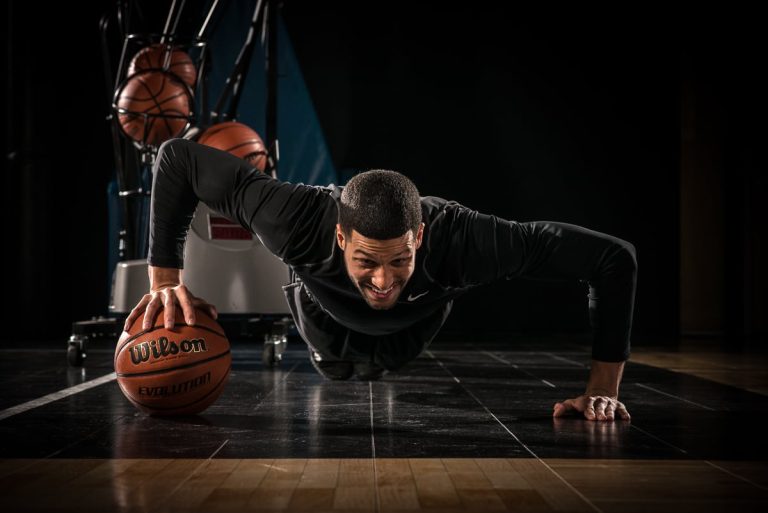
1. Wilson Evolution Game Basketball: The unquestioned king of North American gymnasium courts. The Wilson Evolution features a proprietary microfiber composite cover paired with patented Cushion Core technology, creating the softest, most compliant touch in basketball. Its laid-in composite channels maintain uniform pebble texture from seam to seam. For high school athletes, adult leagues, and gym open-runs, the Evolution delivers unmatched shooter comfort and grip reliability.
2. Spalding TF-1000 Legacy: The longtime benchmark for varsity high school state tournaments. The TF-1000 Legacy utilizes ZK composite leather designed specifically for elite moisture management. Its slightly firmer carcass winding and deeper channel contours cater to power guards and wings who demand sharp, crisp feedback during rapid dribble combinations and tight spin passes.
3. Molten BG4500 FIBA Approved: The official competition ball for FIBA international championships, Olympic qualifying tournaments, and European professional leagues. Featuring Molten’s signature 12-panel design with dual-tone contrast coloring, the BG4500 offers exceptional visual tracking for both shooters and spectators. Its flatter seam channels require strict shooting form discipline, making it the preferred training tool for serious competitive players aiming for international standards.
4. Baden Elite Pro Game Ball: Renowned among shooting coaches for its symmetrical carcass construction and stealth recessed valve system. Baden eliminates the subtle weight irregularities common around traditional inflation valves, producing a ball that rotates with perfect spherical balance. The microfiber composite cover provides a tacky, dry-hand feel that excels during high-intensity collegiate training sessions.
5. The Rock Indoor Basketball by Anaconda Sports: Legendary among east-coast tournament directors and university programs, The Rock features a deep-pebbled C3 composite leather shell that refuses to wear out. The double-pebbled channel construction provides extraordinary fingertip traction that holds up under years of continuous pickup games on wood floors.
Maintenance Protocols: Protecting Indoor Composite Leather
A championship-level indoor basketball is a precise piece of sports equipment that requires disciplined maintenance to protect its cellular composite matrix:
Strict Hardwood-Only Rule: Never allow an indoor composite ball to touch outdoor asphalt, concrete, or chain-link fencing. Outdoor surfaces act as high-grit abrasives that peel the microfiber coating within minutes, leaving smooth, bald patches that ruin ball rotation.
Damp Cloth Cleaning: Over weeks of play, hardwood floor dust, shoe rubber residues, and skin oils lodge inside the micro-pebble recesses. Clean your ball every two weeks by wiping it down with a soft microfiber cloth lightly moistened with clean warm water. Never apply soaps, alcohol wipes, leather detergents, or chemical degreasers, which break down the soft polyurethane binders in the composite cover.
Moistened Inflation Needle Insertion: Always lubricate the metal inflation needle with a drop of water or silicone valve oil before inserting it into the bladder. Inserting a dry, burred needle can nick the inner rubber flap of the valve, creating a slow, irreversible air leak that ruins an expensive game ball.
Regulatory Specifications: FIBA vs NCAA vs NFHS Ball Standards
Understanding which governing body sanctions your league dictates specific dimensional and rebound standards that equipment managers must respect:
NFHS (National Federation of State High School Associations): Requires the official NFHS Authenticating Mark stamped into the composite cover. Specifications mandate a circumference between 29.5 and 30.0 inches for boys (Size 7) and between 28.5 and 29.0 inches for girls (Size 6), with weight ranges of 20 to 22 ounces. The Wilson Evolution and Spalding TF-1000 Legacy carry permanent NFHS stamps, ensuring eligibility for state tournament competition.
NCAA Men’s and Women’s Basketball: Mandates strict coefficient of restitution (COR) testing. When dropped onto an approved maple hardwood floor, the ball must rebound within tight vertical thresholds, maintaining a uniform bounce profile across twelve distinct impact points. The Wilson Solution and Evolution platforms are engineered specifically to comply with NCAA moisture absorption guidelines during tournament play.
FIBA (International Basketball Federation): Imposes the distinctive 12-panel cover construction seen on the Molten BG4500. FIBA regulations enforce rigorous scuff resistance and abrasion cycle tests, requiring balls to endure 20,000 consecutive wall impacts at 25 miles per hour without seam delamination, air leakage, or bladder displacement.
Hardwood Floor Finish Interactions: Polyurethane vs Conversion Varnishes
The friction generated by an indoor basketball is fundamentally an interfacial interaction between the composite cover and the gym floor coating. Modern gymnasium floors typically feature either solvent-based oil-modified polyurethane or high-solids waterborne polyurethane coatings:
Oil-Modified Polyurethane Floors: These traditional amber-toned gym finishes offer high mechanical resilience and a slightly tacky surface profile. Microfiber composite covers with Cushion Core foam layers interact with oil-modified polyurethanes by conforming tightly during rapid crossover dribbles, producing exceptional traction without skidding.
Waterborne Polyurethane and Swedish Conversion Varnishes: Common in newly renovated collegiate facilities, waterborne coats cure to an ultra-hard, crystal-clear sheen. These surfaces are slicker and more prone to static dust attraction. In environments treated with waterborne polyurethanes, basketballs with deeper, laid-in pebble channels like The Rock and Wilson Evolution provide vital tactile edges, allowing players to control the ball securely even when light atmospheric gym dust settles onto the court plane.