Best Badminton Overgrip and Grip Tape: Tacky vs. Towel Compared


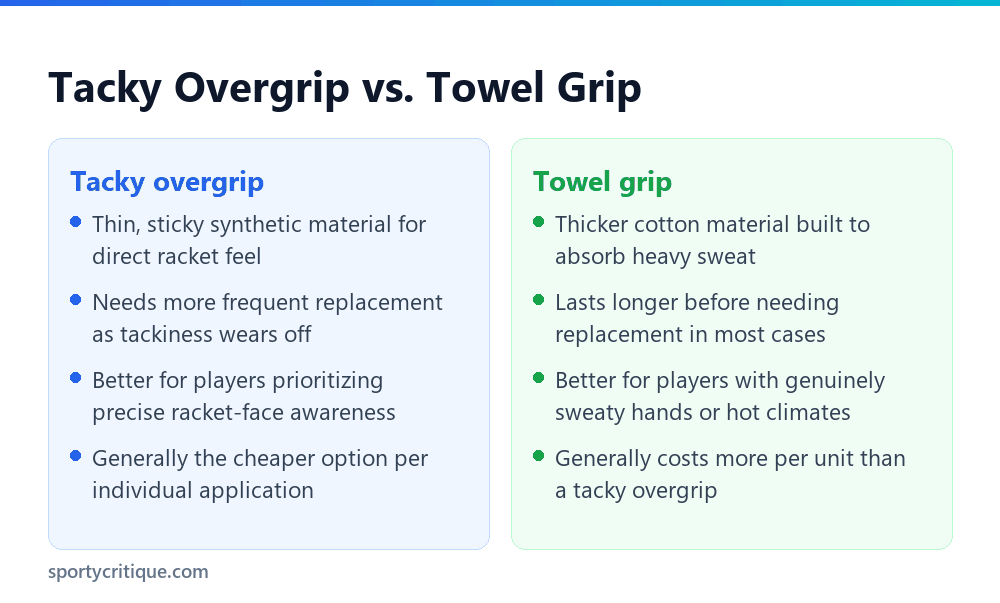
For most players choosing the best badminton overgrip, a tacky option like the Yonex Super Grap suits most badminton players, offering a thin, sticky surface that provides direct racket-face feel and precise control, though they need more frequent replacement. Players with truly heavy hand sweat or those playing in consistently hot, humid conditions do better with a towel grip like the Yonex Towel Grip, a towel-style design made to absorb sweat and maintain a secure hold over a longer play session. Budget-conscious players can look at the perforated Senston pack, which the listing describes as anti-slip and absorbent, at a lower price point.
Overgrip choice is one of the cheapest, most frequently replaced pieces of badminton equipment, yet it directly affects racket control and comfort every single time a player picks up their racket. Understanding the real difference between tacky and towel grip types, rather than choosing purely by brand recognition, leads to a more satisfying match between equipment and actual playing conditions.
Table of Contents
Racket Grip Size & Tension Calculator
Dial in exact grip circumference and bevel alignment to prevent wrist fatigue.
- →Tacky overgrips offer direct racket feel and precise control, in packs priced per grip
- →Towel-style grips are designed to absorb sweat for heavy-sweating players
- →Hand sweat level and climate matter more to this choice than skill level or price alone
- →Buying in bulk packs reduces per-unit cost for players who replace grips frequently
- →Application technique affects grip performance as much as the specific product chosen
What an Overgrip Actually Does
An overgrip wraps around a racket’s existing base grip, providing a fresh, replaceable surface that a player can swap out regularly without needing to replace the entire racket handle underneath, which would be a far more involved and expensive process than simply reapplying a new overgrip layer.
⚠️ Watch out: Playing with a worn, slick overgrip that’s lost its original tackiness or absorbency increases the risk of the racket slipping in hand during a fast, sweaty rally, a specific and avoidable safety and performance issue that a simple, inexpensive overgrip replacement resolves immediately.
Tacky vs. Towel: What Actually Differs
Tacky overgrips use a thin, sticky synthetic material that provides direct feedback from the racket face through the hand, a quality many players specifically value for precise shot control and racket-face awareness during technical shots requiring fine touch.
Towel-style grips use a more absorbent, textured surface designed to handle heavy sweat over an extended play session, trading some of the tacky grip’s precise feel for meaningfully better moisture management, a worthwhile tradeoff for players whose hands sweat heavily enough to compromise a tacky grip’s hold partway through a long match.
4 Real Options, Compared
📊 Note: The two Yonex Super Grap options offer the same tacky formula at different pack sizes, making the 12-pack the more economical choice specifically for players who replace grips frequently enough to benefit from the lower per-unit cost that bulk buying provides.
Application Technique Matters
Wrapping an overgrip with slight, consistent tension and a small overlap between wraps, rather than wrapping loosely or with inconsistent overlap, produces a smoother, more secure final surface that performs noticeably better than a rushed or careless application regardless of which specific product is being applied.
💡 Pro tip: Starting the wrap from the bottom of the handle and working upward, finishing with the included adhesive tab or a small piece of separate tape to secure the top edge, is a common technique, and the instructions that come with a specific product are worth following.
Choosing the Right Grip
- ✓Choose tacky overgrips for precise racket-face feel
- ✓Choose towel grips specifically for heavy hand sweat or hot, humid playing conditions
- ✓Buy in bulk if you replace grips frequently, for a better per-unit cost
- ✓Apply with consistent tension and slight overlap for the best final result
- ✕Continuing to play on a worn, slick grip that’s lost its original tackiness or absorbency
- ✕Choosing a towel grip purely for feel without actually needing its extra sweat absorption
- ✕Wrapping loosely or with inconsistent overlap, producing an uneven final surface
- ✕Assuming grip type matters less than racket choice for overall playing comfort
How Often to Replace an Overgrip
A tacky overgrip used in regular, frequent play typically needs replacement every few weeks to a couple of months, depending on play frequency and individual hand sweat, while a towel-style grip may wear differently, so check it regularly for flattening, fraying, or loss of absorbency.
Checking for visible thinning, a slick feel replacing the original tackiness, or fraying edges gives a clearer replacement signal than relying purely on a fixed time-based schedule, since actual wear depends heavily on how frequently and intensely a specific player actually uses their racket.
Can You Combine Grip Types?
Some players layer a thin tacky overgrip directly over a towel base grip, attempting to combine the towel’s sweat absorption with the tacky layer’s precise surface feel, though this combination adds bulk to the handle that not every player finds comfortable or worth the added thickness.
Experimenting with this layered approach during practice sessions, rather than committing to it for an important match without any prior testing, lets a player determine whether the added bulk and combined feel actually suits their grip and hand size before relying on it in a genuinely important competitive situation.
Grip Thickness and Racket Feel
Adding an overgrip increases the handle’s overall circumference slightly, a detail that matters more for players with smaller hands or a preference for a very thin grip, since even a single thin overgrip layer noticeably changes how a racket feels compared to the bare base grip underneath.
Players who prefer a thinner handle sometimes choose to skip an overgrip entirely and replace the base grip directly instead, though this requires more involved replacement work than simply wrapping a new overgrip layer, making overgrips the more practical, lower-effort choice for most players despite the small thickness tradeoff involved.
Color and Cosmetic Considerations
Overgrips come in a wide range of colors, a purely cosmetic choice for most players, though some competitive players specifically choose darker colors that show less visible dirt and sweat staining over an extended period of regular use compared to lighter, more easily soiled colors.
Team or club-specific color requirements occasionally apply at certain organized levels, similar to equipment color rules covered in other racket sport content on this site, making it worth checking any team-specific requirements before assuming personal color preference is the only factor to consider.
Storage and Humidity Effects on Overgrips
Storing a racket in a hot car or an excessively humid environment can degrade an overgrip’s material faster than normal use alone, since both tacky and towel-style grip materials respond poorly to extreme heat and moisture exposure outside of actual gameplay conditions.
Keeping a racket in a proper bag or case rather than leaving it exposed to direct sunlight or extreme temperature swings between uses extends overgrip life meaningfully, a simple habit that costs nothing but protects an investment that otherwise needs replacing more frequently than necessary.
Using Badminton Overgrips on Other Racket Sports
Many overgrips marketed for badminton, including several options in this comparison, work equally well on tennis, squash, and pickleball rackets and paddles, since the underlying material technology and application method don’t differ meaningfully between these different racket sport categories.
A player active in multiple racket sports can often standardize on one preferred overgrip product across all their equipment, simplifying purchasing decisions and building a consistent, familiar feel across different rackets and paddles rather than learning and adjusting to a different grip feel for each specific sport separately.
Simple Habits That Extend Grip Life
Wiping down an overgrip with a dry cloth after particularly sweaty sessions, rather than letting moisture sit and soak into the material until the next use, helps preserve both tackiness and absorbency longer than leaving a damp grip to dry naturally and slowly between sessions.
Rotating between two rackets with different overgrips, when a player owns multiple rackets already for other reasons, lets each individual grip dry out more fully between uses, a minor but genuinely helpful side benefit for players who already carry a backup racket for other practical reasons like string breakage protection.
Frequently Asked Questions
Should I use a tacky overgrip or a towel grip?
It depends mainly on hand sweat level and playing conditions. Tacky grips offer more precise feel; towel grips are designed for heavy sweat and hot conditions, so compare pack size and price per grip.
How often should I replace my overgrip?
Every few weeks to a couple of months for regular play, though checking for visible thinning or loss of tackiness gives a more reliable signal than a fixed schedule alone.
Does application technique really affect grip performance?
Yes. Consistent tension and slight overlap during wrapping produces a smoother, more secure surface than a rushed or inconsistent application, regardless of the specific product used.
Can I combine a towel grip with a tacky overgrip?
Some players do, layering a thin tacky overgrip over a towel base for combined benefits, though this adds handle bulk that not every player finds comfortable.
Is buying overgrips in bulk worth it?
For players who replace grips frequently, yes, since bulk packs typically offer a lower per-unit cost than buying smaller packs repeatedly.
Is a towel grip only for beginners?
No. The choice depends on hand sweat and playing conditions rather than skill level, so a player of any level who sweats heavily has a reason to use one.
Keeping a small stock of spare overgrips on hand, rather than waiting until a current one wears out completely before ordering more, avoids being caught without a replacement right before an important practice or match, a simple bit of preparation that costs almost nothing given how inexpensive these products are relative to a racket itself.
Matching grip type to actual hand sweat level and playing conditions, rather than defaulting to whichever type feels more familiar or came standard on a new racket, gives a more genuinely comfortable and secure hold through every rally, regardless of which specific product ends up being the final choice.
None of these secondary factors, thickness, color, storage habits, or multi-sport use, should overshadow the primary decision covered throughout this guide: matching tacky or towel material to actual hand sweat level and playing conditions first, then fine-tuning the rest based on personal preference from there.
A player who gets this primary decision right rarely needs to think much about overgrips beyond routine replacement, which is exactly the low-maintenance outcome most players actually want from a piece of equipment this inexpensive and this frequently replaced over a full season of regular play.
In the end, this is one of the simplest equipment decisions a badminton player makes, and getting it right pays off in comfort and confidence every single time the racket comes out of the bag for a practice session or a real match.
As an Amazon Associate, we earn from qualifying purchases through links on this page.