How to Pace Yourself in a Swim Race

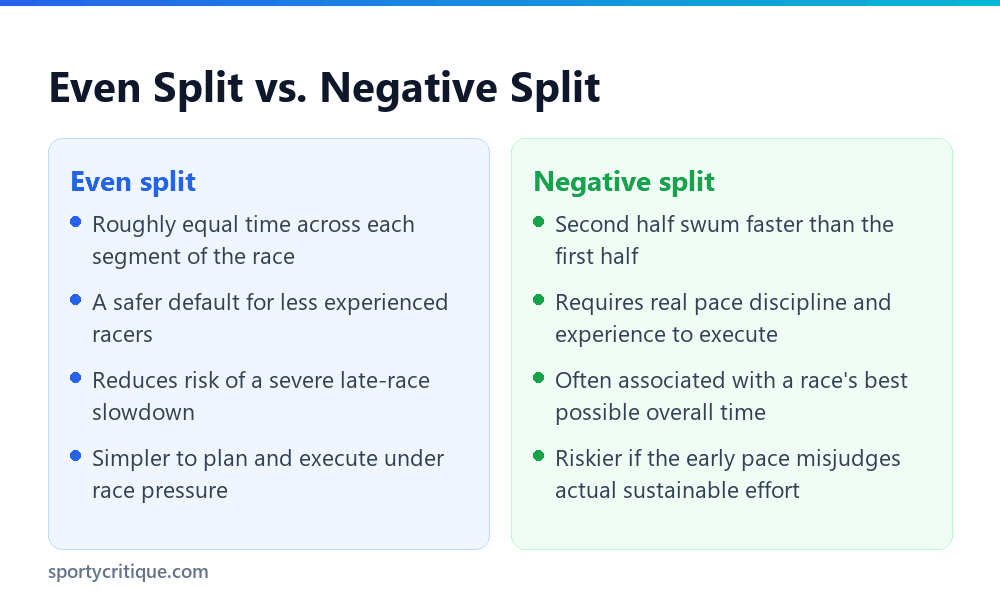
A good swim race pacing strategy generally follows either an even split, roughly equal effort and time across each segment of the race, or a negative split, where the second half is swum faster than the first. Starting too fast and fading badly in the final segment, the most common pacing mistake, undermines a swimmer’s actual finishing time far more than a slightly conservative opening pace ever would. Building accurate pace judgment takes deliberate practice specifically targeting this skill, not just general swimming fitness and speed work.
Pacing is one of the more overlooked aspects of competitive swimming, often receiving far less deliberate practice attention than stroke technique or starts, despite directly determining whether a swimmer’s underlying fitness actually translates into their best possible race result on a given day.
Table of Contents
Endurance Biomechanics Utility
Calculate cadence, foot strike velocity, and biomechanical pacing dynamics.
- →Even splits and negative splits are the two main pacing strategies worth understanding
- →Starting too fast and fading is the single most common and costly pacing mistake
- →Negative splitting generally produces better overall times but requires more pacing discipline
- →Pace judgment is a trainable skill, not something swimmers either have or don’t have naturally
- →Race distance and stroke both affect which pacing approach actually suits a specific race
Even Splitting: The Safer Default
An even split means swimming each segment of a race, whether measured by lap or by a specific distance interval, at roughly the same pace throughout, a straightforward and lower-risk approach that’s easier to plan and execute, particularly for a swimmer still developing accurate pace judgment.
This approach reduces the risk of the severe late-race slowdown that comes from misjudging early pace, making it a sensible default strategy for less experienced racers or for any swimmer attempting an unfamiliar race distance for the first time without established pace benchmarks to reference.
Negative Splitting: The Higher-Reward Approach
A negative split means swimming the second half of a race faster than the first, an approach often associated with a swimmer’s best possible overall time since it requires genuinely holding back controlled effort early rather than accidentally starting too conservatively and simply having energy left over unused at the finish.
⚠️ Watch out: Attempting a negative split without adequate pace judgment experience risks the opposite problem: starting too conservatively out of excessive caution, then being unable to actually accelerate meaningfully in the second half because the early pace wasn’t demanding enough to require any real held-back reserve in the first place.
Why Starting Too Fast Ruins a Race
A swimmer who starts significantly faster than their actual sustainable race pace accumulates excess lactate and fatigue early, leading to a severe slowdown in the race’s final segment that typically costs far more total time than was ever gained during the fast start itself.
This mistake is especially costly because the psychological experience of a strong opening often feels rewarding in the moment, masking the coming consequence until it’s too late to meaningfully correct course during the same race, which is exactly why pace discipline needs to be built and trusted before race day rather than decided in the moment based on how a fast start feels.
💡 Pro tip: Reviewing split times from past races specifically to identify a personal pattern of early-race overpacing, rather than assuming pacing mistakes are random or unpredictable, helps a swimmer recognize and correct a specific, repeated tendency in their own racing habits.
How Distance and Stroke Affect Pacing Strategy
Shorter sprint races, particularly 50-meter events, leave little room for a true pacing strategy in the traditional sense, since the entire race happens at or near maximum effort throughout, making pacing here more about efficient technique under fatigue than the split-based strategy relevant to longer events.
Longer distance events, 400 meters and beyond, benefit most clearly from deliberate even or negative split planning, since there’s enough total race distance for pacing decisions early in the race to meaningfully compound into a significant time difference by the finish, unlike a shorter sprint where pacing strategy has much less room to actually matter.
Common Pacing Mistakes
- ✓Choose even splitting as a safer default until pace judgment is well developed
- ✓Practice negative splitting deliberately before relying on it in an actual race
- ✓Review past race splits specifically to identify personal overpacing patterns
- ✓Match pacing strategy to actual race distance rather than applying one approach universally
- ✕Starting significantly faster than sustainable pace based on race-day excitement alone
- ✕Attempting a negative split without any prior practice or pace judgment experience
- ✕Ignoring past race data that could reveal a repeated, correctable pacing mistake
- ✕Applying the same pacing approach to a 50-meter sprint and a 1500-meter distance race
Practicing Pace Judgment in Training
Broken swims, repeating a race distance in shorter segments with brief rest between each, at a specific target pace, let a swimmer practice and internalize race pace without the full physical and mental fatigue of swimming the complete distance continuously every single practice repetition.
Practicing without looking at a pace clock occasionally, then checking the actual time afterward, trains a swimmer’s internal sense of pace, an underrated skill that becomes valuable during an actual race when constantly checking a pace clock mid-swim simply isn’t practical or reliably possible.
Mental Strategies for Holding Pace
Breaking a long race mentally into smaller segments, focusing on executing one manageable chunk at a time rather than thinking about the full remaining distance all at once, helps a swimmer maintain controlled effort rather than either panicking into an overly fast pace or mentally giving up too early into an overly slow one.
Trusting a pre-planned pacing strategy, rather than making impulsive mid-race adjustments based on how a competitor in an adjacent lane appears to be swimming, keeps a swimmer executing their own prepared plan rather than reacting emotionally to factors that don’t actually reflect their own body’s real, sustainable capacity for that specific race.
Using Split Times as Training Data
Recording split times at regular intervals during both practice and races, every 50 meters for a longer event, for example, builds a personal data set showing exactly where a swimmer’s pace tends to drift, whether that’s a too-fast opening, a mid-race lull, or a final-segment fade.
Comparing these splits across several races reveals patterns that a single race can’t, since one uneven performance might reflect a bad day while a repeated pattern across multiple races points to a genuine, correctable pacing habit worth addressing directly in training.
Turns, Walls, and Pacing
Pool races include a turn every length, and the speed carried off each wall affects overall pace as much as stroke tempo does, meaning a swimmer’s pacing plan needs to account for turn quality and underwater distance, not just the swimming between walls.
Fatigue tends to degrade turn technique before it degrades stroke technique, so a swimmer who practices turns specifically under fatigue, near the end of a hard set, builds the ability to maintain pace through the walls in the final segment of a real race, where sloppy turns quietly cost seconds.
Pacing in Open Water Differs From the Pool
Open water swimming removes walls, lane lines, and a pace clock, which makes internal pace judgment even more important, since a swimmer can’t glance at a split board to confirm they’re on target and has to rely on effort perception alone.
Currents, waves, and drafting behind other swimmers also change what a given effort level actually produces in terms of speed, so open water pacing is better framed around controlled, sustainable effort than around a specific split time target that conditions can easily make unrealistic.
Warm-Up and Race-Day Preparation
A proper warm-up before a race, including a few short, faster efforts, helps a swimmer calibrate how race pace actually feels that day, which makes the early part of the race easier to hold back on instead of simply reacting to adrenaline.
Deciding on a pacing plan before getting behind the blocks, rather than improvising once the race begins, removes one decision from an already high-pressure moment and makes it far more likely the swimmer executes the strategy they actually trained for.
Frequently Asked Questions
What’s the difference between an even split and a negative split?
An even split keeps roughly the same pace throughout a race; a negative split means swimming the second half faster than the first, generally associated with better overall times but requiring more pace discipline.
Why is starting too fast such a common mistake?
A fast start feels rewarding in the moment, but it accumulates excess fatigue that causes a severe slowdown later, typically costing more total time than the fast start ever gained.
Does pacing strategy matter for short sprint races?
Less than for longer races. A 50-meter sprint happens at or near maximum effort throughout, leaving little room for the traditional pacing strategies relevant to longer distance events.
How do I practice pace judgment before a race?
Broken swims at a target pace, and occasionally swimming without checking a pace clock then verifying the actual time afterward, both build accurate internal pace sense over time.
Should I adjust my pace based on what other swimmers are doing during a race?
Generally no. Trusting a pre-planned pacing strategy based on your own actual capacity produces more reliable results than reacting impulsively to a competitor’s pace in an adjacent lane.
Is negative splitting always the better strategy?
Not for every swimmer or every race. It produces the best potential times but requires real pace discipline; a less experienced swimmer often gets more reliable results from an even split instead.
Good pacing is a learnable, trainable skill rather than a fixed trait some swimmers naturally have and others don’t, and deliberate practice specifically targeting pace judgment pays off in race results that more accurately reflect a swimmer’s actual underlying fitness and training.
Age-group and masters swimmers often benefit most from deliberate pacing work, since many enter racing with solid fitness but little formal race-strategy experience, and a few well-chosen practice sets aimed at pace judgment can improve race times faster than another block of general conditioning.
Coaches can speed this up by giving swimmers a specific target split for each set and asking them to guess their time before looking at the clock. The gap between guess and result is the clearest measure of how well a swimmer actually knows their own pace.
Over a season, tracking how that guessing error shrinks gives both swimmer and coach concrete proof that pacing skill is improving, which is more motivating than waiting for a race result that depends on many other variables.
Recovery between races matters for pacing too. A swimmer entered in several events at one meet should plan a slightly more conservative opening in later races, since accumulated fatigue shifts what a sustainable pace actually feels like compared with a fresh morning swim.
Writing the plan down, even as a short note listing target splits and one cue for each segment of the race, helps a swimmer commit to it. A plan that exists only in someone’s head tends to get overridden by adrenaline the moment the starting signal sounds.
After each race, a brief honest review comparing planned splits with actual splits turns every swim into a lesson, and over a full season those small reviews add up to noticeably better judgment about where the limit between controlled and reckless effort actually sits.
Swimmers who treat pacing as a skill worth practicing, not a matter of luck or instinct on race day, are the ones who consistently turn good training into good results.
Swimmers who want a way to practice pace without a pace clock in front of them can try an audible swim metronome such as the waterproof swim tempo trainer ($45.99, checked October 7, 2026), which is listed with tempo, lap, and stroke-per-minute modes. The listing is worth reading for how each mode works, but a beeping reference that clips to a cap or goggle strap gives a swimmer something to hold to between walls.
As an Amazon Associate, we earn from qualifying purchases through links on this page.