Box Lacrosse vs Field Lacrosse Rules: Key Differences


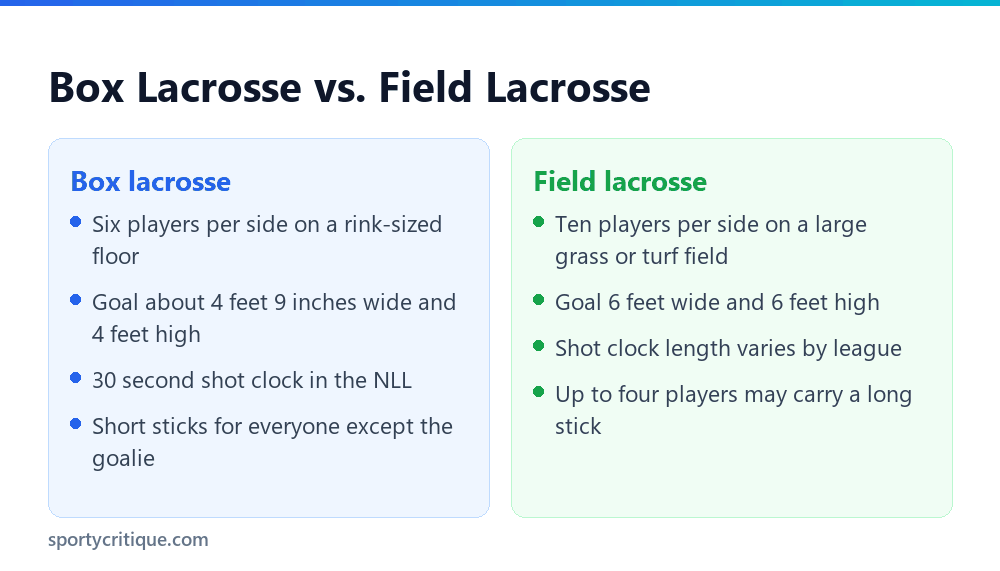
The box lacrosse vs field lacrosse rules differ mainly in space and numbers. Box lacrosse has six players per side on a rink-sized floor with a goal about 4 feet 9 inches wide, while field lacrosse has ten players per side on a field of roughly 110 by 60 yards with a 6 by 6 foot goal. Box uses a 30 second shot clock in the National Lacrosse League, requires short sticks for everyone but the goalie, and allows physical play that field rules limit. Exact rules vary by league, age group, and country.
Lacrosse looks like one sport, but the box and field versions play like cousins. A shooter who dominates in a rink can feel lost on a full field, and a field midfielder used to open space can struggle when every inch of the floor is crowded. Knowing the rules helps parents, new players, and fans follow either game.
Table of Contents
Field Geometry & Kinetic Utility
Calculate field sprint kinetics and velocity dynamics.
- →Box lacrosse is played with six players per side, field lacrosse with ten
- →The box floor is rink sized and enclosed by boards, so play is tight and fast
- →Box goals are smaller, and box goalies wear far more padding
- →Box requires short sticks for everyone except the goalie, while field allows up to four long sticks
- →Rules differ by league and level, so check your own league’s rulebook
A Note on Sources and Leagues
Lacrosse has no single global rulebook. The National Lacrosse League sets box rules for its professional game, and different men’s, women’s, college, high school, and youth organizations set field rules. This guide uses the NLL’s own box versus field explainer for most numbers, and other lacrosse coverage for context. Where details differ between sources or leagues, we say so rather than pick one.
📊 Note: Women’s field lacrosse has its own rule set, with different equipment and contact rules from the men’s game. This guide focuses on men’s box lacrosse compared with men’s field lacrosse.
The Playing Surface
Field lacrosse is played on a grass or turf field. The NLL’s explainer describes a field of about 110 yards by 60 yards, while other coverage describes it as 100 plus yards long and 50 plus yards wide, which reflects that field size varies between leagues.
Box lacrosse is played on a hard floor, often a hockey rink with the ice removed, and enclosed by boards. The NLL describes a floor of about 200 feet by 85 feet. Because the ball stays in play off the boards, stoppages are rarer and play is continuous.
Players on the Floor
Field lacrosse teams put ten players on the field: a goalie, three defenders, three midfielders, and three attackers. Box lacrosse teams put six on the floor: a goalie and five runners.
The smaller number in the box game, on a surface far smaller than a field, means almost no empty space. Players have to create room with quick passes, screens, and short cuts rather than long runs.
Goals and Goalies
A field lacrosse goal is six feet high and six feet wide. A box goal is smaller, listed by the NLL at 4 feet 9 inches wide and 4 feet high. The smaller target changes how shooters think, since they must aim for corners rather than rely on a large gap.
Goalies change too. In field lacrosse, the goalie relies mostly on stick work and wears less protection. Box goalies wear extensive padding, which the NLL compares to hockey goalie gear, because shots at close range come in quickly and often.
Players who want to practice aiming at a smaller target at home can set up a 4 x 4 foot folding steel goal ($169.15, checked October 7, 2026), which is close to box goal size. It is a pricey option, so a cheaper pop-up goal also works for casual practice, but a rigid frame gives a truer feel for rebounds.
Sticks
In field lacrosse, up to four players on the field may carry a long stick, usually the defenders, with the others using short sticks. In box lacrosse, everyone except the goalie must use a short stick.
Stick length limits vary by league. One lacrosse outlet describes field shorts at around 40 inches and box defenders at up to 46 or 48 inches depending on the league. Check your own league’s rulebook before buying equipment.
Shot Clocks and Game Length
The NLL uses a 30 second shot clock in the box game, which starts when a team gets possession. One lacrosse outlet describes the clock as forcing a shot on goal within that time or the opponent gets the ball.
Field lacrosse shot clock rules vary by league and level. The NLL’s explainer cites a range of 52 to 90 seconds, so check the rulebook for the league you actually play in. Both games, according to the NLL, are played in four quarters of 15 minutes.
Substitutions and Positioning
Field lacrosse has positioning rules. The NLL’s explainer says at least four players, including the goalie, must stay in the defensive half and three players must stay in the attacking half, and other coverage describes offside rules in field lacrosse that box lacrosse does not have.
One lacrosse outlet describes box lacrosse as having no offside rule, and the NLL’s explainer says substitutions are made for offensive and defensive possessions, with players able to be on both ends of the floor. When possession changes, the full group on the floor can change with it.
Contact and Penalties
Box lacrosse allows more physical play. One lacrosse outlet says crosschecking is allowed more liberally in box, and fighting is handled with major penalties, as in hockey.
Penalty lengths differ. The NLL lists box minor penalties at 2 minutes, major penalties at 5 minutes, and misconduct as an ejection. Field lacrosse penalties, per the same explainer, include 30 second technical fouls, one minute personal fouls, and three minute major fouls.
⚠️ Watch out: Contact rules vary a lot by age group. Many youth leagues restrict checking and stick contact far more than the professional rules described here, so follow your league’s rules and your coach’s guidance, not what you see on television.
How the Two Games Compare at a Glance
What Each Game Rewards
Box lacrosse rewards quick hands, short passes, and close-range finishing. Players handle the ball in tight spaces, cut off the ball constantly, and take shots from inches away from the defense. Goalies see many more shots at close range.
Field lacrosse rewards speed, vision, and spacing. Midfielders run long distances, attackers work behind the goal, and long poles play a big role on defense. Plays develop over more time and more distance, and a clear shooting lane matters more than a tight corner.
Which Game Suits You?
- ✓Try both if you can, since the skills help each other
- ✓Check your league’s rulebook for stick length and contact rules
- ✓Practice shooting at a smaller target if you want to play box
- ✓Watch a full game of each to see how play flows
- ✕Assume the rules you learned in one game apply in the other
- ✕Buy a stick before checking your league’s length limits
- ✕Copy professional contact levels in youth play
- ✕Expect the same goalie gear for both games
Equipment Differences Beyond the Stick
Both games use a stick, a ball, a helmet, and gloves, but the protective gear leans different ways. The clearest difference is in goal: the NLL says box goalies look much more like hockey goalies, with extensive body padding, while field goalies rely mostly on their stick and wear less protection. For other positions, check your league’s equipment rules.
Footwear depends on the surface. Field lacrosse is played on grass or turf, and box lacrosse on a hard floor, so players usually need shoes suited to each. If your child plays both, check the league’s equipment rules before you buy anything.
Questions Parents Often Ask
Parents new to lacrosse often ask which version is safer. It depends on the league, the age group, and the coaching, not on the version alone. Youth programs in both games usually add contact restrictions and equipment requirements that professional rules do not have, so read your league’s rules and ask the coach how contact is handled.
Another common question is which game to start with. Field lacrosse is more widely offered in many regions, while box lacrosse is easier to find in places with rinks and indoor facilities. Where both are available, a short trial in each is the simplest way to see which one a player enjoys.
Parents also ask whether the skills carry over. Basic stick skills such as cradling, passing, catching, and shooting transfer directly. What changes is decision making: how much space you have, how much time you have, and what you are allowed to do to the player in front of you.
Watching Your First Game
If you are watching a box game for the first time, look for the shot clock and the line changes. Teams swap offensive and defensive units on possession changes, so the players on the floor change constantly. Watch how players use screens to free a shooter in tight space.
When you watch field lacrosse, look at how teams use the whole field. Long poles hold the defense, midfielders run the length of the field, and the attack works around the goal. The pace is steadier, with more build up before a shot.
In both games, pay attention to the goalie. Box goalies face a steady stream of close shots, while field goalies read plays that develop over more distance, and the difference shows in how each position moves and what it takes to play it well.
Crossing Over Between the Two
Many players move between the two games, and coaches often encourage it. Box play sharpens stickhandling in tight spaces and finishing, while field play builds conditioning and spacing. A field player’s dodge, like the split dodge or roll dodge, also appears in box play but with less room to run.
If you are switching, expect an adjustment period. Box players moving to the field often need to learn to use space, and field players moving to box have to learn to play in traffic.
Frequently Asked Questions
How many players are on the floor in box lacrosse?
Six per side: a goalie and five runners.
How many players are on the field in field lacrosse?
Ten per side: a goalie, three defenders, three midfielders, and three attackers.
How big is a box lacrosse goal?
The NLL lists it at 4 feet 9 inches wide and 4 feet high. A field goal is 6 feet by 6 feet.
Is there a shot clock in lacrosse?
The NLL uses a 30 second clock in box lacrosse. Field lacrosse clocks vary by league.
Can you fight in lacrosse?
Box lacrosse handles fighting with major penalties, similar to hockey. Most field leagues do not allow it.
Which is easier to learn, box or field lacrosse?
Neither is easy. Box lacrosse is more crowded and physical, while field lacrosse demands more running and spacing. Many players learn both.
Box and field lacrosse share a ball and a stick, but the differences in surface, numbers, and rules make them feel like different sports. Check your own league’s rulebook, try both if you can, and enjoy the game that suits your style.
As an Amazon Associate, we earn from qualifying purchases through links on this page.