How to Play On-Ball Defense in Lacrosse

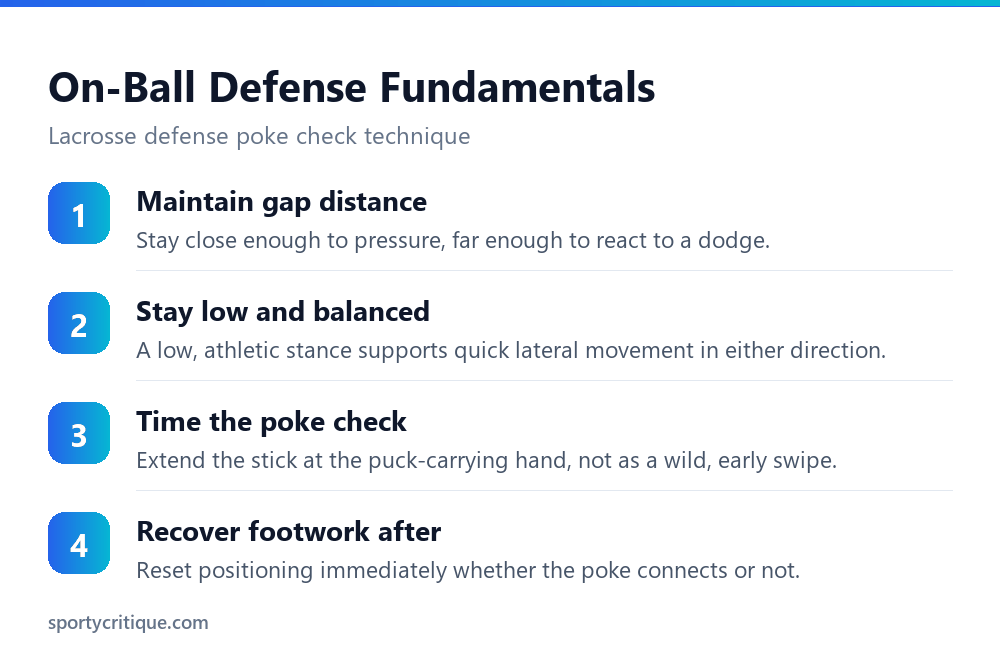
Good lacrosse defense poke check technique combines disciplined gap distance, a low and balanced athletic stance, and a well-timed poke check aimed at the stick’s lower hand rather than a wild, early swipe. Maintaining proper gap distance, close enough to apply pressure but far enough to react to a dodge in either direction, is the foundation that makes everything else, including poke check timing, actually effective rather than a desperate, reactive lunge.
On-ball defense is often reduced to “stick checking” in casual conversation, but the actual skill is built primarily on footwork and positioning, with the poke check serving as one specific tool applied at the right moment rather than the primary defensive action itself. A defender who understands this hierarchy defends far more consistently than one relying mainly on stick skill alone.
- →Gap distance, not stick skill, is the actual foundation of effective on-ball defense
- →A poke check should target the stick’s lower hand, not just swing wildly at the stick generally
- →Staying low and balanced supports quick lateral movement in either direction
- →Footwork recovery after a poke check attempt matters as much as the poke itself
- →Overcommitting to a poke check is a leading cause of getting dodged and beaten wide
Table of Contents
Gap Distance: The Foundation
Gap distance, the space maintained between a defender and the ball carrier, needs to be close enough to apply real pressure and threaten a check, but far enough to give the defender time to react if the ball carrier suddenly changes direction or accelerates into a dodge.
⚠️ Watch out: Playing too tight a gap, crowding the ball carrier aggressively, leaves a defender with no reaction time if beaten off the first move, while playing too loose a gap lets the ball carrier operate with far too much time and space to set up their offensive options unpressured. Finding the correct middle distance is a skill built through repetition, not a fixed universal number.
Stance and Body Position
A low, athletic stance, knees bent, weight centered, and stick held in a ready position, supports quick lateral movement in either direction, which matters more than raw straight-line speed for staying with a ball carrier who can change direction at any moment.
Keeping the stick in an active, ready position, rather than dragging it passively at the side, lets a defender threaten a check at any moment without needing to first reposition the stick before initiating one. This active readiness itself applies pressure on the ball carrier, since they have to account for the check threat continuously, not just when a defender actually attempts one.
Timing the Poke Check
A well-timed poke check targets the ball carrier’s lower hand on the stick specifically, the point of greatest control over the stick, rather than swinging generally at the stick’s head or shaft without a precise target. This precision matters more to actually dislodging the ball than raw check speed or force.
The poke should be a quick, controlled extension of the stick rather than a full-body lunge that commits a defender’s weight and balance toward the check attempt. A poke check that fails while the defender remains balanced allows an immediate recovery; a lunging attempt that fails often leaves the defender completely out of position for whatever comes next.
💡 Pro tip: Practicing poke checks specifically against a live dodger in controlled drills, rather than only against a stationary target, builds the timing sense needed to distinguish a genuine opportunity from a fake or hesitation designed specifically to draw a premature, overcommitted check attempt.
Avoiding Overcommitment
Overcommitting to a poke check, throwing the stick and body weight fully toward the attempt rather than a controlled extension, is one of the most common and costly mistakes in on-ball defense, since a missed overcommitted check leaves almost no time or balance to recover before the ball carrier exploits the resulting opening.
Experienced defenders often deliberately restrain from checking at every available opportunity, recognizing that patient positioning without attempting a check is sometimes the better defensive choice than forcing a check attempt in a situation where the odds of success are actually low.
Common On-Ball Defense Mistakes
- ✓Maintain disciplined gap distance rather than crowding or playing too loose
- ✓Keep the stick active and ready rather than dragging it passively
- ✓Target the lower hand specifically with a controlled, quick poke check
- ✓Stay balanced enough to recover immediately after any check attempt
- ✕Crowding the ball carrier so tightly that a single move beats the defender completely
- ✕Swinging the stick generally at the shaft or head without a precise target
- ✕Overcommitting body weight into a lunging check attempt
- ✕Attempting a check at every opportunity regardless of actual odds of success
Reading the Ball Carrier’s Dodge
Watching a ball carrier’s hips and shoulders, rather than their stick or head, gives a defender the earliest reliable signal of an actual direction change, since the hips and shoulders physically have to commit to a direction before a dodge actually executes, while the stick and head can be used to fake and mislead.
Recognizing common dodge patterns, a split dodge, a roll dodge, a straight bull-rush move, through repeated exposure and film study helps a defender anticipate rather than purely react to an opponent’s move, which is a meaningful advantage over a defender seeing each specific dodge for the first time in every game.
Footwork Recovery
Whether a poke check connects or misses, immediately resetting footwork back into a balanced, ready stance rather than standing still to assess the outcome keeps a defender prepared for whatever happens next in the play, since a ball carrier who shakes off a missed check often continues their attacking move immediately without any pause.
This recovery habit takes deliberate practice to make automatic, since the natural instinct after a check attempt is often a brief pause to see the result, exactly the moment a slower-recovering defender becomes most vulnerable to being beaten completely.
On-Ball Defense Within Team Defense
On-ball defense doesn’t happen in isolation from the rest of a defensive unit; a defender being beaten off the dodge relies on teammates providing slide support and coverage, and understanding this team context affects how aggressively an individual defender can afford to play, knowing help is or isn’t reliably available in a given defensive scheme.
A defender playing a more conservative, patient style of on-ball defense specifically to funnel a ball carrier toward help defense, rather than attempting to win the individual matchup outright through aggressive checking, reflects a more advanced, team-oriented understanding of defensive strategy beyond pure individual technique.
Lift Checks: A Complementary Tool
A lift check, using the defender’s stick to lift the ball carrier’s stick upward and disrupt their grip or shot, offers a different disruption angle than a poke check, particularly useful in tight spaces near the goal where a poke’s forward extension has less room to operate effectively.
Combining both check types in a defender’s overall toolkit, choosing whichever fits a specific situation’s spacing and angle rather than relying on one technique exclusively, builds a more complete and less predictable defensive skill set that’s harder for an offensive player to game plan against over a full game or season.
Combining Stick Checks With Legal Body Positioning
On-ball defense often combines stick-check attempts with legal body positioning, using the defender’s body to cut off angles and limit an offensive player’s driving lanes even when a stick check itself isn’t the primary action in a given moment, a complementary approach covered in more detail in body-checking-specific content on this site.
A defender who relies purely on stick skill while ignoring body positioning cedes an easier path to the goal for a ball carrier willing to simply drive through open space the defender’s positioning failed to close off, regardless of how technically sound that defender’s actual check attempts might be in isolation.
Practicing Against Different Dodge Types
Drilling on-ball defense specifically against each common dodge type separately, rather than only practicing against a generic, undefined offensive move, builds pattern recognition that transfers directly to recognizing and responding to that specific dodge the moment it appears in an actual game situation.
Coaches commonly structure defensive practice around this dodge-specific repetition precisely because reaction speed and correct technique improve faster when a defender has already seen and practiced against a specific move dozens of times, compared to facing a genuinely unfamiliar move for the first time under actual game pressure and consequence.
Conditioning Specific to On-Ball Defense
Lateral quickness and change-of-direction conditioning, shuffle drills and cone-based agility work specifically, translate more directly to on-ball defensive movement than straight-line sprint conditioning alone, since defenders rarely need to simply outrun an opponent in a straight line during actual defensive situations.
Core and lower-body strength also support the low, balanced stance discussed earlier in this guide, since maintaining that stance through a full game or practice requires real muscular endurance that fatigues noticeably by the second half for a defender without adequate underlying conditioning built specifically for this demand.
Frequently Asked Questions
What’s the most important skill in on-ball lacrosse defense?
Gap distance and positioning matter more than stick-checking skill alone. Good footwork and spacing make everything else, including poke check timing, actually effective.
Where should I aim a poke check?
At the ball carrier’s lower hand on the stick specifically, the point of greatest stick control, rather than swinging generally at the stick’s shaft or head.
Why do I keep getting beaten after attempting a poke check?
Overcommitting body weight into the check attempt is a common cause. A controlled, quick extension that keeps you balanced allows immediate recovery if the check misses.
Should I try to check the ball carrier every chance I get?
No. Patient positioning without checking is sometimes the better choice when the odds of a successful check are genuinely low. Overusing checks leads to frequent overcommitment mistakes.
How do I read a dodge before it happens?
Watch the ball carrier’s hips and shoulders rather than their stick or head, since those have to physically commit to a direction before the dodge actually executes.
How does team defense affect individual on-ball defense?
Knowing whether slide support is reliably available affects how aggressively an individual defender can play. Sometimes funneling a ball carrier toward help defense is better than trying to win the matchup alone.
Coaches who break these elements down separately in practice, rather than expecting players to absorb the whole picture at once through scrimmage repetition alone, tend to develop more well-rounded defenders faster than programs relying purely on game-speed learning.
Strong on-ball defense in lacrosse comes from disciplined footwork and positioning far more than aggressive stick work, with the poke check serving as one precise tool applied at the right moment rather than the primary defensive weapon. Defenders who internalize this hierarchy defend more consistently over a full season than those relying purely on stick speed and aggression, building each piece of the overall picture deliberately instead of hoping it all comes together on its own during live games.
None of these pieces work in isolation from each other. Gap control sets up the check opportunity, positioning determines whether that opportunity is a good one, and conditioning determines whether a defender can still execute the fundamentals correctly late in a hard-fought game rather than only in the fresher, less fatigued opening minutes of a matchup.
A defender who commits to this layered approach over a full offseason and season sees the results compound, since each individual improvement, gap control, stance, timing, recovery, and conditioning, reinforces and amplifies the others rather than existing as separate, unrelated skills.
As an Amazon Associate, we earn from qualifying purchases through links on this page.