Best Protective Eyewear for Women’s Lacrosse

Among the best women’s lacrosse goggles, the overall top pick is the STX 4Sight+ S, a widely used, top-rated model balancing protection, visibility, and price. Players specifically struggling with fit issues, a common complaint with lacrosse goggles generally, should consider the STX Focus-S instead, noted specifically for fit quality. Younger players do well with the budget-friendly STX Rookie-S Youth Goggle, while serious, frequently competing players may prefer the premium STX Focus XV-S for its more refined construction.
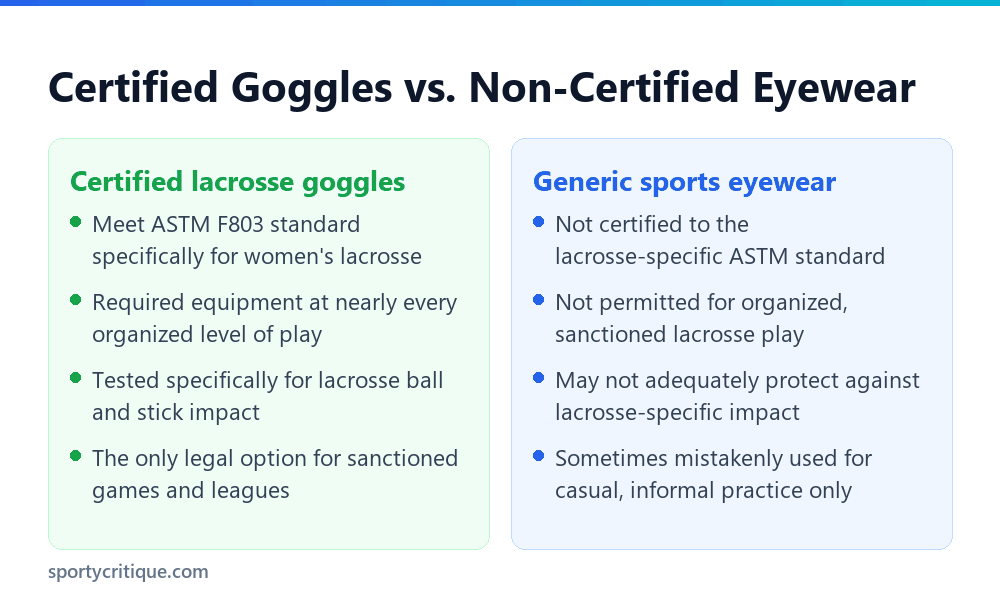
Women’s lacrosse requires ASTM-certified protective eyewear at nearly every organized level of play, a requirement distinct from men’s lacrosse, which uses a full helmet instead. Choosing eyewear that actually meets this specific certification standard, rather than generic sports eyewear that merely looks similar, is a genuine safety requirement, not just a preference.
- →Certified lacrosse goggles meet the ASTM F803 standard specifically tested for lacrosse impact
- →Generic sports eyewear isn’t permitted for organized, sanctioned women’s lacrosse play
- →Fit quality varies meaningfully between models and is worth prioritizing given common complaints
- →Youth players need properly sized youth goggles, not scaled-down adult eyewear
- →Price differences between models mostly reflect fit refinement and construction quality, not certification level
Table of Contents
Why Certification Actually Matters
Women’s lacrosse protective eyewear must meet the ASTM F803 standard specifically developed and tested for lacrosse, a requirement enforced at nearly every organized level from youth leagues through college and professional play, distinct from generic sports sunglasses or safety glasses that might look similar but haven’t been tested against lacrosse-specific impact scenarios.
⚠️ Watch out: Wearing non-certified eyewear, even if it looks protective, is typically not permitted for sanctioned games and can result in a player being unable to participate until compliant, certified eyewear is available. Checking that a specific product explicitly states ASTM F803 certification before purchasing avoids this exact problem.
4 Real Options, Compared
📊 Note: All four options come from STX, a brand with a long-established presence specifically in women’s lacrosse eyewear, though other certified brands exist and are worth comparing directly if a player has a specific fit issue that STX models don’t resolve.
Why Fit Is Such a Common Complaint
Lacrosse goggles sit close to the face and need to stay securely positioned through fast movement, contact, and weather conditions, making fit quality a frequent source of player complaints when a specific model doesn’t match an individual player’s head shape and size well.
A poorly fitted goggle can fog more easily, shift during play in a way that obstructs vision momentarily, or cause discomfort significant enough to distract from actual gameplay, which is why models specifically noted for fit quality, like the Focus-S in this comparison, carry real practical value beyond just brand preference.
💡 Pro tip: Trying goggles on with the specific hairstyle a player actually wears during games, rather than trying them on with hair down when games are typically played with hair tied back, gives a more accurate sense of actual game-day fit before committing to a purchase.
Choosing the Right Goggles
- ✓Confirm explicit ASTM F803 certification before purchasing any eyewear
- ✓Try goggles on with the actual hairstyle worn during real games
- ✓Choose youth-specific sizing for younger players, not scaled adult eyewear
- ✓Prioritize fit quality specifically if past goggles have shifted or fogged during play
- ✕Assuming any protective-looking eyewear meets the lacrosse-specific certification standard
- ✕Trying on goggles only with hair down when games are actually played with hair tied back
- ✕Using an adult goggle sized down for a younger player instead of true youth sizing
- ✕Ignoring recurring fit complaints and continuing with a poorly matched model out of habit
Anti-Fog Coating and Visibility
Fogging is a common frustration during cold-weather games or high-intensity play, and checking whether a specific model includes anti-fog treatment on the lens, rather than assuming all certified goggles handle this equally well, helps a player choose eyewear suited to their actual playing conditions.
Peripheral vision also varies somewhat between models based on frame design and lens curvature, a detail that matters more for a player’s on-field awareness than it might initially seem, since restricted peripheral vision can affect a player’s ability to track teammates and opponents during fast transitions.
Caring for and Replacing Goggles
Cleaning lenses with a soft cloth and mild soap, avoiding harsh chemicals that can degrade anti-fog coatings or the lens material itself, extends a pair’s usable clarity and life compared to using an abrasive or inappropriate cleaning product.
Replacing goggles after any significant impact, even if they appear undamaged visually, follows the same precautionary principle used for other protective sports equipment, since internal structural damage isn’t always visible externally but can compromise the eyewear’s actual protective capability in a future impact.
How to Actually Verify Certification
Checking a product listing’s specific description for an explicit ASTM F803 mention, rather than assuming any lacrosse-branded eyewear automatically meets this standard, is the most reliable way to confirm certification before a purchase, since not every product marketed toward lacrosse players necessarily carries current, valid certification.
Manufacturers typically print certification information directly on the goggles themselves as well, usually on the inside of the frame, giving a physical reference point to double-check against the listing’s claims once a pair actually arrives, rather than relying purely on the online description alone.
Strap Systems and Secure Attachment
A well-designed, adjustable strap system keeps goggles securely positioned through fast directional changes and incidental contact, and checking strap adjustability and material quality specifically matters as much as the frame and lens themselves for overall in-game reliability.
Some models include a specific mechanism to help the strap stay in place over a ponytail or other tied-back hairstyle common during games, a small design detail that meaningfully affects how securely the goggles actually stay positioned during real play compared to a generic strap not designed with this specific consideration in mind.
Lens Color and Playing Conditions
Clear lenses suit indoor play or overcast outdoor conditions, while tinted lenses can reduce glare during bright, sunny outdoor games, and some players keep two different lens options available specifically to match whatever lighting conditions a given game or practice session actually presents.
Checking whether a specific goggle model allows lens swapping, rather than being a fixed, single-lens design, matters for players who compete across varied lighting conditions throughout a season and want the flexibility to adjust rather than compromising with one fixed lens tint regardless of actual conditions on a given day.
Transitioning to a New Goggle Model
Switching to a meaningfully different goggle model than one previously used, particularly a different frame shape or fit profile, benefits from a short adjustment period during practice before relying on the new pair for an actual competitive game, similar to breaking in any other piece of protective equipment.
Wearing new goggles during a full practice session, including sprinting, cutting, and simulated contact, reveals fit and comfort issues that a brief, static try-on at a store or immediately after unboxing simply can’t replicate, making this practice-session test a worthwhile step before fully committing to a new model for game use.
Additional Considerations for Youth Players
Beyond correct sizing, younger players benefit from involvement in the actual selection process where practical, since a goggle that feels comfortable and secure to the player wearing it matters as much as any objective specification a parent or coach might otherwise prioritize alone without the player’s own direct input.
Growing players may need to size up more frequently than adults, similar to other youth protective equipment covered elsewhere on this site, making a slightly more budget-friendly option like the Rookie-S a practical choice for a player expected to need a replacement pair again within a season or two due to normal growth.
Frequently Asked Questions
Do I need ASTM-certified goggles for casual lacrosse?
For organized, sanctioned play, yes, certification is typically required. For purely casual, informal practice, requirements may be more relaxed, but certified eyewear is still the safer choice regardless of setting.
Why do women wear goggles while men wear full helmets in lacrosse?
This reflects different rule sets and historical development between the men’s and women’s games, with women’s lacrosse specifically requiring ASTM-certified eyewear rather than a full helmet.
How do I fix goggles that keep fogging up?
Check whether the specific model includes anti-fog lens treatment, and clean lenses only with mild soap and a soft cloth, avoiding harsh chemicals that can degrade any existing anti-fog coating.
Should I replace goggles after a hard impact even if they look fine?
Yes, as a precaution. Internal structural damage isn’t always visible externally but can compromise protective capability in a future impact.
What’s the biggest factor in goggle satisfaction beyond certification?
Fit quality. A poorly fitted goggle can shift, fog more easily, or cause discomfort, which is why models specifically noted for fit deserve real consideration beyond price alone.
Are all STX goggle models certified the same way?
All four models in this comparison are marketed as meeting the ASTM F803 standard, though confirming current certification status on the specific listing before purchase is always worth doing.
Replacing goggles proactively before an old pair becomes visibly worn, rather than waiting for an obvious failure or discomfort to force the decision, keeps a player consistently protected rather than gradually accepting declining fit and clarity as simply normal wear and tear over a season of regular use.
Keeping a spare, backup pair in a team or personal equipment bag also avoids the scenario of a player being unable to participate in a game or practice due to a lost, broken, or misplaced primary pair, a small precaution that costs little relative to the disruption of showing up without any certified eyewear available at all.
Confirming certification first, then prioritizing fit and visibility based on a player’s specific needs and past experience with other models, leads to a more satisfying purchase than choosing purely by price or brand recognition alone.
Coaches and team equipment managers outfitting a full roster sometimes standardize on a single certified model to simplify bulk ordering and ensure consistent baseline protection across every player, though individual fit differences mean even a standardized team purchase should still allow for exchanges when a specific player’s pair doesn’t fit well.
A parent or player new to organized lacrosse should specifically ask a coach or league administrator about any additional equipment requirements beyond the ASTM certification itself, since some leagues add their own supplementary rules around color, visibility, or specific approved brands and models that go beyond the baseline national certification standard.
Taken together, these small habits, checking certification directly, testing fit properly, keeping a backup on hand, and replacing worn pairs proactively, add up to meaningfully better protection and comfort across a full season than treating goggle selection as a single, one-time decision made without any ongoing attention afterward for the rest of that season and for every single competitive season that comes well after it too.
That’s the real payoff of treating eyewear selection with this level of care: a player who trusts their own equipment can focus entirely on the game itself instead of worrying about fit, fog, or whether a pair still meets the standard it was bought to meet in the first place.
As an Amazon Associate, we earn from qualifying purchases through links on this page.