Best Table Tennis Blades Carbon vs All-Wood: Outer Carbon vs Innerforce, Plies Density, and Vibration Resonance

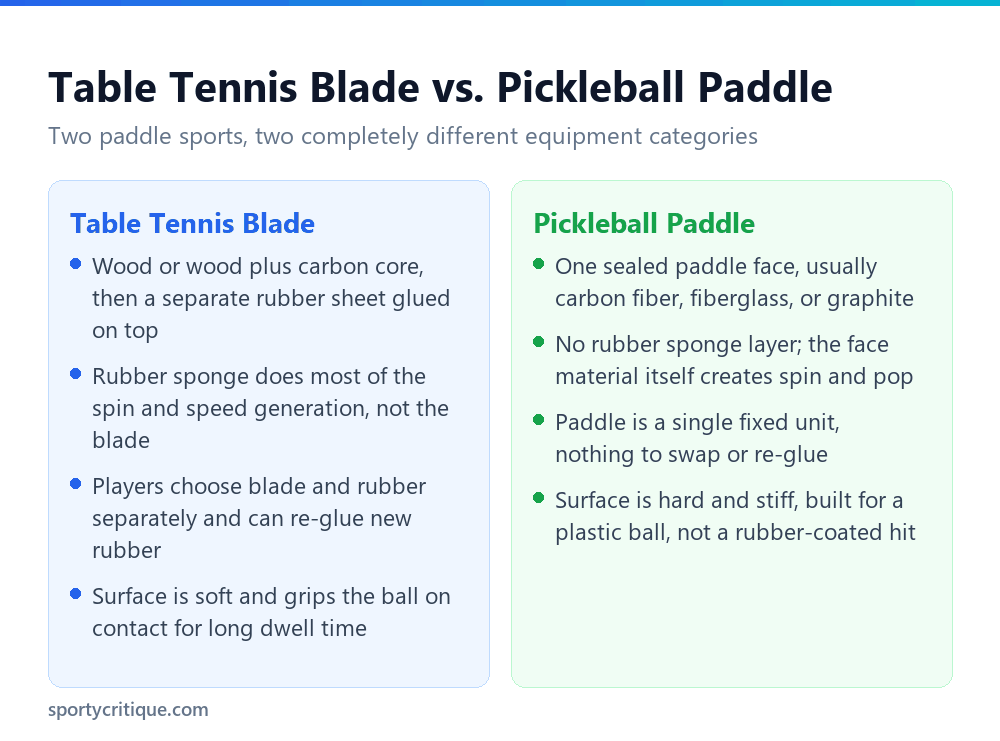
In competitive table tennis, the blade represents the structural skeleton of the player’s racket, determining baseline rebound velocity, vibrational feedback, and ball dwell time. While sponge rubber sheets provide surface friction and catapult spin, the underlying blade dictates how kinetic energy transfers from the arm stroke into the plastic 40+ poly ball. A flexible, absorbent all-wood blade bends elastically on impact, holding the ball for crucial milliseconds to maximize spin generation on slow opening loops. Conversely, an ultra-stiff carbon fiber composite blade rebounds the ball instantly, creating blistering flat-hit velocity and rock-solid stability during off-the-bounce counter-drives.
Selecting the optimal table tennis blade requires evaluating the nuanced engineering of timber species, ply count, and composite fiber positioning. Modern offensive blades diverge into two primary architectures: traditional multi-ply all-wood construction (typically five or seven thin timber laminates bonded under hydraulic heat) and composite blades reinforced with synthetic woven fibers like Arylate-Carbon (ALC) or Zylon-Carbon (ZLC). Within composite blades, the exact placement of the carbon layer—whether placed directly beneath the outer veneer (Outer Carbon) or positioned deep inside adjacent to the center core (Innerforce)—fundamentally changes the blade’s personality from a stiff speed monster to a sensitive looping instrument. This technical guide analyzes five premier table tennis blades, measuring vibrational frequencies, dwell times, sweet spot expansion, and timber grain densities.
Table of Contents
Blade Physics: Timber Acoustics, Composite Weaves, and Dwell Mechanics
The Complete Pro Competition Paddle & Rubber Setup
Updated Nov 2026
Premade recreational paddles deaden spin on modern 40+ plastic balls. Upgrading to a tournament-certified Arylate-Carbon blade with Spring Sponge X rubbers delivers explosive loop speed and surgical counter-topspin bite:
Butterfly Viscaria FL Blade
5 plies wood + 2 outer Arylate-Carbon layers combine high reaction speed with prolonged ball dwell time.
Butterfly Dignics 09C (2.1mm)
Friction-enhanced tacky topsheet paired with dense 44° Spring Sponge X creates insane topspin arcs.
Butterfly Tenergy 05 (2.1mm)
The gold standard in mechanical spring tension for aggressive over-the-table flicking and backhand drives.
Nittaku 3-Star Premium 40+ (6-Pack)
Made in Japan non-celluloid poly ball with surgical roundness and true uniform bounce height.
The International Table Tennis Federation (ITTF) mandates that at least eighty-five percent of a blade’s total thickness must consist of natural timber wood. The remaining fifteen percent may be reinforced with carbon fiber, arylate, glass fiber, or aramid synthetic fabrics. This regulatory constraint creates a delicate balance: manufacturers must pair natural wood species with synthetic weaves to achieve targeted stiffness without deadening organic ball feel.
The choice of outer wood veneer dictates the initial contact sensation:
- Limba (Terminalia superba): A soft, porous African hardwood. Limba flexes gently upon impact, dampening initial ball rebound and allowing high-friction rubber topsheets to grip the ball surface. It is the premier choice for spin-oriented loopers who rely on curved flight arcs and heavy topspin rotation.
- Koto (Pterygota macrocarpa): A dense, stiff African hardwood with a tight linear grain. Koto produces a sharp, crisp acoustic crack and fast ball departure, making it ideal for aggressive close-table attackers and punch-blockers who prioritize linear speed over prolonged dwell time.
- Ayous (Triplochiton scleroxylon): A lightweight, highly elastic timber frequently deployed as thick center cores or intermediate cross-plies. Ayous acts like a wooden spring, absorbing heavy incoming loops and springing back forward during full-effort counter-attacks.
Composite fiber engineering fundamentally alters vibrational resonance. Pure carbon fibers (such as Butterfly Tamca 5000) offer immense tensile strength and stiffness, producing ultra-fast rebound but harsh, numb hand feedback. To soften this impact, modern blades weave carbon alongside polyarylate fibers (Arylate-Carbon or ALC). Arylate acts as a shock-absorbing damper, dissipating high-frequency vibrations while preserving the broad, uniform sweet spot and torsional rigidity of carbon.
Top 5 Table Tennis Blades: Technical Performance Matrix
The comparative data matrix below details blade compositions, ply architectures, carbon positions, stiffness ratings, and primary playing style applications across the five leading blades on the market.
| Blade Model | Ply Composition | Carbon Placement | Outer Veneer | Stiffness / Speed | Best Application |
|---|---|---|---|---|---|
| Butterfly Viscaria ALC | 5 Wood + 2 Arylate-Carbon | Outer Carbon (Directly under surface) | Crisp Koto Hardwood | Stiff / Off+ High Speed | Close-to-table counter-loopers & aggressive attackers |
| Butterfly Innerforce Layer ALC | 5 Wood + 2 Arylate-Carbon | Inner Carbon (Placed around core) | Flexible Limba Hardwood | Medium-Stiff / Off Balanced | Mid-distance loopers demanding maximum dwell time |
| Stiga Clipper Wood | 7-Ply Solid Natural Wood | Pure All-Wood (Zero synthetic) | Classic Limba & Ayous | Medium-Stiff / Off Power | Direct power drivers, smashers, and short-pips hitters |
| Yasaka Ma Lin Extra Offensive | 5-Ply Solid Natural Wood | Pure All-Wood (Zero synthetic) | Hard Walnut Outer Plies | Medium / Off Dynamic Control | Controlled spin attackers and developing tactical players |
| DHS Hurricane Long 5 | 5 Wood + 2 Arylate-Carbon | Inner Carbon (Deep core placement) | Limba outer + Ayous core | Dynamic Flex / Off+ Power | Ma Long power loopers executing full-body swings |
1. Butterfly Viscaria ALC: The Historic King of Outer Carbon Attack
Released originally in 1993, the Butterfly Viscaria is arguably the most famous and widely copied composite table tennis blade in history. Powered by Butterfly’s signature 5+2 ply architecture, the Viscaria positions two layers of Arylate-Carbon directly beneath crisp, hard Koto outer veneers. This outer placement produces an immediate, responsive ball launch off the blade face.
The Viscaria’s outer ALC construction drastically expands the effective sweet spot across roughly eighty-five percent of the blade face, virtually eliminating dead zones on off-center edge contacts. The Koto outer wood provides a crisp, sharp sensation that excels at close-to-the-table counter-looping, off-the-bounce backhand flicks, and punch blocking against heavy incoming drives. Used by world champions like Zhang Jike, the Viscaria delivers unmatched stability and linear speed for aggressive, fast-paced offensive play.
Technical Specifications: Construction: 5 Wood + 2 Arylate-Carbon (Outer) | Outer Wood: Koto | Blade Thickness: 5.8 mm | Average Weight: 86 grams | Speed Rating: 88 | Control Rating: 82 | Vibration Frequency: Approx 1450 Hz | Handle Styles: Flared (FL) and Straight (ST).
View Butterfly Viscaria on Amazon
2. Butterfly Innerforce Layer ALC: Natural Dwell Time with Carbon Reserve
While the Viscaria excels at stiff, immediate rebound, many spin purists found outer carbon too rigid for opening loops against heavy backspin. Butterfly solved this with their Innerforce design, moving the two Arylate-Carbon plies inward so they wrap directly around the central Ayous core, beneath two layers of natural wood.
The result is a blade that behaves like a sensitive, flexible all-wood blade on light-touch shots, drop shots, and passive service returns. The soft Limba outer veneers provide deep ball holding dwell time, allowing the player to impart massive rotational spin on slow loops. However, when the player accelerates into a full-effort counter-loop, the ball compresses deep into the blade, engaging the inner ALC carbon layer to produce explosive spring-like catapult velocity. For players transitioning from wood to carbon who refuse to sacrifice touch, Innerforce ALC is the perfect bridge.
Technical Specifications: Construction: 5 Wood + 2 Arylate-Carbon (Inner) | Outer Wood: Soft Limba | Blade Thickness: 6.0 mm | Average Weight: 88 grams | Speed Rating: 84 | Control Rating: 87 | Dwell Time: Significantly longer than outer carbon | Best Rubber Pairing: Tenergy 05 or Dignics 05.
View Innerforce Layer ALC on Amazon
3. Stiga Clipper Wood: The Legendary Seven-Ply Natural Powerhouse
Before composite fibers existed, Stiga introduced the Clipper Wood in 1981, establishing the seven-ply all-wood architecture that remains a cornerstone of the sport over four decades later. Composed of alternating laminates of high-grade Limba and dense Ayous wood bonded with specialized organic glues, the Clipper achieves substantial structural rigidity purely through timber mechanics.
Weighing around ninety grams with a solid 6.8 mm thickness, the Clipper Wood delivers a dense, reassuring impact feel that synthetic blades cannot replicate. It provides exceptional energy transfer on flat smashes, active counter-drives, and short-pips backhand blocks. Because it contains zero synthetic carbon fibers, the player feels every subtle ball vibration clearly in their palm, allowing for micro-adjustments to racket face angles on tricky service returns. For players who value organic feedback and raw natural power, the Clipper is an enduring icon.
Technical Specifications: Construction: 7-ply solid natural hardwood | Material: Selected Limba and Ayous plies | Blade Thickness: 6.8 mm | Average Weight: 90 grams | Speed Rating: 85 | Control Rating: 80 | Acoustic Feedback: Deep organic wood report | Playing Style: Aggressive driving, blocking, and flat hitting.
View Stiga Clipper Wood on Amazon
4. Yasaka Ma Lin Extra Offensive: Surgical Walnut Looping Precision
Developed for three-time Olympic gold medalist Ma Lin, the Yasaka Ma Lin Extra Offensive (YEO) is one of the most celebrated 5-ply all-wood blades ever produced. Yasaka achieved its distinctive playing dynamics by pairing a flexible Scandinavian pine core with dense, hard Scandinavian walnut outer veneers.
The thin, hard walnut surface produces a sharp, crisp initial contact that provides outstanding trajectory control on short pushes and aggressive wrist flicks over the table. Beneath the surface, the medium-soft 5-ply construction flexes during powerful arm swings, generating heavy rotational spin on medium-distance loops. Because it weighs around 85 grams and features a slender ergonomic handle, the YEO offers incredible maneuverability for quick transitional play, making it a favorite for both traditional penhold and shakehand tactical attackers.
Technical Specifications: Construction: 5-ply solid wood | Outer Wood: Hard Scandinavian Walnut | Blade Thickness: 6.0 mm | Average Weight: 85 grams | Speed Rating: 82 | Control Rating: 85 | Maneuverability: Outstanding wrist agility and balance | Origin: Crafted in Sweden by Yasaka timber masters.
View Yasaka Ma Lin Extra on Amazon
5. DHS Hurricane Long 5: The Chinese National Team Power Engine
Engineered by Double Happiness (DHS) specifically for the greatest table tennis player of all time, Ma Long, the Hurricane Long 5 is designed to maximize power from athletic, full-body looping mechanics. Utilizing a specialized 5+2 inner Arylate-Carbon construction, the Long 5 is calibrated with a thicker Ayous center core and elastic Limba surface veneers.
The defining characteristic of the Hurricane Long 5 is its massive dynamic power gear. On soft, passive strokes, the blade feels surprisingly gentle and slow, allowing players to place short balls with pinpoint touch. However, when engaged with full torso rotation and aggressive arm speed, the inner carbon springs to life, launching heavy, dipping topspin drives that carry extreme rotational momentum. Paired with firm tacky Chinese rubbers like DHS Hurricane 3 Neo on the forehand, it represents the gold standard for high-level looping dominance.
Technical Specifications: Construction: 5 Wood + 2 Arylate-Carbon (Inner) | Outer Wood: Selected Limba | Blade Thickness: 5.9 mm | Average Weight: 89 grams | Speed Rating: 90 (at maximum effort) | Control Rating: 84 | Handle: Oversized flared handle for enhanced grip leverage | Endorsed By: Double Grand Slam Champion Ma Long.
View DHS Hurricane Long 5 on Amazon
Outer Carbon vs Inner Carbon: How Composite Depth Dictates Play
Understanding the mechanical distinction between outer and inner composite placement is crucial when investing in a high-end blade:
- Outer Carbon (Viscaria, Fan Zhendong ALC): The carbon/ALC fabric sits directly beneath a thin 0.5 mm surface veneer. This positions the rigid composite layer close to the ball impact point. The blade exhibits minimal flex, high rebound velocity, and short dwell time. It excels at fast, off-the-bounce counter-attacks, active blocking, and punch shots where immediate linear speed overpowers the opponent.
- Inner Carbon (Innerforce ALC, Long 5): The composite fabric sits beneath two layers of natural timber, wrapped directly against the central core. The blade retains the soft, gripping dwell time of an all-wood blade on low-impact shots, making opening loops over the table easier to control. The carbon only engages when the ball impacts hard enough to compress through both outer plies, generating extra speed on full-power drives.
- All-Wood (Stiga Clipper, Yasaka YEO): Contains zero synthetic fibers. The blade flexes naturally throughout its entire body, transferring pure tactile vibrational waves directly into the player’s fingers. It delivers the highest level of ball feedback and forgiveness, making it ideal for players developing proper stroke mechanics.
Handle Ergonomics: Flared (FL) vs Straight (ST) Grip Mechanics
The geometry of the blade handle influences how your wrist flexes and transitions between forehand and backhand strokes:
1. Flared Handle (FL): The handle widens toward the base. This flared collar locks the handle naturally into the palm, preventing the racket from sliding outward under centrifugal force during heavy forehand swings. Over eighty percent of modern offensive loopers use flared handles for stable grip retention.
2. Straight Handle (ST): The handle maintains a uniform cylindrical or rectangular profile from neck to base. This allows the player to rotate the racket slightly between their fingers, making it easier to transition between forehand and backhand grips or execute wristy backhand flicks over the table. Straight handles are favored by defensive choppers and tactical backhand specialists.
Frequently Asked Questions About Table Tennis Blades
Here are authoritative answers to common inquiries regarding table tennis blade selection, ply structures, and composite fiber types.
Should a beginner or intermediate player use a carbon blade?
Generally, developing players should start with a 5-ply or 7-ply all-wood blade (such as the Stiga Clipper or Yasaka YEO). All-wood blades offer longer dwell time and superior tactile feedback, helping players learn proper brushing mechanics before advancing to stiff carbon blades.
What is the difference between ALC and ZLC carbon?
ALC (Arylate-Carbon) weaves carbon with flexible arylate fibers, dampening harsh vibration and providing a balanced medium-stiff feel favored for looping. ZLC (Zylon-Carbon) weaves carbon with high-tensile Zylon, producing higher rebound velocity and an even wider sweet spot with slightly more stiffness.
How does blade weight affect play?
Lighter blades (80 to 85 grams) offer faster wrist speed and quick recovery on close-table exchanges. Heavier blades (88 to 94 grams) provide greater momentum and stability on mid-distance counter-loops, producing heavier ball carry.
Can you seal a table tennis blade to prevent splintering?
Yes, applying an ultra-thin coat of water-based polyurethane blade sealant or specialized table tennis lacquer seals the outer wood grain. This prevents wood splinters from pulling off when changing glued rubbers in the future.
What is the difference between 5-ply and 7-ply all-wood blades?
A 5-ply wood blade is thinner (5.5 to 6.0 mm) and more flexible, offering longer dwell time and higher arc spin for looping. A 7-ply wood blade is thicker (6.5 to 7.0 mm) and stiffer, providing more direct linear speed for flat hitting and blocking.
Selecting the ideal table tennis blade—whether the explosive outer carbon precision of the Butterfly Viscaria, the versatile dwell control of the Innerforce Layer ALC, or the classic natural feedback of the Stiga Clipper Wood—anchors your offensive game in proven mechanical physics. With optimized timber plies, specialized composite weaves, and comfortable handle geometry, you can command every rally with devastating spin and pinpoint directional control.