
Why the Best Ping Pong Paddle for Control Isn’t the Fastest One


A paddle rated for control is not a slower version of an offensive paddle, it is built with a different sponge and blade so mishits and off-center contact stay on the table. That trade-off is deliberate, and it is exactly what most beginners and defensive players actually need more than raw power.
The best ping pong paddle for control right now is the JOOLA Omega Control Table Tennis Racket, (listed at $19.95 at time of writing). It pairs a 5-ply wood blade with 1.8mm Vizon rubber that JOOLA itself rates at 75 speed, 75 spin, and 97 control on its own 0-100 performance scale, among the highest control ratings the brand publishes on a pre-built racket. If you are choosing between control, spin, and speed as your priority, control is the right call for defensive play, all-round beginners, and anyone who loses more points to mishits than to being outpaced.
- →Manufacturers rate paddles on separate Speed, Spin, and Control axes, and the three genuinely trade off against each other
- →A control paddle uses softer sponge and a more flexible blade so the ball dwells longer and mishits stay on the table
- →The JOOLA Omega Control Table Tennis Racket publishes a 97/100 control rating from JOOLA itself, the highest of the paddles checked here
- →Control paddles suit beginners, defensive chop/block players, and anyone rebuilding technique after a plateau
- →This is one of five guides on this site covering each real speed/spin/control combination separately

Table of Contents
Why “control” is a real, separate rating, not marketing copy
Table tennis manufacturers, JOOLA, STIGA, Butterfly, and most of the smaller brands that copy their conventions, rate paddles and rubbers on three published axes: Speed, Spin, and Control. The scales differ by brand (JOOLA runs some models past 100, STIGA and Palio commonly use a 1-10 range), but the underlying physics is the same everywhere. A softer sponge compresses more on contact, which slows the ball down and holds it on the rubber a fraction of a second longer. That extra dwell time is what lets a player place the ball rather than just react to where it goes.
The tradeoff is unavoidable. The same soft sponge that adds control also caps how much energy the paddle returns to the ball, which is why control-rated paddles rarely post high speed numbers. A blade built for control usually runs thinner and more flexible too, which absorbs vibration on off-center hits instead of sending the ball flying long. That flex is a feature for a beginner still finding the sweet spot, and a limitation for an advanced player trying to end the point in three strokes.
⚠️ Watch out: A paddle marketed only as “beginner” is not automatically control-rated. Some cheap beginner sets use hard, low-friction rubber because it is inexpensive to manufacture, not because it is forgiving. Check for a stated control rating or rubber described as soft/slow before assuming a low price means high control.
Our pick: JOOLA Omega Control
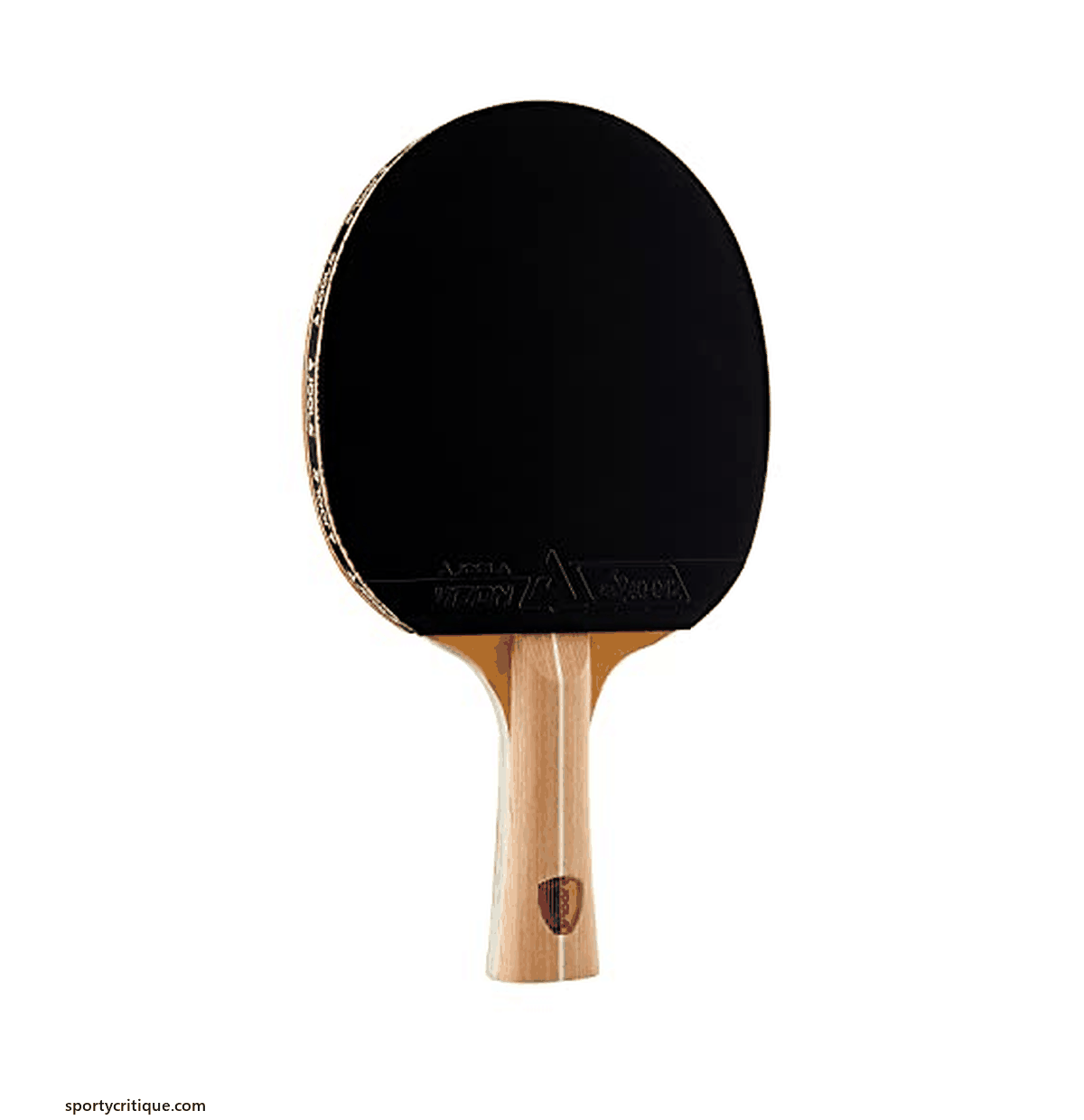
The JOOLA Omega Control Table Tennis Racket (listed at $19.95 at time of writing) is built around a 5-ply real wood blade, a mix of basswood for a soft touch and tungwood for consistent strength, paired with pips-in Vizon rubber at 1.8mm sponge thickness on both sides. JOOLA’s own published rating for this racket is Speed 75, Spin 75, Control 97 on their internal 0-100 scale used across the Infinity and Omega lines. The gap between the control number and the other two is unusually wide for a pre-assembled racket, which is the actual point: this is not a jack-of-all-trades paddle, it is built to reward placement over power.
JOOLA specifically recommends it for chopping and push-and-block play, the two styles that depend most on a slower, more predictable ball off the paddle. If your game is still built around getting the ball back safely rather than ending points early, this is the sponge-and-blade combination designed for exactly that.
Three more control-leaning options worth checking
The Omega Control is not the only paddle built around this axis. Availability on Amazon shifts often for smaller-batch and off-brand paddles, so we checked current listing status for three more control-oriented options rather than assuming last month’s in-stock paddle is still buyable today.
📊 Note: When a listing shows no current price or stock data, that is disclosed above rather than guessed at. Amazon inventory for mid-tier paddles turns over fast, and a paddle that was in stock last week can go unavailable without the listing being removed.
Who a control paddle is actually right for
- ✓Beginners still developing a consistent stroke and paddle angle
- ✓Defensive players who chop, block, or push rather than attack
- ✓Anyone whose mishits fly off the end of the table more than they fall short
- ✓Players returning to the sport after a long break and rebuilding feel
- ✕Advanced attacking players who already generate their own pace and spin
- ✕Anyone frustrated that their shots feel “slow” against a hard-hitting opponent
- ✕Players who already have a consistent stroke and want more finishing power
- ✕Doubles players who need to react and counter-attack in tight exchanges
How control rubber and blades differ from offense builds
Sponge thickness is the first place to look. Control paddles commonly run 1.6mm to 1.8mm sponge, thinner than the 2.0mm to 2.2mm common on offense-rated rubber. Thinner sponge compresses less, returns less energy, and gives a more linear, predictable response, exactly what a player still learning to judge power wants. Blade construction matters just as much: an all-wood 5-ply blade flexes more on contact than a carbon or fiberglass-reinforced blade, which is part of why nearly every control-rated racket in this bracket skips carbon layers entirely.
💡 Pro tip: If you already own an offense-rated paddle and want to test whether control actually fits your game before buying a second full racket, swapping in a softer, thinner rubber sheet on your existing blade is a cheaper way to find out than buying a whole new paddle.
Sponge thickness, explained without the jargon
Every inverted rubber sheet has two numbers that matter: sponge thickness and sponge hardness. Thickness is the easier one to compare across brands because it is measured in millimeters and printed on nearly every listing. A 1.6mm sponge compresses less under impact than a 2.2mm sponge, which means less stored energy gets released back into the ball. That is the entire mechanism behind why thinner sponge feels slower and more controllable, and it is also why swapping rubber alone, without changing the blade, still shifts a paddle’s feel noticeably.
Hardness is graded on a durometer scale that varies by manufacturer, so a “medium” sponge from one brand is not identical to a “medium” from another. Softer sponge generally means more control and less speed, following the same logic as thickness. When a listing does not specify hardness, thickness alone is still a reasonable proxy: look for 1.6mm to 1.8mm on a control-first purchase, and treat anything past 2.0mm as drifting toward an all-round or offensive build regardless of what the title says.
How to test a control paddle the day it arrives
Set the paddle on a table and press a thumb into the rubber near the center. It should give slightly and return slowly, not spring back instantly. A rubber sheet that snaps back fast under light pressure is tuned for speed regardless of what the box says. Next, bounce a ball flat against the rubber from a consistent height a few times. A control-rated sheet produces a noticeably lower, quieter bounce than an offense-rated one at the same drop height, and that difference is usually obvious within the first ten bounces.
Check the blade separately from the rubber. Hold it by the handle and flex the head gently with your other hand. A control-oriented all-wood blade has noticeable give; a carbon or fiberglass-reinforced blade feels almost rigid by comparison. If a paddle marketed for control feels stiff as a board, either the blade construction does not match the marketing, or the rubber alone is doing more of the control work than the listing implies.
A short buyer’s checklist before you order
When it’s time to move past a control paddle
The signal to change equipment is not a calendar date, it is a change in what is actually limiting your game. If your rallies are consistent and the ball rarely leaves the table on your own shots, but you are losing points because opponents have time to read and counter your attacks, that is the moment a control-first paddle starts working against you rather than for you. At that point, the spin-and-control guide is the more natural next step, since it keeps most of the forgiving margin while adding real spin generation, rather than jumping straight to a full offensive build.
📊 Note: There is no fixed number of months or matches that signals a paddle upgrade. Watch for the specific symptom, opponents reading your shots because they lack pace or spin, rather than assuming more experience automatically means a faster paddle.
A note on grip and handle shape
Handle shape does not change a paddle’s speed/spin/control rating, but it changes how consistently you can execute the shots that rating is built around. A flared handle, wider at the base, locks the hand in place and suits players who rely on a stable, repeatable grip, which lines up well with the deliberate, placement-first play a control paddle rewards. A straight handle allows more grip adjustment mid-rally, which matters more for penhold-adjacent styles than for the shakehand grip most control-first beginners use. If a listing offers a handle choice, flared is the safer default for control-focused play.
Common myths about control paddles
Comparing this to the other four combinations on this site
Control is one end of a real spectrum, not an isolated category. If pure control feels too passive for your game but you still want a forgiving margin, the spin-and-control guide covers paddles that add real spin generation without giving up that safety margin. If you want to compare against the opposite end entirely, the spin-and-speed guide covers full offensive builds that sacrifice control for maximum pace and rotation.
Bottom line
If mishits, not missed opportunities, are costing you points, a control-rated paddle solves the actual problem. The JOOLA Omega Control Table Tennis Racket is the clearest example of the category done well, a published 97/100 control rating on a real 5-ply wood build, at a price that does not require committing to a $100-plus racket to find out if the control-first approach fits your game.
What makes a ping pong paddle “control-rated” specifically?
Manufacturers publish separate Speed, Spin, and Control scores for most performance paddles. A control-rated paddle scores noticeably higher on Control than on Speed, usually achieved with softer, thinner sponge and a more flexible wood blade that absorbs energy instead of returning it.
Is a control paddle only for beginners?
No. Beginners benefit most because a forgiving paddle shortens the learning curve, but defensive, chop, and all-round block-heavy players at any level keep control-rated equipment because the playing style depends on it, not just the skill level.
Will a control paddle slow down my progress toward a faster game?
Not if you are still developing consistent technique. Learning placement and stroke mechanics on a forgiving paddle first, then moving to faster equipment once your contact is consistent, is a more common and reliable progression than starting on an unforgiving offensive paddle.
What is the actual difference between the JOOLA Omega Control and STIGA Apex?
Both target control, but through different mechanisms: JOOLA’s Omega Control uses a softer Vizon rubber sponge at 1.8mm, while STIGA’s Apex relies on its ACS microscopic-air-capsule rubber technology. Check current price and stock before deciding, since availability on both shifts.
Does a thicker sponge always mean a faster paddle?
Generally yes, thicker sponge stores and returns more energy on contact, which is why offense-rated rubber commonly runs 2.0mm to 2.2mm versus 1.6mm to 1.8mm on control-rated sheets. Hardness matters too, so thickness alone is a strong indicator but not the only variable.
Can I convert an offensive paddle into a control paddle by replacing the rubber?
Partially. Swapping in softer, thinner rubber shifts the feel noticeably and is a cheaper way to test whether control suits your game than buying a new racket outright. The blade itself still matters, though, since a stiff carbon blade under soft rubber will play faster than an all-wood blade under the same rubber.
As an Amazon Associate, we earn from qualifying purchases through links on this page.


