
Best Pickleball Paddle for Ping Pong Players Switching Sports


Best pickleball paddle for ping pong players is a genuinely different question than “best pickleball paddle,” because table tennis and pickleball run on completely different paddle technology. Here’s what real, currently available paddles offer, and an honest look at what does and doesn’t carry over from the table.
There isn’t a pickleball paddle that recreates a table tennis blade, and there shouldn’t be, they’re built for different games. What a table tennis player should look for instead is a paddle with a textured carbon fiber or fiberglass face for spin, a handle length close to what your grip is used to, and a weight in the 7.5 to 8 ounce range so the transition doesn’t feel like swinging a brick. The JOOLA Ben Johns Perseus, Paddletek Bantam EX-L, and Paddletek Phoenix Genesis are three real, currently listed paddles that fit that profile at different price points.
If you’ve spent years playing table tennis and a friend just dragged you onto a pickleball court, the first thing you’ll notice is that none of your paddle instincts carry over the way you’d expect. This guide is specifically about the best pickleball paddle for ping pong players making that jump, not a general beginner’s pickleball guide, and not a claim that the two sports share equipment. They don’t.
Pickleball is its own sport, one that happens to share a wall with table tennis in a few places: a similar underhand-friendly serve motion, a net in the middle, and a scoring rhythm that rewards placement over raw power. It is not the same equipment, and anyone telling you your table tennis paddle skills transfer directly is oversimplifying a sport with its own separate technology, rules, and court geometry.
- →Pickleball paddles use a solid sealed face (carbon fiber, fiberglass, or graphite); table tennis blades use a separate glued-on rubber sheet
- →The rubber sponge layer that does most of a table tennis blade’s spin work has no equivalent in pickleball
- →A textured carbon fiber paddle face is the closest pickleball equivalent to a spin-generating table tennis rubber, but it isn’t the same mechanism
- →Table tennis reflexes and touch around the net transfer better than any specific paddle skill
- →Weight matters differently: most pickleball paddles run 7.3 to 8.3oz, a narrower range than table tennis blades
Table of Contents
Why this isn’t just “a different racket for the same game”
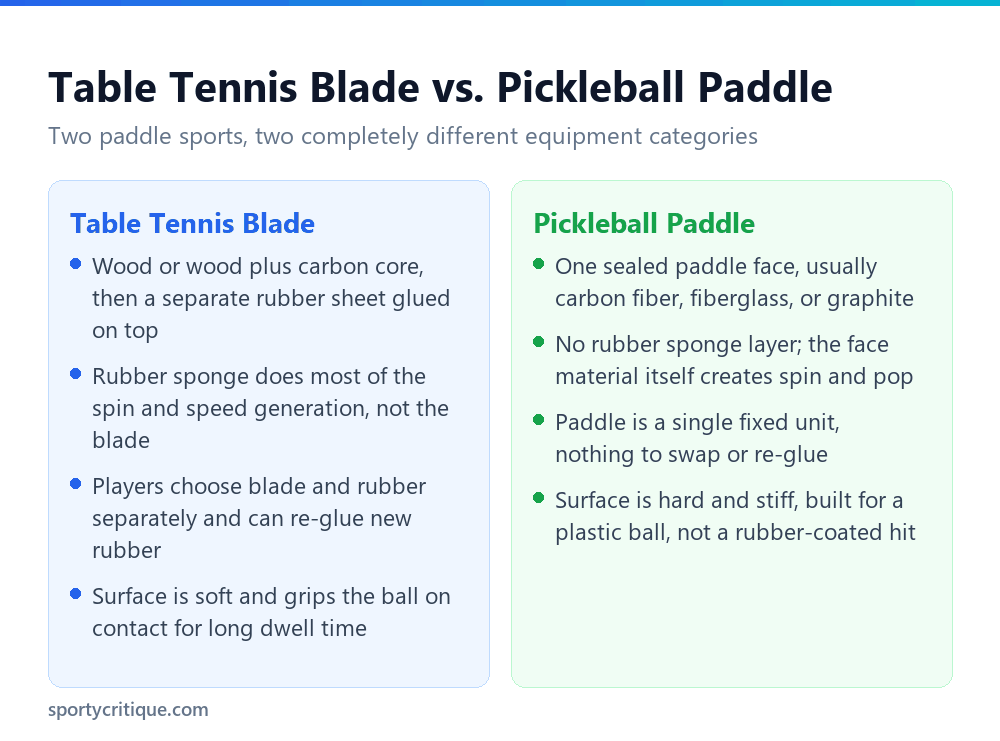
A table tennis blade is actually two separate pieces of equipment glued together: a wood or wood-and-carbon blade, and a rubber sheet with its own sponge layer underneath. Nearly all of the spin and speed a serious table tennis player generates comes from that rubber sheet compressing and releasing on contact, which is why players buy blades and rubbers separately and re-glue new rubber every few months as it wears out.
Pickleball paddles don’t work that way at all. A pickleball paddle is one sealed unit, a rigid core (usually polymer honeycomb, sometimes foam) wrapped in a face material like carbon fiber, fiberglass, or graphite. There’s no separate spin-generating rubber layer to swap out. Whatever spin the paddle produces comes from the texture and stiffness of that outer face material grabbing a hard plastic ball, which is a different physical mechanism than a soft rubber sponge grabbing a seamed rubber ball.
⚠️ Watch out: Don’t buy a pickleball paddle expecting it to feel like your table tennis blade with a different label. The ball is harder and lighter, the paddle face doesn’t compress the way rubber does, and shots that work in table tennis, like a heavy topspin loop off a soft sponge, don’t translate the same way onto a rigid carbon face.
What actually does transfer from table tennis
The equipment doesn’t transfer, but a real set of skills does. Table tennis players tend to pick up pickleball’s soft game, dinking at the net, controlled drop shots, reading an opponent’s paddle angle, faster than players coming from tennis or from no racket sport background at all. Years of tracking a small, fast-moving ball at close range builds hand eye coordination and reaction time that actually carries over, even though the paddle in your hand works on completely different physics.
What doesn’t transfer as cleanly is anything built around rubber-generated spin. A table tennis player’s forehand loop relies on brushing a soft, tacky rubber surface up the back of the ball at speed. A pickleball paddle face doesn’t compress or grip the ball the same way, so that exact swing produces a different, usually less dramatic, spin result. Expect an adjustment period specifically around spin shots, even if your general court sense and reflexes are ahead of a true beginner’s.
What to actually look for in a paddle, coming from table tennis
Since you can’t buy a pickleball paddle that mimics your table tennis blade, the more useful question is what paddle characteristics will feel least foreign while you adjust. Three things matter most:
Our picks, across the price range
The JOOLA Ben Johns Perseus Pickleball Paddle sits at the premium end of this list. It uses a fully encased carbon fiber face built around JOOLA’s charged surface texture, designed to generate more spin off contact than a plain smooth carbon face, and it carries the USAPA approval stamp that matters if you ever play in a sanctioned event. It’s a real tour-level paddle, priced accordingly, and probably more paddle than you need for your first few months adjusting to the sport, but if you already know pickleball is going to stick, buying once at this tier is a reasonable call.
The Paddletek Bantam EX-L Pickleball Paddle is the more sensible starting point for most table tennis players trying pickleball seriously. It pairs a polymer honeycomb core with a polycarbonate surface and a Bantom PolyCore layer, and it’s USAPA approved, which means it’s legal for club and tournament play if you get that far. It’s a genuine step up from a beginner set without the full premium price tag.
The Paddletek Phoenix Genesis Pickleball Paddle is a similarly capable option in the same rough price bracket, built around a honeycomb core with a fiberglass epoxy surface rather than polycarbonate. The two play a little differently, fiberglass tends to feel softer and more forgiving on off-center hits, polycarbonate a bit more locked-in and precise, so if you can try both before buying, that difference is worth feeling for yourself.
The Franklin Sports Pilot Pickleball Paddle is the budget option worth mentioning honestly: at the time of writing, the live Amazon listing didn’t return a current price or stock status through our product data check, so treat that as a starting point to search for rather than a guaranteed buy-now link. It’s a legitimate entry paddle if you just want to confirm you enjoy pickleball before spending on a performance-tier paddle.
- ✓Buy a mid-range carbon or fiberglass paddle if you already know you’ll play regularly
- ✓Try a friend’s paddle or a rec-center rental before committing to a premium purchase
- ✓Expect a real adjustment period for spin shots specifically, even with good reflexes
- ✓Match grip length to what your table tennis hand is used to when the spec is listed
- ✕Assume any paddle advertised as “spin friendly” replicates rubber-sheet spin mechanics
- ✕Buy the most expensive tour-level paddle before you know you’ll stick with the sport
- ✕Expect your table tennis topspin loop to work the same way off a rigid carbon face
- ✕Ignore USAPA approval status if there’s any chance you’ll play in an organized league
Core materials, briefly
Pickleball paddle cores are usually one of two things: a polymer honeycomb structure, which is the current standard on most mid-range and premium paddles, or a foam core, more common on cheaper and older-generation paddles. Polymer honeycomb tends to produce a quieter, softer feel on contact and is generally considered the better all-around choice, which is why all three of the paddles above use it. Nomex cores, once common in early pickleball paddle design, have mostly fallen out of favor for being louder and less forgiving, and are worth avoiding unless you specifically know you want that older playing feel.
The rules differences worth knowing before your first game
Two rules will feel unfamiliar even once your paddle skills catch up. First, the double bounce rule requires the ball to bounce once on each side before either player can volley it, which doesn’t exist in table tennis and changes the early rhythm of every point. Second, the non-volley zone, commonly called the kitchen, is a no-volley area near the net where you can’t hit the ball out of the air, only after it bounces. Both rules push the game toward the soft, controlled dinking style at the net rather than the fast exchanges table tennis trains you for, which is part of why the adjustment period is real even for a strong table tennis player.
💡 Pro tip: Spend your first few sessions specifically on dinking and soft shots at the kitchen line rather than trying to hit hard from the baseline. That’s where your table tennis touch and reaction time will show up fastest, and it builds the patience the non-volley zone rule actually rewards.
Grip technique also needs adjusting
Most table tennis players use either a shakehand or a penhold grip, both built around a thin, light handle designed for fast wrist rotation. Pickleball paddles use a single continental-style grip closer to a tennis grip, with a longer, thicker handle that doesn’t reward the same wrist snap. Trying to force a table tennis wrist motion onto a pickleball swing is a common early mistake, since the added handle length and paddle weight make a wristy swing less controlled rather than more powerful, the opposite of what a fast table tennis wrist flick achieves on a light blade.
How long the adjustment actually takes
Most table tennis players report feeling reasonably comfortable with basic pickleball strokes within three to five sessions, faster than a total sports beginner, but the specific skill of generating spin off the paddle face typically takes longer, often a full season of regular play, to feel natural. That’s a realistic timeline to set for yourself rather than expecting years of table tennis experience to shortcut the process entirely.
Bottom line
The best pickleball paddle for ping pong players isn’t one that tries to copy your table tennis blade, because that paddle doesn’t exist and wouldn’t work if it did. It’s a paddle with a spin-friendly carbon or fiberglass face, a manageable weight, and a grip that doesn’t fight your existing hand feel, paired with realistic expectations that the sport itself, not just the equipment, is still new.
See also: Best Ping Pong Paddle for Beginners if you’re still building your table tennis game alongside this crossover, or Best Ping Pong Paddle for the Money for what different price tiers buy on the table tennis side.
Can I use my table tennis paddle to play pickleball?
No. Table tennis blades use a soft rubber sheet designed for a light, seamed ball, and pickleball is played with a hard plastic ball against a rigid paddle face. Using a table tennis blade in pickleball would also not be legal in any sanctioned or USAPA-approved play.
What paddle material is closest to table tennis rubber for spin?
Nothing recreates rubber-sheet spin mechanics exactly, but a textured carbon fiber or fiberglass paddle face is the closest available option in pickleball, generating spin through surface texture rather than a compressing rubber sponge.
Do table tennis players have an advantage in pickleball?
Mainly in reflexes, hand-eye coordination, and reading an opponent’s paddle angle at close range, skills built from years of table tennis. The paddle itself works differently enough that equipment familiarity mostly resets to zero.
What weight pickleball paddle should a table tennis player start with?
Somewhere in the 7.5 to 8oz range is a reasonable, forgiving starting point. It’s a narrower range than table tennis blade weights, and starting lighter within it usually feels less foreign while you adjust to the longer handle and different swing mechanics.
As an Amazon Associate, we earn from qualifying purchases through links on this page.


