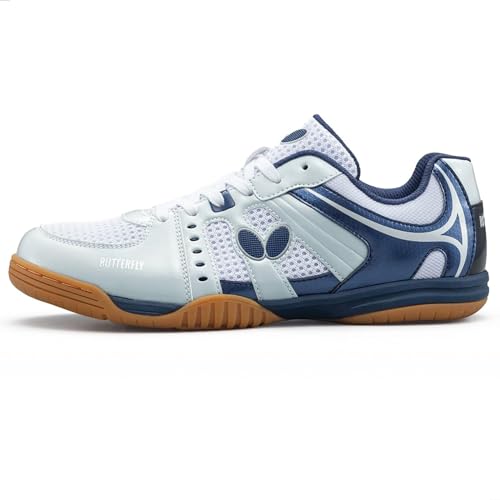
Best Shoes for Playing Ping Pong: Grip and Sole Design Explained


Most lists of the best shoes for playing ping pong rank models by brand reputation and stop there. Two shoes can look almost identical on a shelf and play completely differently on a table tennis court, and the difference rarely shows up in a product photo. It’s in the outsole tread pattern, the sole height, and how much the forefoot flexes when you push off at an angle instead of running in a straight line. This is a look at the specific features that separate a shoe that performs well for table tennis footwork from one that just happens to be athletic footwear, and which current models get those features right.
The two features that matter most for in-play performance are outsole grip pattern and sole height. A low, flexible sole keeps your foot stable during a lateral lunge, and a tread built for lateral push-off grips a sport-court floor without catching or feeling sticky mid-pivot. The Butterfly Lezoline Gigu and Lezoline Mach both deliver on these specifically, at different price points.
Table of Contents
Grip: What the Outsole Pattern Is Actually Doing
A running shoe’s outsole is built around forward traction: lugs and grooves oriented to bite the ground as your foot rolls from heel to toe. Table tennis footwork barely uses that motion. Most of your pushes are sideways or at a diagonal, from a stationary or semi-stationary stance. A table tennis outsole reflects that with a flatter, more uniform tread of small non-marking rubber studs or a smooth gum rubber surface designed to grip a sport-court floor across a wider range of push angles, not just straight ahead.
That’s why a shoe can feel grippy when you walk in it and still feel unstable the first time you lunge wide for a ball. Standing traction and lateral push-off traction aren’t the same test, and a lot of casual athletic shoes are only built for the first one.
💡 Pro tip: If you want a quick real-world check before buying, look at reviews or forum threads that specifically mention court surface. A shoe that grips carpet-topped courts well can behave differently on a hardwood or vinyl sport-court floor, and that’s the surface most club and tournament play actually happens on.
Sole Height: Why Lower Is More Stable During a Lunge
When you lunge sideways for a wide ball, your ankle rolls slightly toward the outside edge of the shoe as your weight shifts. The further your foot sits above the ground, the more leverage that roll has, and the more the shoe has to work to keep your ankle from over-rotating. A thick, elevated midsole, the kind built into most running shoes for shock absorption over long distances, actually works against you here. It raises your center of gravity above the sole and gives a lateral roll more distance to build force before your foot and ankle can correct it.
A low-to-ground table tennis shoe keeps that lever short. Your foot sits closer to the floor, the roll has less distance to travel, and recovering your footing after a wide lunge takes less time and less conscious effort. This is also why table tennis shoes tend to feel underbuilt or minimal to someone used to cushioned running shoes. The sole isn’t thin because the manufacturer cut corners. It’s thin because a thick sole is the wrong tool for this specific movement.
Two Models Built Around These Features

The Butterfly Lezoline Gigu is priced at $129.99 and built around shock absorption paired with a grip-focused outsole, which sounds like a contradiction until you feel it: the cushioning sits low and firm rather than soft and elevated, so you still get impact protection over a long session without losing the low center of gravity a lunge depends on. Stock is limited, currently down to 4 units on Amazon. Check current availability ↗
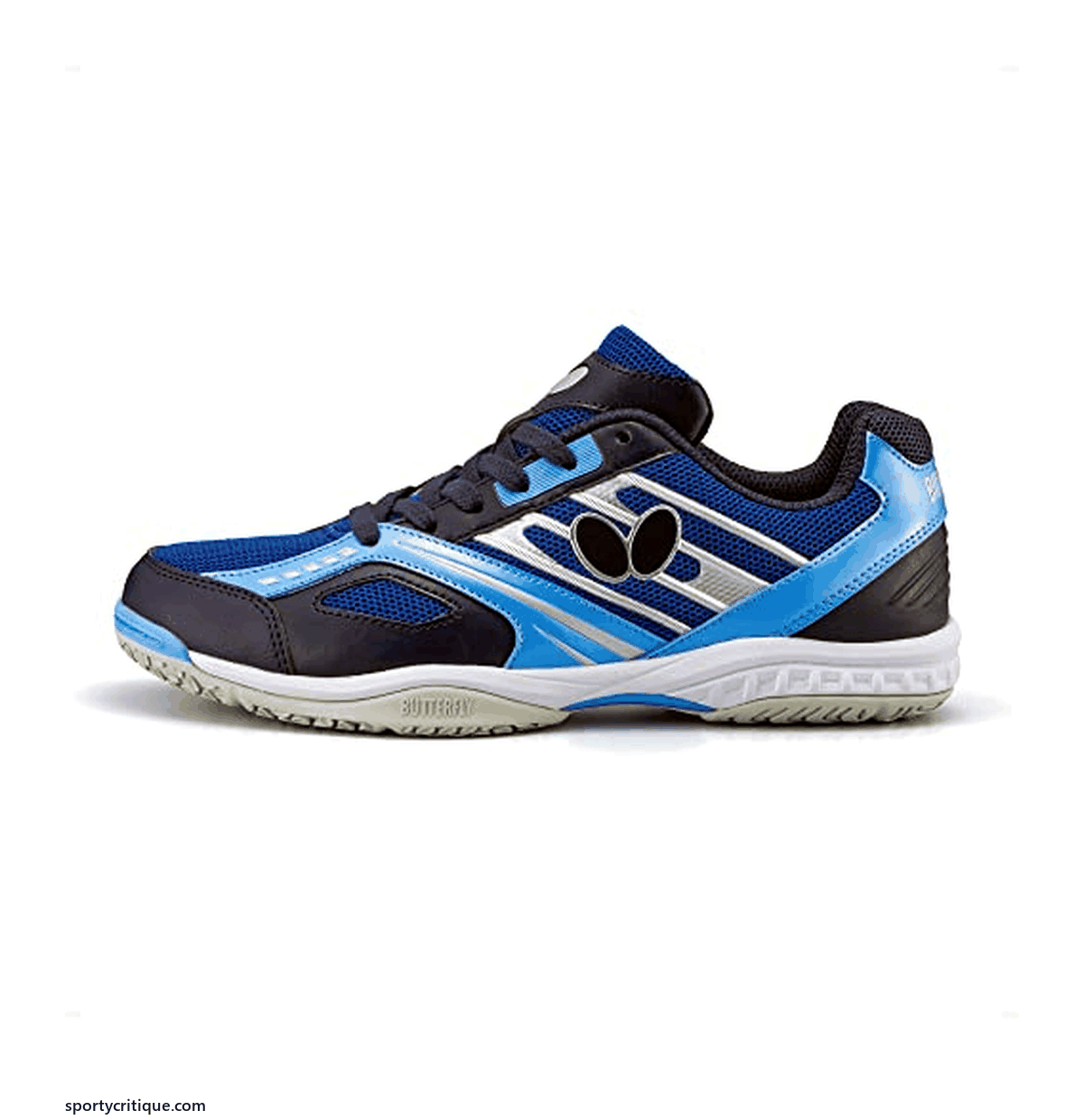
The Lezoline Mach, at $149.99, takes the opposite approach: less cushioning, an even lower profile, and an outsole pattern tuned specifically for multi-directional grip over straight-line traction. It rewards a player who already has decent footwork technique and wants the shoe to get out of the way rather than compensate for weaker fundamentals. Only 2 left in stock as of this writing. See the current listing ↗
A Budget Option That Still Gets the Basics Right
The ASICS Gel-Rocket 11 is a volleyball shoe, not a table tennis shoe, and its outsole pattern is tuned for a slightly different sport. What it still gets right is the core structure: low-to-moderate sole height and an indoor-court outsole built for lateral movement rather than forward running. At $69.48, it’s a reasonable entry point for someone who wants to feel the difference a proper court shoe makes before spending on a dedicated table tennis model. Stock is down to 1 unit on Amazon.
A Discontinued Example Worth Knowing About
The Butterfly Lezoline Vilight built a strong reputation for its grip pattern and is still referenced constantly in older reviews and forum threads, which is worth flagging here: it currently shows as unavailable on Amazon. It’s mentioned because understanding why it was well regarded (a fine-grained tread pattern paired with a notably light upper) helps explain what to look for in whichever current model you end up buying instead. If it comes back in stock, the specs are worth comparing against the Gigu and the Mach above.
📊 Note: Checked live against Amazon’s catalog at the time of writing: the Vilight shows as currently unavailable. It isn’t linked here since there’s nothing to buy, only referenced for context.
Forefoot Flex: The Feature Most Buyers Never Check
Grip and sole height get most of the attention, but forefoot flexibility decides how fast you can change direction once your foot is already planted. A stiff sole resists bending at the ball of the foot, which means part of the energy from your push-off gets absorbed by the shoe fighting its own shape instead of moving you sideways. Table tennis shoes are built with a flex point positioned specifically under the ball of the foot, in the same place your weight actually shifts during a quick pivot, rather than the more generic flex point running shoes use for a heel-to-toe stride.
You can feel this difference by hand before you ever put a shoe on. Hold it at both ends and bend it the way your foot would bend during a push-off. A table tennis shoe folds relatively easily at the forefoot and stays stiff through the midfoot and heel, giving you flexibility exactly where the movement happens and support everywhere else. A shoe that bends evenly along its whole length, or barely bends at all, wasn’t built with this specific motion in mind.
Upper Weight and Why It Adds Up Over a Match
A few extra ounces per shoe sounds trivial until you count how many times your feet actually move during a single game. A rally that lasts ten shots can involve a dozen or more small foot adjustments per player, and a long match multiplies that into thousands of individual movements. Extra material in the upper, thicker padding around the ankle collar, or a heavier outsole compound all add up to real fatigue by the third or fourth game, even if the shoe felt fine standing in a store for thirty seconds. This is the main reason table tennis shoe uppers favor mesh and lightweight synthetic panels over the more padded construction common in running and cross-training shoes.
💡 Pro tip: If you’re comparing two shoes that seem similar on paper, pick them both up in your hands rather than trying to judge weight by looking at them on a shelf. The difference between a light and a heavy model is usually obvious once you feel it directly.
Testing This Yourself Before You Commit
You don’t need a lab to feel the difference between a real performance shoe and a generic trainer. Stand in the shoe, push off hard to one side the way you would reaching for a wide ball, and pay attention to two things: whether your ankle feels like it has to work to stop the roll, and whether the outsole catches the floor cleanly or slides slightly before it grips. A shoe that passes both checks in a store is very likely to hold up in a real rally. One that doesn’t usually won’t improve once you’ve broken it in.
Putting It Together
None of these features work in isolation. A shoe with great grip and a stiff forefoot still slows you down on the recovery step. A low sole with poor outsole traction still slides out from under you on a hard push. The models that show up repeatedly in serious players’ bags, the Lezoline line among them, tend to get all four of these right at once rather than excelling at one and ignoring the rest. That’s a more useful way to evaluate a shoe than any single spec on its own, whether you end up buying one of the models covered here or something else entirely.
- →Lateral grip and standing traction are different things; a shoe that feels grippy walking around isn’t automatically grippy during a lunge.
- →A low sole shortens the lever your ankle has to fight during a lateral roll, which is why table tennis shoes run thinner than running shoes.
- →The Butterfly Lezoline Gigu balances cushioning with a low center of gravity at $129.99; the Lezoline Mach strips cushioning further for an even lower profile at $149.99.
- →The ASICS Gel-Rocket 11 is a volleyball shoe that still covers the basics of lateral grip and low sole height for under $70.
- →Check grip and ankle stability in-store with a real lateral push-off before buying, not just by standing still.
Frequently Asked Questions
Does a thicker sole ever help table tennis footwork?
Not for lateral stability. A thicker sole adds cushioning that helps with straight-line impact absorption, which matters more in running than in table tennis. For the side-to-side movement this sport requires, a lower sole gives your ankle a shorter lever to control, which is more useful than extra padding.
Is outsole grip the same on every indoor court surface?
No. A tread built for a rubberized sport-court floor can behave differently on polished hardwood or a carpet-style court. If you play on an unusual surface, checking reviews or forum discussion specific to that surface is worth the extra few minutes before buying.
Can a running shoe’s grip be fixed with different insoles?
Insoles change cushioning and arch support, not outsole tread pattern or sole height, which are the two features that matter most for lateral push-off. An insole swap won’t fix a shoe built for forward motion.
How much does sole flexibility actually matter compared to grip?
Grip determines whether your foot holds its position during a push-off; forefoot flexibility determines how quickly you can redirect after that push. Both matter, but grip failures are the more common cause of a missed shot or a rolled ankle, so it’s the feature worth prioritizing first.
Does shoe weight really make a measurable difference in a match?
On its own, a couple of ounces won’t change the outcome of a single point. Over the hundreds of small foot adjustments in a full match, a lighter shoe reduces cumulative fatigue, which shows up more in games three and four than it does early on. It’s a real effect, just a gradual one rather than something you’ll notice on point one.
As an Amazon Associate, we earn from qualifying purchases through links on this page.