Table Tennis Shoes vs Running Shoes: What’s Actually Different


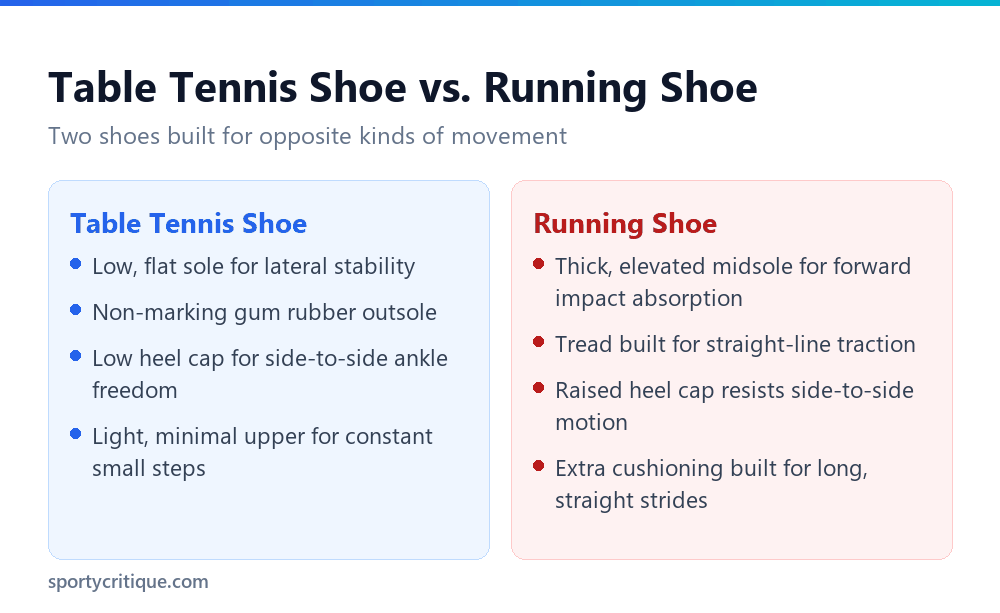
Table tennis shoes vs running shoes comes up constantly from players who already own a perfectly good pair of sneakers and don’t see why they’d need another pair just for table tennis. It’s a fair question, and the honest answer isn’t a flat yes or no. The two shoe types are built around opposite assumptions about how your foot moves, and that difference matters more in some situations than others. This breaks down what’s actually different, where it matters, and where it doesn’t, so you can decide for your own situation instead of taking either side on faith.
🏓 Table Tennis Hub: Explore all 70 paddle reviews, table comparisons, and spin drills in our Complete Ping Pong Resource Hub.
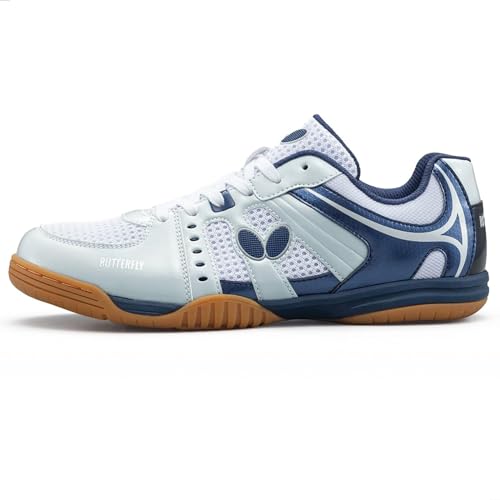
Running shoes are built for repeated forward motion: a raised heel, a thick cushioned midsole, and tread oriented for a heel-to-toe stride. Table tennis is almost entirely lateral, short, sharp side-to-side pushes rather than long forward strides, so a table tennis shoe drops the heel height, thins the sole, and switches to a grip pattern built for pivoting rather than running. For casual, occasional play, a running shoe won’t ruin your game. For regular or competitive play, the difference in stability and grip becomes hard to ignore.
Table of Contents
The Core Difference: Forward Motion vs. Lateral Motion
A running shoe is engineered around one repeated motion: the foot strikes at the heel and rolls forward to push off at the toe, over and over, thousands of times over a run. Every part of the shoe, the cushioning, the tread pattern, the flex point, is built around that specific roll.
Table tennis footwork doesn’t move like that. You plant, push off sideways or at a sharp angle, and reset, usually within a step or two of where you started. There’s very little heel-to-toe rolling motion involved. A shoe optimized for forward roll is, by design, not optimized for that lateral push, in the same way a shoe built for weightlifting isn’t built for sprinting even though both are athletic shoes.
Sole Height and Heel Cap
This is the difference players notice fastest once it’s pointed out. Running shoes raise the heel above the forefoot, usually by a meaningful margin, to cushion the repeated heel strike of running. That raised heel also comes with a taller heel cap around the ankle for support during forward motion.
Table tennis shoes flatten that out. A low, close-to-even sole keeps your foot closer to the ground, which shortens the lever your ankle has to control during a lateral roll. A lower heel cap gives your ankle more freedom to move side to side instead of bracing against a wall built for a different direction of stress. Neither design is wrong. They’re solving different problems.
Outsole Grip: Straight-Line Traction vs. Pivot Grip
Running shoe outsoles are built to grip pavement, trails, or a treadmill belt in one direction, forward. The tread pattern reflects that: lugs and grooves oriented to bite as the foot rolls heel-to-toe. A table tennis outsole is closer to flat, non-marking gum rubber, built to grip a sport-court floor across a wide range of angles rather than one direction. Push off sideways in a running shoe on a gym floor and you’ll often feel a slight slide before the tread catches, if it catches at all. That fraction of a second of slip is exactly the moment table tennis footwork can’t afford.
Weight and Upper Construction
Running shoes carry more structure in the upper and midsole to support and cushion a repetitive, high-mileage motion. That extra material adds weight that pays for itself over a five-mile run. It doesn’t pay for itself over a table tennis rally, where your feet are making small, constant adjustments rather than covering long distances. Table tennis shoes trade some of that structure for a lighter mesh upper, on the logic that quickness matters more than long-distance cushioning for this specific sport.
Cushioning Philosophy: Long-Distance Impact vs. Short-Burst Stability
Running shoe cushioning is designed around absorbing the same vertical impact thousands of times over a run, spreading that force across a thick midsole so joints don’t take the full hit on every stride. That’s a real engineering problem, and running shoes solve it well for what running actually demands.
Table tennis puts a different kind of stress on your feet: shorter, sharper, more frequent direction changes rather than one repeated vertical impact. A thick midsole doesn’t address that stress pattern well, and in some cases works against it by adding instability during a lateral cut. Table tennis shoe cushioning tends to sit lower and firmer, prioritizing a stable base over shock absorption, because the movement it’s protecting against is sideways rather than straight down.
Durability: Which Wears Out Faster in This Sport
A running shoe’s outsole wears from repeated forward contact, usually starting at the heel and the outer edge of the forefoot where a typical stride lands. Used for table tennis instead, that wear pattern shifts to spots the shoe wasn’t built to protect, often the outer edge near the toe where lateral pushes concentrate force the tread wasn’t designed to handle. The result is a running shoe that can wear unevenly and lose structure faster when it’s used for a sport it wasn’t built for, even if the total number of hours on the shoe is the same as normal running use.
💡 Pro tip: If you notice a running shoe wearing unevenly on one side after switching it into regular table tennis use, that’s a sign the shoe is being asked to do something its outsole wasn’t built for, not a manufacturing defect.
When a Regular Sneaker Is Genuinely Fine
- ✓Wear a flat, low-profile athletic sneaker for a casual game with friends
- ✓Use a running shoe for a single social session if it’s what you have
- ✓Switch to a dedicated shoe once you’re playing more than once a week
- ✕Rely on a running shoe for club or tournament-level competitive play
- ✕Ignore ankle instability during lateral movement and assume it’s normal
- ✕Expect a heavily cushioned trail or road running shoe to grip an indoor court well
Casual, occasional play is the honest exception here. If you’re playing once in a while at a family gathering or a rec center, the difference between a running shoe and a dedicated table tennis shoe isn’t going to be the deciding factor in how much fun you have. The gap matters more as frequency and intensity go up, which is exactly where the injury risk from a raised heel and weak lateral grip also goes up.
A Dedicated Shoe and a Middle-Ground Option
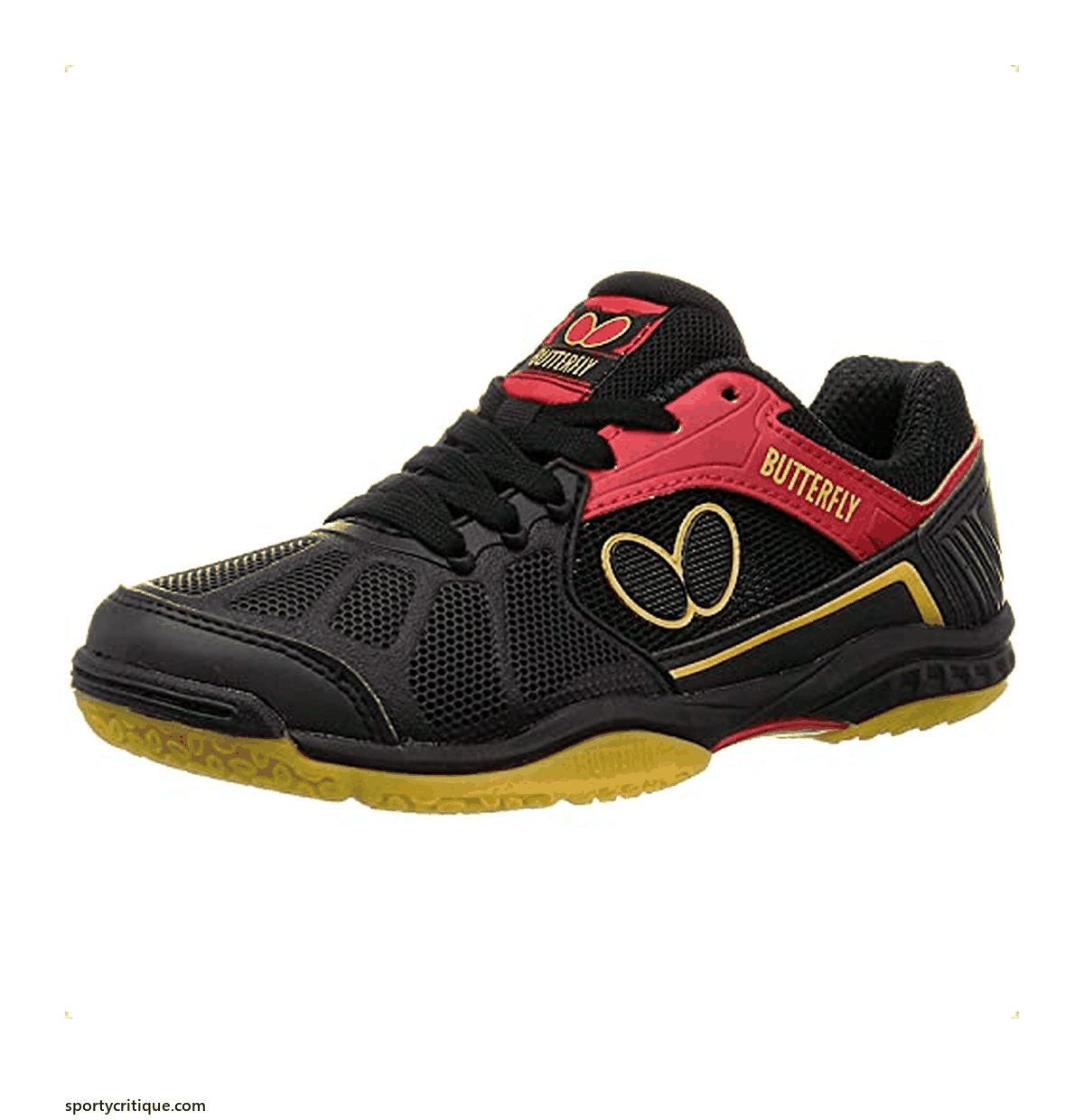
For a clear example of the dedicated end of this comparison, the Butterfly Lezoline Rifones ($159.99, in stock) is built with everything described above: low sole, non-marking outsole grip, light upper. Check the current listing ↗
If you’re not ready to commit to a shoe built specifically for this sport, the ASICS Gel-Rocket 11 ($69.48, only 1 left) sits in the middle. It’s a volleyball shoe, not a running shoe and not a table tennis shoe, but it shares the low sole and lateral-grip outsole that running shoes lack, which makes it a reasonable stepping stone between the two categories. See the current listing ↗
📊 Note: A pair of thin, non-bunching socks, like these table tennis socks at $10.95, matters more once you switch to a low-profile shoe than it does in a cushioned running shoe, since there’s less padding to absorb a bulky sock seam.
Why the Confusion Persists
Part of the reason this question keeps coming up is that both shoe types get lumped under the same general label of athletic footwear, and most sporting goods stores don’t separate them clearly on the shelf. A table tennis shoe and a running shoe can sit next to each other in the same aisle, priced similarly, marketed with the same generic language about comfort and performance. Nothing about the packaging tells you they were engineered for opposite movement patterns. That’s a marketing gap, not a sign the difference doesn’t matter.
The Side-by-Side Summary
- →Running shoes are built for forward, repetitive motion; table tennis is almost entirely lateral, short bursts.
- →A raised heel and thick midsole increase ankle-roll leverage during lateral movement instead of protecting against it.
- →Running shoe outsoles grip in one direction; table tennis outsoles grip across a wide range of push angles.
- →Casual, occasional players can get away with a regular sneaker. Regular or competitive players notice the gap quickly.
- →A dedicated shoe like the Lezoline Rifones or a crossover court shoe like the ASICS Gel-Rocket 11 both solve the lateral-grip problem a running shoe doesn’t.
Frequently Asked Questions
Can wearing running shoes for table tennis actually cause an injury?
The raised heel and taller heel cap on a running shoe increase the leverage on your ankle during a hard lateral push, which raises the chance of a roll compared to a low-profile court shoe. It’s not a guaranteed injury, but it’s a real, mechanical difference rather than just a comfort preference.
Are basketball or tennis shoes a better substitute than running shoes?
Closer, but still not the same. Basketball and tennis shoes are built for lateral movement too, so they share more with a table tennis shoe than a running shoe does. They tend to run heavier and more cushioned than table tennis shoes need, which can slow down the quick, small steps this sport relies on.
Do trail running shoes make the problem better or worse?
Worse, generally. Trail shoes add even more sole height and a more aggressive tread built for uneven outdoor terrain, both of which work against the low, flat, multi-directional grip a table tennis shoe needs on a smooth indoor court.
If I already own minimalist or zero-drop running shoes, are those closer to a table tennis shoe?
Closer on sole height, since minimalist shoes reduce or remove the raised heel. They still won’t have the same lateral-grip outsole pattern a table tennis shoe uses, so they’re a partial improvement over a standard running shoe, not a full substitute.
Will a running shoe mark up an indoor sport-court floor?
It can. Many running shoe outsoles use a darker rubber compound designed for outdoor pavement, which can leave scuff marks on lighter indoor court surfaces. Table tennis and other indoor-court shoes use non-marking rubber specifically to avoid this, which matters if you’re playing somewhere that requires non-marking soles.
Is it worth buying a table tennis shoe if I also play badminton or squash?
Usually yes. All three sports rely on similar lateral, stop-start footwork, so a shoe built around low sole height and multi-directional grip tends to transfer well between them. A shoe built specifically for one of those sports may have small differences, like extra cushioning for badminton’s jumping, but the core design still serves the others reasonably well.
How quickly would I actually notice the difference switching from running shoes?
Most players notice it within the first session, usually the first time they push off hard for a wide ball. The grip and stability difference tends to be more immediately obvious than the weight difference, which shows up more gradually over a longer session.
As an Amazon Associate, we earn from qualifying purchases through links on this page.