How to Treat Tennis Elbow: Stretches and Eccentric Strengthening Exercises


Knowing how to treat tennis elbow at home starts with a specific stretch and exercise routine, not a general instruction to rest. This guide walks through the actual movements: how to do the wrist extensor stretch correctly, the eccentric wrist extension exercise that physical therapists rely on most, and how to structure sets, reps, and load progression over several weeks without aggravating the injury.
🎾 Tennis Hub: Explore all 51 racket reviews, court shoes, and scoring rules in our Complete Tennis Resource Hub.
A daily routine of a wrist extensor stretch held for 30 seconds, followed by 3 sets of 10 to 15 slow eccentric wrist extensions using a light weight or resistance band, is the core self-directed exercise approach for tennis elbow. Consistency over 6 to 12 weeks matters more than intensity. Combine it with activity changes that remove whatever motion is aggravating your elbow, and stop or scale back any exercise that causes sharp, worsening pain rather than expected mild muscle soreness.
- →The wrist extensor stretch and eccentric wrist extension are the two exercises with the most consistent support
- →Eccentric means the slow lowering phase of a movement, that slow, controlled phase is the part that matters most
- →Start light: a can of soup or a very light dumbbell is a reasonable starting load for eccentric wrist extension
- →Sharp pain during an exercise means stop; mild working soreness afterward is expected and normal
- →Give the routine a genuine 6 to 12 weeks before judging whether it is working
Table of Contents
Before you start: a quick check
This routine is meant for a typical, previously diagnosed or clearly recognizable case of tennis elbow, pain and tenderness on the outer elbow that worsens with gripping or wrist extension. If you have not had it evaluated and pain is severe, came on suddenly with real trauma, or comes with numbness, tingling, or noticeable weakness beyond just pain, see a doctor before starting an exercise program rather than assuming it is straightforward tennis elbow.
Step 1: Warm up before stretching or exercising
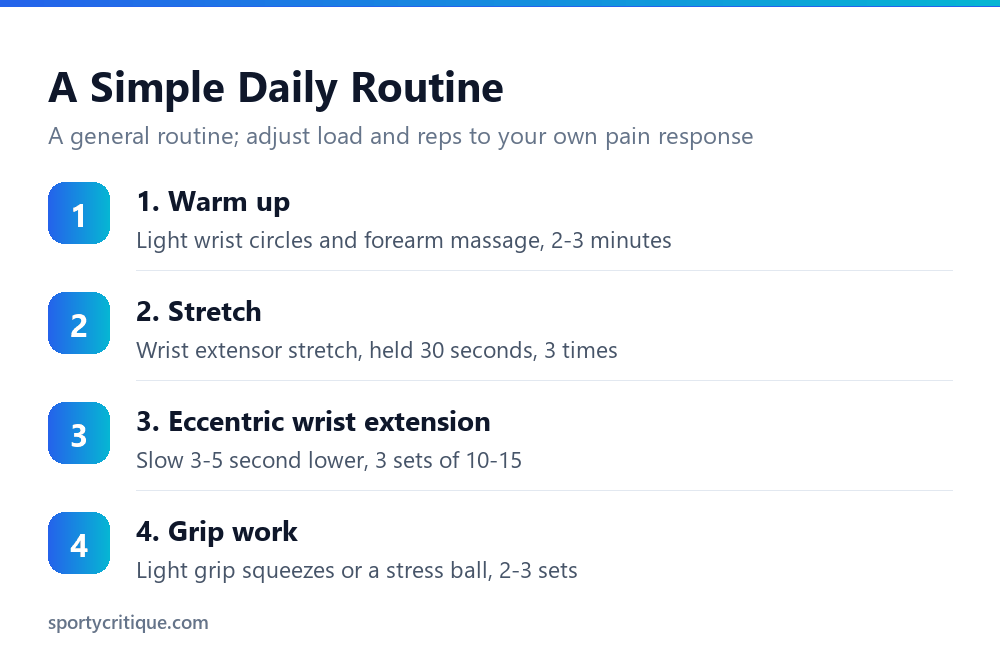
Spend two to three minutes on light wrist circles in both directions and gentle self-massage along the forearm muscles before stretching. Cold, unwarmed tissue is more prone to aggravation from a stretch or exercise than tissue that has had a couple of minutes of light movement first. This does not need to be elaborate, rotating the wrist slowly and rubbing the forearm muscles with your opposite hand covers it.
Step 2: The wrist extensor stretch
💡 Pro tip: You should feel a stretch along the top of your forearm, not sharp pain at the elbow itself. If straightening the elbow fully is too aggravating at first, a very slight bend while still pressing the wrist down is a reasonable modification to start with.
Step 3: Eccentric wrist extension, the key exercise
Eccentric means the muscle is lengthening under load, in this case the slow lowering phase after lifting your hand up. This slow, controlled lowering is the part of the exercise doing the actual work, which is why the technique below emphasizes the down phase specifically rather than treating this like a normal curl.
⚠️ Watch out: If the lowering phase causes sharp pain rather than a working, muscle-fatigue type of discomfort, reduce the weight before increasing reps. Progressing load too fast is a common way people aggravate tennis elbow while trying to treat it.
Two more exercises worth adding once the basics feel manageable
Eccentric wrist flexion
The same slow-lowering principle applied to the opposite motion: rest your forearm the same way, but this time hold the weight with your palm facing up. Use your other hand to lift the weight into wrist flexion (curling the palm up toward you), then slowly lower it back down over 3 to 5 seconds using only the affected arm. This targets the wrist flexor muscles on the inside of the forearm, which work alongside the extensors during grip and can benefit from the same kind of controlled loading, particularly for people whose tennis elbow involves gripping-heavy activity like racquet sports or manual work.
Forearm pronation and supination with light rotation
Hold a light weight, a hammer or a similarly shaped light dumbbell works, with your elbow bent at 90 degrees and tucked against your side. Slowly rotate your forearm so your palm faces down (pronation), then slowly back so it faces up (supination), controlling both directions rather than letting momentum do the work. This exercise targets the rotational control of the forearm, which is involved in many of the same activities, like a tennis stroke or a screwdriver motion, that aggravate tennis elbow in the first place.
Common technique mistakes that slow recovery
The most common mistake is treating the eccentric exercise like a normal curl, lifting and lowering at the same speed, rather than deliberately slowing down only the lowering phase. The slow lowering under control is the entire point of an eccentric exercise; rushing it removes most of the intended benefit even if you complete the same number of reps. A second common mistake is increasing weight before the current load feels fully manageable through the whole slow lowering phase, which tends to reintroduce the sharp pain the exercise is meant to gradually reduce. A third is skipping days inconsistently, since eccentric loading works through steady, repeated stimulus over weeks rather than occasional effort.
📊 Note: It is normal to feel a mild, dull ache in the forearm muscles for a day after a session, similar to typical muscle soreness after exercise. What is not normal is a sharp, localized pain spike at the elbow itself during or right after the exercise; that is the signal to reduce load rather than push through.
Icing after exercise: technique that actually helps
Apply ice wrapped in a thin towel, never directly on bare skin, for 10 to 15 minutes after the exercise session, particularly if the elbow feels warm or mildly swollen afterward. Longer than about 15 to 20 minutes does not add meaningful extra benefit and increases the risk of skin irritation or, in rare cases, frostbite with prolonged direct contact. A simple gel ice pack or a bag of frozen vegetables both work fine for this; there is no need for a specialized product unless you find the convenience worth it.
Step 4: Grip strengthening, added once the sharp pain has settled
Once daily pain has settled to a manageable level, adding light grip work, squeezing a stress ball or soft grip trainer for 2 to 3 sets of 10 to 15 squeezes, helps rebuild the grip strength that often drops noticeably during a tennis elbow flare-up. Keep this light early on; aggressive grip strengthening too soon can aggravate the same tendon the eccentric exercises are trying to calm down.
Progressing the exercise over several weeks
Fitting this into a busy schedule
The full routine described here, warm-up, stretch, eccentric wrist extension, and eventually grip work, realistically takes 10 to 15 minutes a day. If a busy day makes the full sequence hard to fit in, doing the eccentric wrist extension sets alone is a reasonable minimum, since that exercise carries most of the actual therapeutic value. Skipping entirely for a day is far less of a setback than skipping for a full week; the consistency that matters is measured over weeks, not perfect daily attendance.
What to do alongside the exercises
Exercise works best paired with identifying and reducing the specific motion that aggravates your elbow, whether that is a sport technique, a repetitive work task, or a home project. Ice for 10 to 15 minutes after exercise can help with any soreness, and a counterforce strap or compression sleeve can reduce strain during the activities you cannot fully avoid while you work through the program.
- ✓Warm up briefly before stretching or exercising
- ✓Focus on the slow lowering phase of the eccentric exercise, that’s the part doing the work
- ✓Start light and progress load gradually over weeks
- ✓Give the routine a genuine 6 to 12 week trial before judging it
- ✕Push through sharp, worsening pain during any exercise
- ✕Jump straight to heavy weight or high reps to speed things up
- ✕Skip the warm-up and stretch and go straight to loaded exercise
- ✕Ignore numbness, tingling, or weakness, that needs a doctor, not more exercise
How many times a day should I do these exercises?
Once daily is a reasonable standard starting point for the full routine, with the stretch alone done a few times through the day if it feels helpful. Consistency day to day matters more than doing the routine multiple times in one day.
What weight should I use for eccentric wrist extension?
Start very light, a can of soup or a one to two pound dumbbell is a reasonable starting point, and increase gradually only once the current weight feels manageable through the full slow lowering phase without sharp pain.
How long until I notice improvement?
Many people notice some improvement in pain within a few weeks, but a full course is typically described as 6 to 12 weeks. Grip strength often takes longer to fully recover than day-to-day pain does.
Should I stretch before or after exercising?
Both have a place: a brief stretch as part of the warm-up before the eccentric exercises, and again afterward once the muscles are warm, can help with overall flexibility.
What if the exercises make my pain worse?
Reduce the weight or reps immediately, and if pain is worse rather than the expected mild muscle soreness, stop the routine and check in with a doctor or physical therapist before continuing, since technique or load progression may need adjustment.