Best Ball for Soccer: 4 Verified Picks From Training to Match Day


Before brand or price, get the size right: size 5 for 13 and up, size 4 for roughly ages 8 to 12. Here’s how four verified, currently sold soccer balls split between casual recreational play and frequent training use.
⚽ Soccer Hub: Explore all 30 cleat reviews, striking tutorials, and recruiting guides in our Complete Soccer Resource Hub.
The single most important spec on a soccer ball is size, not brand. Size 5 is standard for adults and players roughly 13 and up; size 4 fits players roughly 8 to 12; size 3 is for younger kids. Beyond size, the real split is between recreational balls (built for casual play, generally cheaper) and training or club-tier balls (built for repeated practice sessions, generally sturdier and pricier). We checked pricing and stock on four listings spanning both sizes and both categories.
A lot of soccer ball marketing leans on vague words like “performance” without saying what that actually means in construction terms. What we can verify, and what we’re sticking to here, is size, price, brand, and current stock status, checked directly against Amazon’s own product data. We’re not going to claim we personally struck each of these balls on a field and compared the touch, because we didn’t; what follows is an honest comparison of what’s actually for sale and what the size and category differences mean practically.
- →Size matters more than brand: size 5 for 13 and up, size 4 for roughly ages 8-12, size 3 for younger kids
- →Recreational balls are cheaper and fine for casual play; training and club-tier balls are built for repeated practice
- →Check the size printed on the listing, not just the age range in the title, before buying
- →Lower-stock or club-tier listings can sell out faster than mass-market recreational balls; check current availability
- →A more expensive ball is not automatically the right size or the right category for your use case
Table of Contents
Size first, everything else second
Before comparing brands or price, confirm the size you actually need. Size 5 is the regulation adult size used from about age 13 through professional play. Size 4 is smaller and lighter, standard for roughly ages 8 to 12, and easier for smaller feet and developing technique to control. Size 3 is smaller still, for young children. Buying the wrong size doesn’t just feel off, it can actually slow skill development for younger players, since a ball that’s too heavy or too large for their foot encourages compensating technique rather than clean contact.
This matters directly for two of the four balls below: the Wilson Traditional is a size 5, built for adult and older youth play, while the Wilson NCAA Vantage in our comparison is a size 4, built for younger players. They’re from the same brand and similar price range, but they are not interchangeable for the same player, and buying based on brand name alone without checking the size would be a mistake.
⚠️ Watch out: Listing titles don’t always make the size obvious at a glance, especially when the same product line sells in multiple sizes. Check the size explicitly stated in the listing details before adding to cart, not just the thumbnail image or the general product name.
Recreational versus training and club-tier balls
A recreational ball is built for casual, lower-frequency play: weekend games, backyard practice, general kickabouts. It’s cheaper because it doesn’t need to survive daily impact at a training facility. A training or club-tier ball costs more because it’s built to hold its shape and air pressure through repeated, frequent use, the kind of wear a ball doing 50 shooting reps a session for months takes on. If you’re buying for occasional family use, paying for training-tier construction is money spent on durability you won’t stress-test. If you’re buying for a player training several times a week, the cheaper recreational ball may wear out and go soft faster than the extra cost of a training ball would have.
Four verified options across sizes and categories
We checked live pricing and stock for four listings spanning both size categories and both recreational and training-tier construction.
Wilson Traditional Soccer Ball

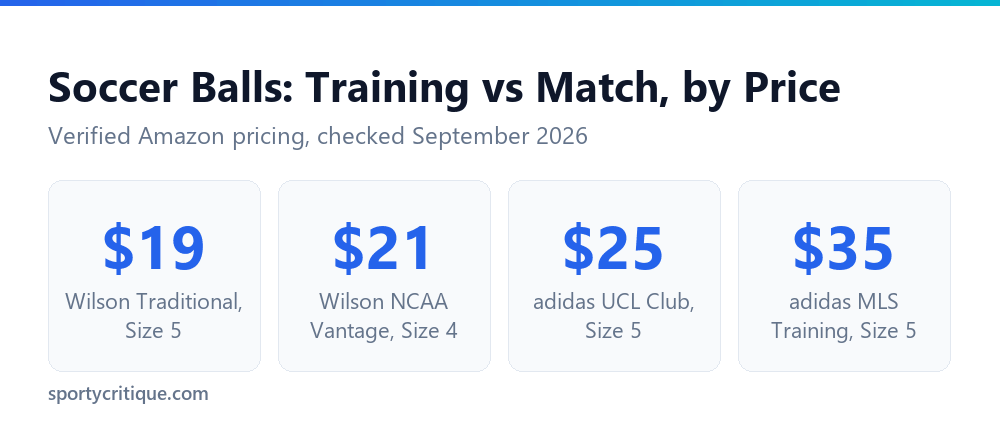
The Wilson Traditional Soccer Ball was listed at $18.67 at last check, verified in stock. Size 5 (standard adult/youth 12+). It’s the cheapest of the four, a straightforward recreational build in the standard size 5, sized for adult and older youth casual play and practice.
Wilson NCAA Vantage Soccer Ball

The Wilson NCAA Vantage Soccer Ball was listed at $21.37 at last check, verified in stock. Size 4 (youth, roughly ages 8-12). This is a size 4, not size 5, meant for younger players roughly ages 8 to 12 rather than adults; double check the size against your league’s age bracket before buying, since size and age don’t always map the way people assume.
adidas UCL Club Soccer Ball

The adidas UCL Club Soccer Ball was listed at $25.31 at last check, verified in stock. Size 5. Stock on this one was tight at last check, only a single unit listed, so confirm current availability on the listing before counting on it; club-tier balls like this one restock in smaller batches than mass-market recreational balls.
adidas MLS Training Soccer Ball

The adidas MLS Training Soccer Ball was listed at $34.99 at last check, verified in stock. Size 5. It’s the most expensive of the four, positioned as a training ball rather than a casual recreational ball, meant for repeated practice sessions rather than occasional weekend play.
What actually differs in construction between tiers
Recreational balls are typically machine-stitched panels over a rubber or butyl bladder, a simple, durable, and cheap-to-manufacture construction that’s been standard for decades. Training and match-tier balls more often use thermally bonded panels, meaning the seams are heat-fused rather than stitched, which reduces water absorption and keeps the ball’s flight and weight more consistent through a season of use. This is a general, well-established difference in soccer ball manufacturing rather than a specific claim about any one listing above; check each product’s own description for its exact seam construction if that detail matters for your purchase, since not every listing states it explicitly.
💡 Pro tip: If you’re buying for a player who trains several times a week, ask whether the ball needs frequent re-inflating after storage. A ball that loses air quickly between sessions usually points to a lower-grade bladder, and repeated re-inflation over time can shorten a cheaper ball’s usable life faster than the wear from play itself.
Matching the ball to how it’ll actually be used
- ✓Confirming the exact size (3, 4, or 5) against the player’s age before comparing brands
- ✓Choosing a recreational ball for occasional, casual play where cost matters more than durability
- ✓Choosing a training or club-tier ball for a player training multiple times a week
- ✓Checking current stock on lower-availability, club-tier listings before counting on a specific ball
- ✕Buying a size 5 ball for a player who needs a size 4 just because the price looked good
- ✕Assuming the most expensive ball is automatically the right choice for casual weekend play
- ✕Ignoring stock warnings on limited-availability listings and hoping it restocks in time
- ✕Judging a ball purely by star rating without checking whether the size matches your need
Common myths about soccer balls
Basic care that actually extends a ball’s life
Most soccer balls arrive partially deflated and need inflating with a needle pump before first use. Overinflating past the pressure printed on the ball (usually in the 8.5 to 15.6 psi range depending on size and brand) stresses the seams and bladder unnecessarily, while underinflating changes how the ball responds off the foot and makes it feel dead on contact. Check the printed PSI range on the ball itself rather than guessing, and use a pressure gauge if you have one rather than inflating by feel.
Storage matters more than most players expect. A ball left fully inflated in a hot car or garage through a summer will lose air faster and can develop a seam issue sooner than one stored at moderate temperature. Deflating slightly for long-term off-season storage, and keeping the ball out of direct sun when it’s not in use, extends the usable life of any ball regardless of price tier.
📊 Note: None of the four listings above publish an exact number of hours or sessions before performance noticeably degrades, and we’re not going to invent one. Expect a recreational ball used several times a week to need replacing well before a training-tier ball used at the same frequency, but the actual timeline depends heavily on surface (turf wears balls faster than grass) and storage habits.
Bottom line
Get the size right before anything else: size 5 for 13 and up, size 4 for roughly ages 8 to 12. From there, a recreational ball like the Wilson Traditional covers casual and weekend play at a lower price, while a training-tier ball like the adidas MLS Training ball is worth the extra cost for a player training several times a week. Check current stock before counting on any specific listing, especially the lower-availability club-tier option above.
What size soccer ball should I buy?
Size 5 is standard for players roughly 13 and older, including adults. Size 4 fits players roughly ages 8 to 12. Size 3 is for younger children. Check the size stated explicitly in a listing’s details rather than assuming it from the product photo or age range in the title.
What’s the difference between a training ball and a recreational ball?
A recreational ball is built for casual, lower-frequency play and generally costs less. A training or club-tier ball is built to hold its shape and pressure through frequent, repeated use, often using thermally bonded rather than stitched seams, which usually costs more but holds up better for a player training several times a week.
Is a more expensive soccer ball always better?
Not for every use case. For occasional, casual play, a cheaper recreational ball is entirely adequate and you’d be paying for durability you won’t stress-test. For frequent training, the extra cost of a training-tier ball tends to pay off in how long it holds its shape and air pressure.
Why does a soccer ball go soft or lose air over time?
This usually points to bladder quality or a small leak developing at a valve or seam over repeated use. Cheaper recreational balls tend to need more frequent re-inflation than training-tier balls with thermally bonded seams, though any ball can develop a slow leak with enough wear.
Can I use a size 4 ball for an adult casual game?
You can, but it’s not standard. A size 4 ball is smaller and lighter than the regulation size 5 used in adult and older youth play, so it will feel and fly differently than what most players are used to. For anything beyond casual backyard use, stick to size 5 for players 13 and up.
As an Amazon Associate, we earn from qualifying purchases through links on this page.