Best Ping Pong Ball for the Money: Our Single Pick, Explained


If you just want the best ping pong ball for the money without sorting through a price-tier breakdown yourself, here’s our single recommendation and the specific reasoning behind it, not a menu of options to weigh on your own.
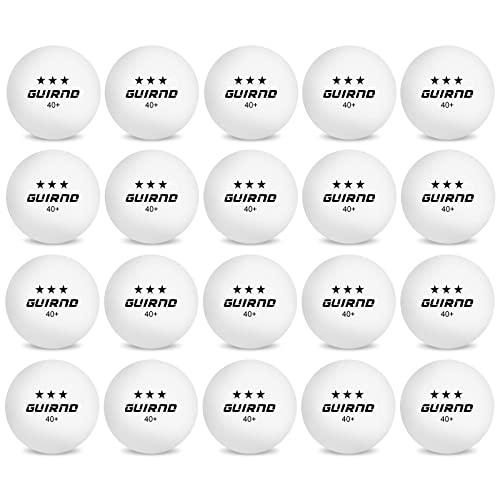
Our pick for the best ping pong ball for the money is the PRO-SPIN 3-Star Premium Orange 12-pack. It’s ITTF-tier three-star quality at a small-pack price that undercuts most other certified balls we checked, without dropping to the inconsistency of an unrated one-star ball. It’s the right call if you want one specific answer rather than a menu of price tiers to sort through yourself.
This is a single-recommendation guide, not a comparison chart. If you’d rather see how price scales across the full one-star to three-star range and decide for yourself, our broader price-tier breakdown covers that ground instead. Here, we’re making one specific case for one specific product and explaining exactly why it earns the recommendation.
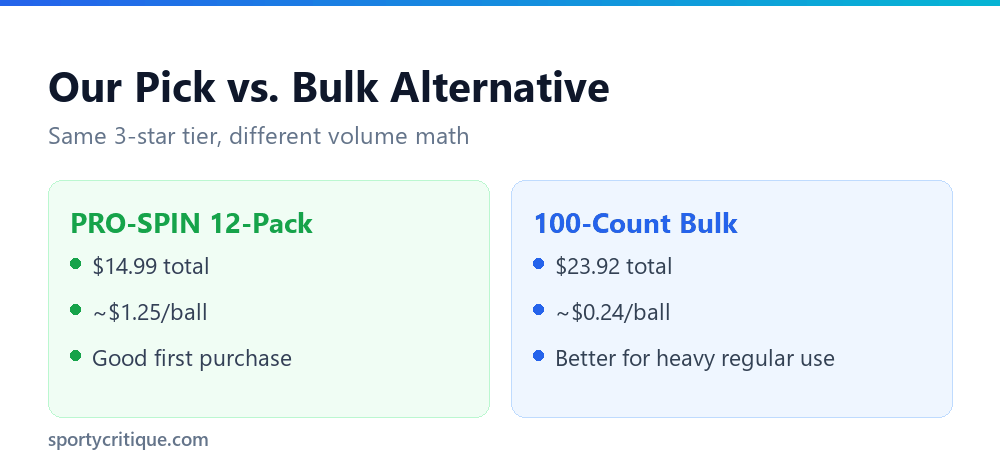
- →Our pick is the PRO-SPIN 3-Star Premium Orange 12-pack, currently around $1.25 per ball
- →It carries genuine three-star, ITTF-tier manufacturing quality, not a diluted mid-tier claim
- →The 12-pack size avoids overcommitting to bulk before you know you like the ball
- →Orange is the tournament-standard color, better contrast against most table surfaces than white
- →If you go through balls fast enough to justify buying in bulk, we name the better bulk option too
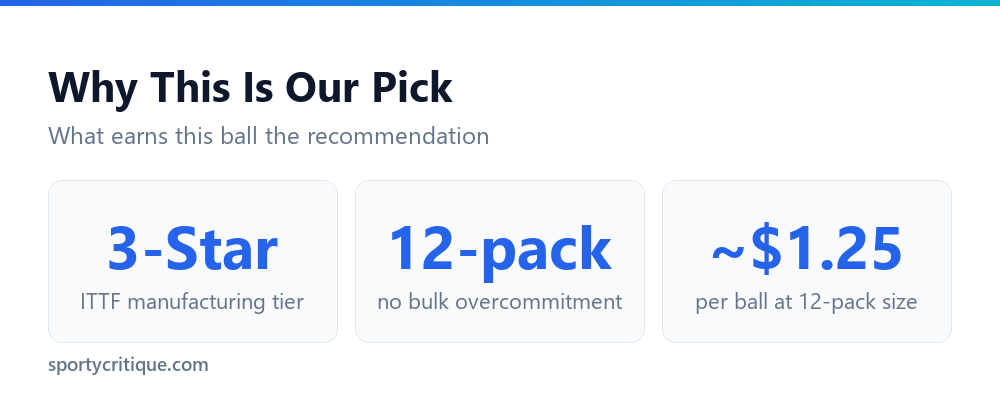
Table of Contents
The pick
The PRO-SPIN 3-Star Premium Orange Table Tennis Balls, 12-pack is our answer for anyone who wants the best ping pong ball for the money without picking through a tier chart first. It’s built to the same 40+ millimeter ABS plastic, three-star manufacturing standard used in ITTF-sanctioned play, sold in a 12-ball pack that’s large enough to actually get through a season of casual-to-serious play without committing to a 100-count box before you’ve confirmed you like the ball.
The case for value here isn’t that this is the cheapest three-star ball available in absolute terms, it’s that the price-to-quality ratio holds up better than the alternatives we checked at a similar pack size. Several small-pack three-star listings run noticeably higher per ball for the same certification tier, without a corresponding jump in build quality that would justify the premium.
Why three-star and not a cheaper tier
A one-star or two-star ball would cost less up front, but “for the money” is a value question, not just a cheapest-price question. A one-star ball’s looser manufacturing tolerance means more mis-bounces and more replacements over time, so the sticker savings shrink once you account for how many you’ll actually use before you’re annoyed enough to upgrade anyway. Starting with an actually certified ball avoids that mid-purchase regret entirely.
⚠️ Watch out: Watch for listings that say “professional” or “tournament grade” without stating an actual star rating. That’s marketing language filling in for a spec the seller isn’t willing to commit to. A ball that’s truly three-star will say so explicitly, usually in the title itself, not just in a review blurb.
Why orange, and why this pack size
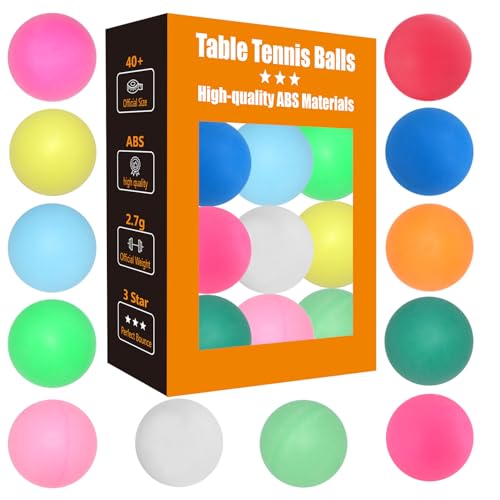
Orange and white are both regulation tournament colors, so the choice between them is about contrast, not legality. Orange stands out better against a standard blue or green table and under most indoor lighting, which is part of why competitive players lean toward it when a table isn’t neutral-colored. White remains the more traditional choice and performs identically otherwise.
The 12-ball pack size is deliberate in this recommendation. It’s enough balls to survive normal play, mis-hits, and the occasional one rolling under furniture, without asking you to commit to a 100-count box on a ball you haven’t played with yet. Once you know you like it, buying a larger case of the same ball is the more economical move, and we name that option below.
If you go through balls faster than this
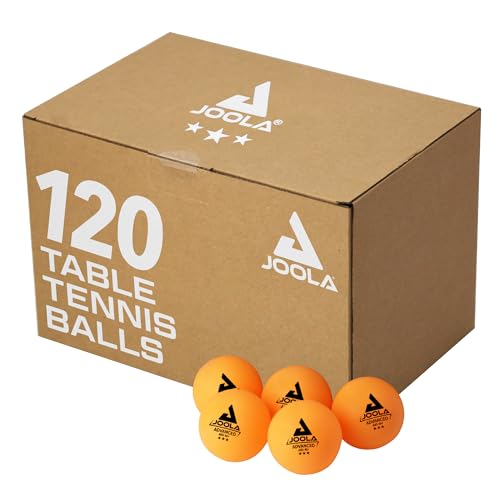
Regular players who burn through balls quickly should look at the 100-count 3-Star Orange bulk box instead. It’s the same certification tier at a lower cost per ball once you’re buying in that volume, and it makes sense once you already know a three-star ball suits your play rather than as a first purchase.
How we’re defining “value” here
Value isn’t the same question as “cheapest.” A ball that costs half as much but bounces unpredictably one time in ten isn’t a better deal, it’s a worse product you happened to pay less for. Our definition weighs three things against each other: certification tier, price per ball at a realistic purchase size, and whether the pack size matches how most people actually buy their first set of balls, rather than assuming everyone wants to commit to a 100-count box on day one.
That’s a different lens than a straightforward price-per-unit spreadsheet would use, and it’s deliberate. Plenty of listings win on raw per-ball cost by cutting either pack size flexibility or actual manufacturing consistency, and neither of those trade-offs shows up in a simple price comparison until you’re already mid-game and the ball won’t bounce the same way twice.
What the seam construction tells you
Most modern three-star balls, including this one, are built as a seamless single piece rather than two glued hemispheres. That matters for value because seamed construction is where a lot of the older, cheaper manufacturing inconsistency used to come from: an off-center seam changes how the ball flies and spins in a way that’s hard to predict shot to shot. Seamless construction removes that specific failure point, which is part of why current three-star balls hold their certification more reliably than older seamed designs did.
📊 Note: Listings don’t always state seam construction explicitly. If a product claims three-star ITTF-tier quality without a visible seam in photos, that’s a reasonable sign it’s built to the current seamless standard rather than an older or lower-grade production method.
How this compares to buying a paddle-and-ball bundle instead
Some listings bundle a handful of balls in with paddles, a net, or a carrying case. Those bundles can look like better value on price alone, but the balls included are frequently one-star or unrated filler rather than the three-star quality this pick offers, because the bundle’s actual value is concentrated in the paddles. If you already own paddles and a table and just need good balls, buying balls specifically, rather than as an afterthought in a bundle, is almost always the better use of the same money.
What we’d flag as a downside
No small-pack ball is the cheapest per-unit option on the market, and this one isn’t either; that title goes to bulk boxes, and to uncertified one-star balls if certification doesn’t matter to you at all. If your only priority is the lowest possible price and you don’t care about tournament-tier consistency, this isn’t the pick for you, and we’d point you to the price-tier breakdown instead so you can choose a cheaper tier deliberately rather than by accident.
What happens after the first few sessions
Expect the pack to thin out faster than you’d guess. Between balls that roll away and never get found, mis-hits that crack a ball on a table edge, and normal wear from smashes, a 12-pack for two regular players tends to last a few weeks of consistent play rather than a full season. That’s normal and not a sign of a weak product; it’s the actual attrition rate of ping pong balls in general use, which is exactly why we frame the bulk box as the next purchase once you’ve confirmed this is the ball you want to keep buying.
If you notice a ball has developed a small dent rather than cracking outright, retire it from serious play even though it still looks mostly fine. A dented ball will bounce differently in a way that’s easy to miss casually but obvious once you’re rallying at speed, and continuing to use it undermines the entire reason for buying a certified ball in the first place.
💡 Pro tip: Store any three-star ball in its original packaging or a padded case rather than loose in a bag. A dent from something heavy pressing against it undoes the manufacturing consistency you paid for, and an out-of-round ball plays the same regardless of what its box says.
Who should buy this specific ball
- ✓You want one confident recommendation instead of researching tiers yourself
- ✓You play often enough to want a certified bounce, but not so often you need 100 balls yet
- ✓You want a pack size that doesn’t ask you to overcommit before trying the ball
- ✕You only play a few times a year; a cheaper one-star pack fits better
- ✕You already go through balls quickly; the bulk box is the better buy
- ✕You need a specific ball color to match table branding or a club requirement
How this pick holds up against name-brand alternatives
Bigger table tennis brands sell three-star balls too, often at double or triple the price for the same certification tier. Some of that premium buys a marginally tighter tolerance that only matters at a truly elite competitive level; most of it is brand equity. For recreational and club-level play, the practical difference between this pick and a name-brand three-star ball is small enough that the price gap isn’t worth paying unless you’re specifically shopping for a sponsor-required or league-mandated brand.
Bottom line
For most people asking which ping pong ball is the best for the money, the honest answer isn’t a tier chart, it’s one specific, properly certified ball at a fair per-unit price and a pack size that doesn’t force an oversized commitment. That’s what this pick is built around, and it’s the one we’d hand a friend who just wants a straight answer instead of homework before their next game night.
One last practical note: check the current listing price before you buy rather than trusting the numbers in this article as fixed. Amazon pricing on ping pong balls shifts with promotions and seller stock fairly often, and while the relative value case for this pick holds up across normal price fluctuations, it’s worth a quick glance at the live page to confirm you’re still getting the deal described here.
What is the single best ping pong ball for the money?
Our pick is the PRO-SPIN 3-Star Premium Orange 12-pack. It carries genuine ITTF-tier three-star manufacturing quality at a per-ball price that beats most other small-pack three-star listings we checked.
Is a 12-pack better value than a 100-count bulk box?
It depends on how much you play. The 12-pack has a higher per-ball cost but is a safer first purchase. Once you know you like the ball, the 100-count box brings the per-ball price down significantly for regular players.
Does ball color affect performance or value?
No. Orange and white are both regulation tournament colors and perform identically; the choice is about contrast against your table, not quality or price.
Why not just buy the cheapest one-star ball instead?
You can, and for very casual play it’s a reasonable choice. But a one-star ball’s looser manufacturing tolerance means more inconsistent bounces, which shows up quickly once you’re playing somewhat regularly rather than a few times a year.
As an Amazon Associate, we earn from qualifying purchases through links on this page.