
Best Ping Pong Balls for Price: A Tier-by-Tier Comparison


Comparing the best ping pong balls for price means looking at more than the sticker cost. Prices range from under a dollar a ball to well over a dollar, and the difference isn’t marketing, it’s manufacturing tolerance. Here’s what each price tier actually buys you, so you can pick the right one for how you play instead of guessing.
Price on ping pong balls tracks star rating, not brand. One-star balls run roughly $0.60 to $0.85 each and are fine for backyard rallies. Two-star balls sit in the middle and mostly exist for training. Three-star, ITTF-approved balls cost the most per ball but are the only ones with a consistent, certified bounce, and buying them in a 100-count bulk box brings the per-ball price down close to what a two-star ball costs.
This is a companion piece to our single-pick value guide, which names one specific ball as the best buy for most players. That’s the right read if you just want an answer. This one is for the opposite situation: you want to understand what you’re actually paying for at each price point before you decide which tier fits your budget and how you play.
- →Star rating, not brand name, is the real driver of price across ping pong balls
- →One-star balls are the cheapest per ball but have real roundness and bounce variance
- →Two-star balls are a training compromise: better than one-star, not certified like three-star
- →Three-star (ITTF-approved) balls cost the most per unit in small packs, but bulk 100-count boxes close that gap
- →All modern tournament-legal balls are 40+ ABS plastic, not the older celluloid material
Table of Contents
Why the price actually varies
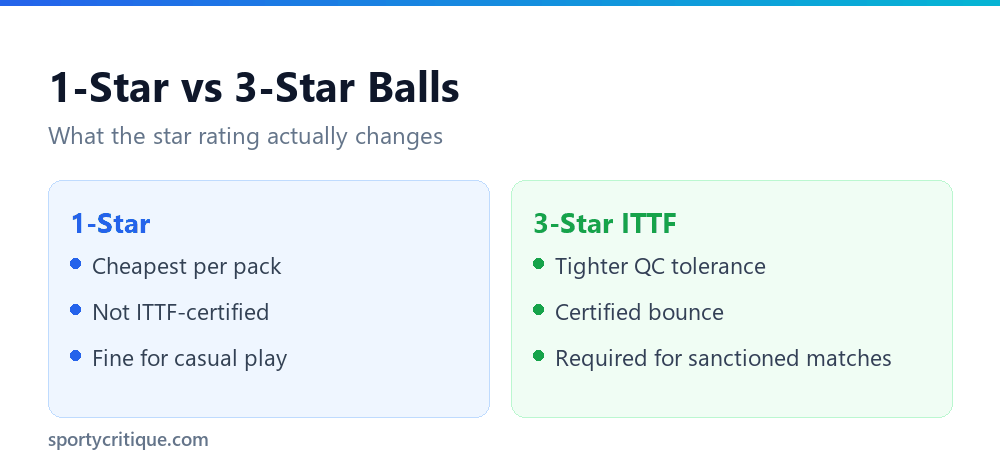
Table tennis balls are rated on a one-to-three star scale that describes manufacturing consistency, not size or color. Every rating uses the same 40+ millimeter ABS plastic standard the sport switched to when the ITTF phased out celluloid balls in 2014, so a one-star ball and a three-star ball from the same brand are the same base material. What changes between tiers is how tightly the factory controls roundness, wall thickness, and weight during production, and that quality control is what you’re paying for as the star count goes up.
A one-star ball can come out of the mold slightly out of round or with uneven wall thickness in a way that’s invisible to the eye but shows up as an inconsistent bounce or a wobble in flight. That’s tolerable in a backyard game where nobody’s tracking spin precisely. It’s not tolerable in a rated match, which is exactly why sanctioned play requires three-star, ITTF-approved balls specifically.
Tier 1: one-star, the cheapest entry point
The STIGA 1-Star White Ping Pong Balls is a straightforward example of this tier. It’s sold in a small pack rather than bulk, which keeps the per-ball price higher than you’d expect from a one-star rating, but the balls themselves are exactly what the rating promises: fine for casual games, not built for consistent competitive bounce. If you’re outfitting a rec-room table for family use or replacing balls that roll under the couch and get lost, this tier does the job without overpaying for certification you don’t need.
⚠️ Watch out: Don’t buy one-star balls for a table tennis robot or serious drilling. The roundness variance that’s invisible in a casual rally becomes obvious and annoying when a machine is feeding you the same shot repeatedly and the bounce height keeps shifting ball to ball.
Tier 2: two-star, the training middle ground
The STIGA 2-Star Spin Tracker Ping Pong Balls sits between the two certified tiers. Two-star balls aren’t ITTF-approved for sanctioned play, but the manufacturing tolerance tightens up noticeably from one-star, which means more consistent bounce during repetitive drills without paying full three-star prices for balls you’re going to lose to mis-hits and wear anyway. This is the tier most club-level players actually use for solo practice and multiball training, saving the three-star balls for matches.
Tier 3: three-star, ITTF-approved
In a small pack, three-star balls like the PRO-SPIN 3-Star ITTF-Approved Table Tennis Balls cost noticeably more per ball than the lower tiers. That’s the certification tax: every ball in the batch has to meet a tighter roundness and weight tolerance to earn ITTF approval, and that quality control isn’t free. What you get in exchange is a bounce that’s consistent enough to trust in a competitive rally, which matters once you’re playing someone who can actually exploit an unpredictable ball.
The per-ball math changes once you buy in bulk. A 100-count box like the MAPOL 100-Count White 3-Star Table Tennis Balls brings the cost per ball down to roughly what you’d pay for a small pack of two-star balls, while every ball in the box still carries the three-star rating. If you’re going to lose or wear through balls quickly anyway, which is normal for anyone playing regularly, buying three-star in bulk is usually the better value than buying two-star in small packs.
Does the brand name matter at all?
Somewhat, but less than people assume. Established table tennis brands tend to have tighter internal quality control even within the same star rating, so a one-star ball from a dedicated table tennis brand may still bounce more predictably than a one-star ball from a generic party-supply seller. That said, the star rating is still the bigger signal. A no-name three-star ball that’s genuinely ITTF-tested will outperform a well-known brand’s one-star ball every time, because the rating reflects an actual manufacturing standard, not just reputation.
How to read a listing so you know what tier you’re actually buying
The star rating should be stated explicitly in the product title or bullet points. If a listing doesn’t mention a star rating at all, treat it as unrated and assume it’s closer to one-star quality regardless of price. Also check whether the listing specifically claims ITTF approval, since that’s the actual competitive-legality marker, not just the word “professional” or “tournament” used loosely in the title.
💡 Pro tip: If you’re buying for a robot or ball machine, prioritize consistency over star rating alone. Two-star balls from a brand known for tight tolerances can outperform a poorly reviewed three-star ball from an unfamiliar seller. Check the review text, not just the star count on the box.

Picking a tier for how you actually play
- ✓Buy 1-star for backyard tables, kids, or casual multi-family use
- ✓Buy 2-star for solo drilling where you’re not chasing certified bounce
- ✓Buy 3-star in bulk if you play regularly and go through balls fast
- ✓Buy 3-star in a small pack only if you need a handful for a specific match
- ✕Don’t buy 1-star for robot training; the bounce variance will frustrate you
- ✕Don’t assume “professional” in a title means ITTF-approved
- ✕Don’t buy small three-star packs repeatedly when a bulk box is cheaper per ball
- ✕Don’t mix tiers in the same match; the bounce difference is noticeable mid-rally
Durability differences between tiers
Price also tracks how long a ball survives real use, though not in the direction some buyers expect. A one-star ball is thinner-walled and cracks or dents sooner under a hard smash, but since it’s also the cheapest, replacing it is a minor cost. A three-star ball holds its shape better under repeated hard hits, which is part of why it’s the standard for matches where a cracked or dented ball mid-game is a real problem, not just an inconvenience. Neither tier is meaningfully more “durable” in an absolute sense; they’re built to different priorities.
Storage matters more than most buyers assume, and it applies across every tier equally. ABS plastic balls, unlike the old celluloid ones, don’t degrade from humidity the way older stock did, but they do dent if something heavy sits on them in a drawer or bag. A ball that’s slightly out of round from storage damage will behave unpredictably regardless of what star rating is printed on the box, so a dented three-star ball is worse to play with than an undamaged one-star ball.
Where the price actually goes when you buy online
Amazon listings for ping pong balls vary a surprising amount in presentation even within the same tier. Some sellers bundle balls with paddles or a storage case, which raises the sticker price but isn’t really a per-ball price increase, it’s a bundle. If you’re comparing price purely on balls, subtract out anything bundled before judging whether a listing is actually expensive for its tier or just packaged differently.
Color is another variable that doesn’t track with quality but does track with price in a small way. Orange and white are both standard tournament colors and cost the same to produce; novelty colors, glow-in-the-dark variants, or seasonal packaging sometimes carry a small premium that has nothing to do with the ball’s actual manufacturing tier. If price is your priority, standard orange or white in the tier you need is almost always the better buy over a novelty-colored version of the same rating.
A quick gut check before you buy
Ask yourself two questions before adding a listing to your cart: how often do you actually play, and does anyone you play against care about a certified bounce. If the honest answer is “a few times a year” and “no,” the one-star tier is not a compromise, it’s the correct choice, and spending more on three-star balls for that use case is money that would be better spent on a paddle upgrade instead. If you play weekly or you’re in any kind of club or league setting, the three-star bulk option earns its price back in fewer bad bounces and arguments about whether that shot was really in.
Bottom line
There’s no single “best price” tier because the right one depends on how seriously you play. Casual and family use doesn’t need to pay the three-star certification premium. Regular players who want a trustworthy bounce should buy three-star, and buying it in bulk is what actually makes the price reasonable. If you want one specific recommendation instead of a tier breakdown, our single-pick guide below covers exactly that.
Are three-star ping pong balls worth the extra cost?
For regular or competitive players, yes. The tighter manufacturing tolerance means a more consistent bounce, which matters once you’re playing someone who can read and exploit an unpredictable ball. For casual or backyard use, the extra cost usually isn’t worth it.
What’s the actual difference between 1-star and 3-star balls?
Manufacturing consistency, specifically roundness, wall thickness, and weight tolerance during production. The base material and size are the same across all three tiers; only the quality control tightens as the rating goes up.
Is it cheaper to buy ping pong balls in bulk?
Per ball, almost always. A 100-count box of three-star balls typically brings the per-ball cost down close to what a small pack of two-star balls costs, while every ball still carries the three-star rating.
Do I need 3-star balls for casual home play?
No. One-star or two-star balls are perfectly adequate for casual, family, or backyard play where nobody is tracking a certified tournament-legal bounce.
As an Amazon Associate, we earn from qualifying purchases through links on this page.


