
Best Ping Pong Balls for Spin: What Actually Affects It


Shopping for the best ping pong balls for spin gets confusing because a lot of listings imply the ball itself controls how much spin you can put on a shot. It doesn’t. Here’s what ball construction actually changes, and what to upgrade instead if more spin is the real goal.
Spin in table tennis comes mostly from paddle rubber, not the ball itself, so no ball makes you spin the ball harder. What a ball’s construction does change is how consistently it holds and releases spin on contact, and that comes down to two real factors: seamless versus seamed construction, and manufacturing consistency tied to star rating. A visually patterned ball can also help you learn to see and read spin, which is a training benefit, not a physical one.
It’s worth being upfront about something a lot of ball listings blur together: a ball doesn’t generate spin, your paddle rubber and stroke do that. What the ball affects is how reliably that spin transfers and how visible it is once it’s on the ball. This guide separates those two things so you’re not shopping for a property balls don’t actually have.
- →Spin is generated by paddle rubber and stroke technique, not by the ball itself
- →Seamless construction gives more consistent spin behavior than older seamed balls
- →Manufacturing tolerance (star rating) affects how predictably a ball holds spin under contact
- →Patterned “spin tracker” balls help you see and learn to read spin, which is a real training aid
- →A poorly-made ball can make spin look inconsistent even when your technique is fine

Table of Contents
Seamless versus seamed construction
Older table tennis balls, and some cheaper current ones, are built from two glued hemispheres with a visible seam running around the ball. Modern three-star balls are almost universally seamless, molded as one piece. The seam itself doesn’t stop a paddle from generating spin, but an off-center or uneven seam changes the ball’s weight distribution slightly, which can cause a subtle wobble in flight that makes spin harder to read consistently, especially on serves where the receiver is trying to judge rotation from ball flight alone.
This matters more for the receiving player’s ability to read spin than for the serving player’s ability to generate it. If you’re specifically working on serve variation and want your opponent, or yourself during solo practice, to get a clean read on the spin you’re actually producing, a seamless ball removes one source of flight inconsistency that has nothing to do with your technique.
Manufacturing tolerance and why it matters here
A PRO-SPIN 3-Star ITTF-Approved ball is built to a tighter roundness and wall-thickness tolerance than a lower-star ball, and that consistency is what lets spin behave the same way shot after shot. An out-of-round ball can grip a paddle’s rubber slightly differently depending on which part of the ball makes contact, which shows up as spin that seems to vary even when your stroke doesn’t. That’s a manufacturing artifact, not something you did wrong.
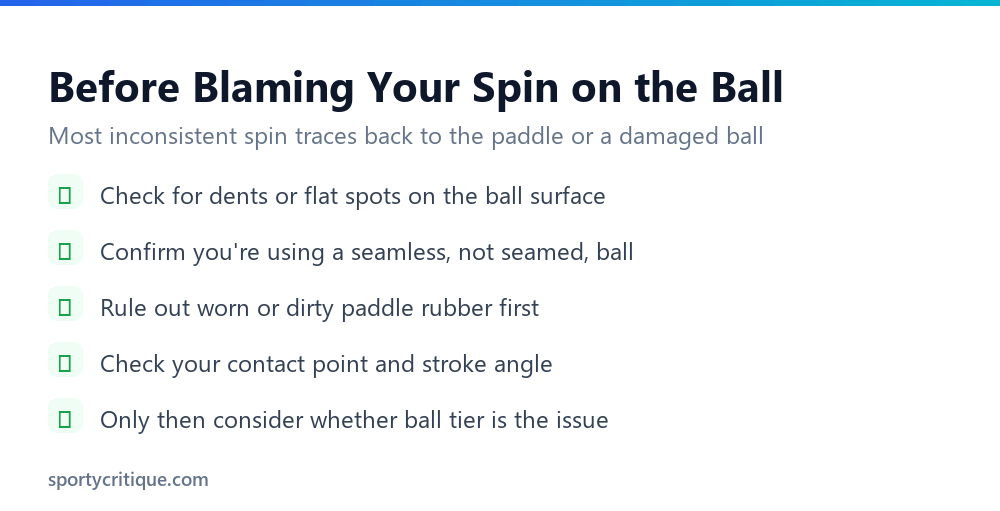
⚠️ Watch out: If you’re consistently getting a spin serve to “die” or behave unpredictably despite a clean stroke, check whether the ball has a small dent or flat spot before assuming it’s a technique problem. A damaged ball is a common, overlooked cause of inconsistent spin behavior during practice.
What “spin tracker” balls actually do
The STIGA 2-Star Spin Tracker Ping Pong Balls use a visible surface pattern rather than a plain solid color. To be precise about what that does: the pattern doesn’t change how much spin the ball carries, it makes existing spin visible to the eye as the pattern rotates in flight. That’s genuinely useful as a coaching and self-training tool, since a big part of learning to read spin is learning to see rotation direction and speed before the ball arrives, and a plain orange or white ball gives almost no visual cue for that.
💡 Pro tip: Use a patterned ball specifically during serve-return drills where you’re training yourself to read spin visually, then switch back to a standard ball for match-simulation practice, since match balls won’t give you that visual crutch and you want to train the skill without it eventually.
A standard 3-star option if you don’t need the pattern
If you don’t need the visual tracking feature and just want a reliable, consistent ball for spin-focused drills, the STIGA 3-Star Orange Ping Pong Balls covers the actual mechanical requirement: seamless construction and tournament-tier manufacturing tolerance, in a plain color that’s closer to what you’ll be playing with in a real match.
Where spin actually comes from, briefly
Since this is easy to get backwards from marketing copy, it’s worth stating plainly: spin comes from the interaction between your paddle rubber’s surface grip, the angle and speed of your stroke at contact, and how long the ball stays on the rubber during that contact. Tackier, longer-pip, or higher-friction rubbers grip the ball more and transfer more rotation for the same swing. None of that is a property of the ball, which is a fixed, smooth plastic sphere regardless of which brand or tier you buy.
That’s also why upgrading rubber has a bigger effect on your spin game than upgrading balls ever will. If your actual goal is more spin on your serves and loops, a rubber upgrade or a technique adjustment will move the needle; ball choice mainly determines whether that spin behaves consistently and whether you can see it clearly enough to train against it.
How ball hardness plays into this
All current tournament-legal balls are made from the same 40+ ABS plastic standard, but hardness can still vary slightly between manufacturers within that spec. A marginally harder ball tends to come off the rubber a touch faster with slightly less dwell time at contact, while a slightly softer one sits on the rubber a fraction longer. Neither difference is dramatic enough to notice in casual play, but players doing focused spin work sometimes report a preference for one brand’s feel over another’s for exactly this reason, even though both are technically the same star rating.
This is a real but minor factor, and it’s not something to chase before you’ve nailed down the bigger variables of rubber choice and stroke technique. If you’ve already got those dialed in and you’re fine-tuning at the margins, trying a couple of different 3-star brands to see which feel you prefer is a reasonable next step. If you’re still working on basic spin technique, this level of detail won’t move the needle yet.
Age and wear: when a ball stops behaving consistently
Even a well-made ball degrades with use. Repeated hard contact gradually stresses the plastic, and a ball that’s been through dozens of sessions can develop micro-flex that changes how predictably it responds to spin, well before it shows any visible crack or dent. There’s no fixed lifespan in hours or sessions since it depends heavily on how hard you hit and how often the ball takes full-power contact, but if a ball that used to behave consistently starts feeling inconsistent for no clear reason, age and accumulated stress is a more likely explanation than a sudden change in your own technique.
💡 Pro tip: Keep your spin-training balls separate from your general practice pile and retire them from that specific use once you notice any inconsistency, even if they’re still fine for casual rallying. Spin-reading drills are exactly where subtle ball degradation shows up first.
Practicing spin serves specifically
If your main goal is developing a better spin serve, the ball variable that matters most is simply having a large enough supply of consistent balls that you can serve dozens of times in a row without constantly stopping to collect them. A patterned spin-tracker ball helps here too, since it lets you watch your own serve’s rotation as it leaves the paddle, giving you real-time visual feedback on whether your contact point and paddle angle are producing the spin you intended, rather than only finding out from how your partner or opponent reacts.
Pair that visual feedback with slow-motion video occasionally if you have the means; watching your own contact point on a patterned ball in slow motion is one of the more reliable ways to self-diagnose why a serve isn’t producing the rotation you expect, separate from whatever the ball itself is doing.
Who should prioritize this
- ✓You’re specifically training serve variation or spin-reading skills
- ✓You want a patterned ball as a visual training aid, then plan to drop it for match balls later
- ✓You want consistent, seamless construction so spin behaves predictably shot to shot
- ✕You’re expecting a ball to increase how much spin you can generate; that’s a rubber and technique question
- ✕You’re buying for casual play where spin consistency isn’t a training focus
- ✕You already have a reliable 3-star ball; a spin-specific pattern isn’t necessary
What to check before buying
Look for explicit confirmation of seamless construction and a stated star rating in the listing itself, not just in a review. If you want the patterned option for training, confirm the pattern is described as visual only rather than a claimed performance feature; a listing that markets a pattern as making the ball “spin more” is overstating what a ball’s surface pattern can physically do, and that’s worth treating as a signal to read the rest of the listing skeptically too.
Bottom line
The best ping pong balls for spin work aren’t magic; they’re seamless, tightly toleranced balls that behave predictably, paired with a patterned option when you specifically want to train reading rotation visually. The actual spin still comes from your rubber and stroke, and no ball purchase substitutes for that.
As with any Amazon listing, prices and stock levels shift, so treat the figures above as a snapshot rather than a guarantee. Confirm the current price and availability on the live product page before checking out, especially if you’re buying multiple packs at once for a training routine that runs through balls quickly.
Do certain ping pong balls actually generate more spin?
No. Spin comes from your paddle rubber and stroke, not the ball. Ball construction affects how consistently spin behaves and, with patterned balls, how visible it is, not how much spin is produced.
What do ‘spin tracker’ balls actually do?
They use a visible surface pattern that makes existing spin easier to see as the ball rotates in flight. It’s a training and coaching aid for learning to read spin, not a physical spin enhancement.
Does a seamless ball really matter for spin?
Yes, for consistency. A seam can create a slight wobble in flight that makes spin harder to read accurately, even though it doesn’t change how much spin was generated at contact.
What should I upgrade if I want more spin on my shots?
Your paddle rubber and technique, not your balls. Rubber grip, stroke angle, and swing speed at contact are what actually determine how much spin you generate.
As an Amazon Associate, we earn from qualifying purchases through links on this page.


