
Best Ping Pong Table for Home Use: Space and Assembly Guide


Finding the best ping pong table for home use comes down to three practical questions: does it fit the room, how hard is it to set up, and does it support how the household will actually play. Here’s how three real tables answer those questions, checked against live pricing and stock.
🏓 Table Tennis Hub: Explore all 70 paddle reviews, table comparisons, and spin drills in our Complete Ping Pong Resource Hub.
For most homes, the best ping pong table for home use is a full-size table with a fold-down playback mode, like the JOOLA Inside at $429.95, since it lets one person practice alone without needing a second player every time. If the room is smaller, a mid-size table like the GoSports set at $139.99 trades some playing feel for a footprint that fits an apartment or a shared family room. If the space needs to double as a general game room, a combo table like the 13-in-1 at $219.99 covers ping pong alongside several other games in one piece of furniture.
Buying for home use is a different question than buying for a basement, an outdoor patio, or value for the money in the abstract; this guide covers all three of the practical questions that actually come up when a table needs to work inside a regular living space: does it fit, how hard is it to set up, and does it support how the household will actually use it week to week.
Three tables are compared here across those questions, all checked against live Amazon pricing and stock before writing this. If your home use case is specifically a basement with ceiling or moisture constraints, the basement-specific guide on this site covers that narrower situation in more depth than this general overview does.
- →Playback mode is the single most useful feature for home use if practicing solo matters
- →Full regulation size needs roughly 5 feet of clearance beyond the table on every side
- →A mid-size table is a fair tradeoff for apartments and smaller shared rooms
- →Combo game tables are worth considering if the space needs to serve more than one game
- →All three tables compared here were confirmed in stock with current pricing
Table of Contents
Space planning before you buy
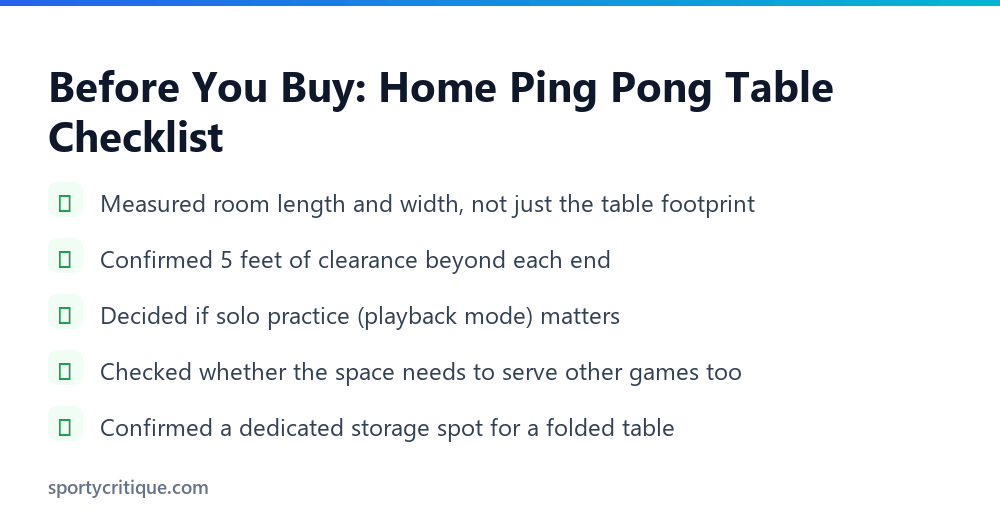
A regulation ping pong table measures 9 feet by 5 feet, but the table itself is only part of the footprint that matters. Comfortable play needs roughly 5 additional feet of clearance beyond each end for serving and return shots, and at least 2 to 3 feet along the sides. That works out to needing a room closer to 19 by 10 feet for truly comfortable full-size play, which surprises a lot of first-time buyers who measure only the table’s own dimensions before ordering.
If your available room can’t fit that, a mid-size table isn’t a downgrade so much as a realistic match to the space. Playing on a smaller table in a room with proper clearance is a better experience than playing on a full-size table where every serve risks hitting a wall.
Full size with playback mode: the JOOLA Inside
The JOOLA Inside Professional Indoor Ping Pong Table at $429.95 is a full regulation table built around 10-minute assembly and a quick-clamp net system, but the feature that earns it the top spot for general home use is the single-player playback mode: one half of the table folds upright, turning it into a practice wall for solo drilling. That single feature changes how much the table actually gets used day to day, since it removes the requirement of finding a second player every time someone wants to hit some balls. It was confirmed in stock at last check.
Smaller footprint: the GoSports mid-size set
The GoSports Mid-Size Table Tennis Table Set at $139.99 is a 6-by-3-foot table with adjustable height, built specifically for rooms that can’t accommodate full regulation size. It’s a genuine tradeoff, not a compromise disguised as a feature: the playing feel is tighter, and serious players will notice the reduced margin for error on wide shots. For a household that wants casual games without dedicating a full room to it, that tradeoff is usually worth the smaller price tag too.
Multi-game households: the 13-in-1 combo table
The Best Choice Products 13-in-1 Combo Game Table at $219.99 (discounted from $249.99) bundles ping pong with foosball, basketball, air hockey, and several other games into one piece of furniture. It’s a different kind of answer to “best for home use”: instead of optimizing for ping pong specifically, it optimizes for a room that needs to serve a family with different-aged kids and varying interests. The ping-pong playing surface on a combo table is generally smaller and less true to regulation feel than a dedicated table, so treat this as the pick for variety over ping pong performance specifically.
⚠️ Watch out: Don’t assume a folding table’s storage footprint matches its playing footprint. A regulation table folded for storage is still roughly 5 feet wide and often over 5 feet tall standing upright, which needs its own dedicated corner or closet space, not just “somewhere out of the way.”
Assembly time for home setups
The JOOLA Inside is built around a notably fast assembly process, with most reviewers reporting under fifteen minutes working solo, largely thanks to the quick-clamp net system replacing the screw-and-bracket net mounts common on cheaper tables. The GoSports mid-size table is even faster given its smaller size and lighter frame, typically closer to ten minutes. The combo table takes longest, often thirty to forty-five minutes, since it’s assembling multiple game surfaces into one unit rather than a single dedicated table.
Playback mode: worth the extra cost?
Playback mode adds real cost to a table, and it’s only worth paying for if solo practice is actually part of the plan. For a household where two or more people usually play together, it’s a feature that may go unused for months at a time. For anyone trying to seriously improve, a teenager working on serves, an adult picking the game back up after years away, it’s one of the few features in this price range that changes how much the table actually gets used rather than just how it looks in a listing.
- ✓Measure the room before comparing tables, not after picking a favorite
- ✓Consider playback mode seriously if solo practice matters to anyone in the household
- ✓Think about who else uses the space and whether a combo table fits better
- ✓Check current stock and pricing before finalizing a decision
- ✕Don’t buy full regulation size into a room without checking real clearance
- ✕Don’t pay for playback mode if no one will realistically use it solo
- ✕Don’t assume a combo table’s ping pong surface plays like a dedicated table
- ✕Don’t skip planning where a folded table will actually be stored
💡 Pro tip: If you’re not sure whether full or mid-size will fit, mark out the full 9×5 footprint plus clearance on your actual floor with painter’s tape before ordering. It takes five minutes and settles the space question more reliably than any measurement done from a tape measure alone.
Floor surface considerations
Carpeted rooms need extra attention to leg leveling, since even a small amount of carpet compression under one leg more than the others can introduce a lean that affects bounce. Hardwood and tile floors generally give a more stable base but increase the importance of felt or rubber leg pads to avoid scratching. None of the three tables here are designed specifically for one floor type over another, but checking the leg levelers work through their full adjustment range before finalizing setup is worth the extra five minutes on any surface.
Noise and where a table gets placed in the house
Ping pong is louder than most people expect before living with a table for the first time, particularly on a hard floor in a room with bare walls. If the table is going in a room near bedrooms or a shared wall with neighbors, a few cheap fixes help more than expected: a rug under the table area, felt pads on the legs, and even just curtains or a wall hanging on one side to break up hard sound reflection. None of these change how the table plays, but they meaningfully change how much the sound carries through the rest of the house during an evening game.
Basements and garages tend to be the most forgiving locations for this reason, since they’re usually further from bedrooms and already have harder, less sound-sensitive surfaces. A finished family room or living room works fine too, but it’s worth a conversation with anyone else in the house before committing a shared space to regular evening games.
Kids, pets, and shared-space considerations
For households with younger kids, table height matters more than most buying guides mention. Standard regulation height is 30 inches, which is fine for most adults and teens but can put a younger child at an awkward angle for a comfortable swing. The GoSports mid-size table’s adjustable height feature is a genuine advantage here, letting the table lower slightly for younger players without needing a separate junior-sized table. Full regulation tables like the JOOLA Inside are fixed at standard height, which is worth factoring in if the primary players skew younger.
Pets are a more minor consideration, but a stray ball rolling under furniture is a near-daily occurrence in households with dogs or cats curious enough to chase it. None of the three tables here solve that problem directly, but the corner ball holders included with the JOOLA Inside at least cut down on how often a ball ends up loose on the floor between points.
Bottom line
For most homes with the space to fit it, the JOOLA Inside at $429.95 is the strongest general pick, mainly because playback mode extends how much use the table actually gets over time. Where space is tighter, the GoSports mid-size set at $139.99 is a fair, honest compromise rather than a downgrade. For households that need the room to serve more than just ping pong, the 13-in-1 combo table at $219.99 is worth the tradeoff in pure ping-pong feel.
How much space do I actually need for a home ping pong table?
Plan for the 9-by-5-foot table itself plus roughly 5 feet of clearance beyond each end and 2 to 3 feet along the sides, which works out to a room closer to 19 by 10 feet for comfortable full-size play.
Is playback mode worth paying extra for?
Only if solo practice is actually part of the plan. It’s one of the more useful features for keeping a table in regular use, but it adds cost that isn’t worth it if the table will always be used with two or more players.
What if my room can’t fit a full regulation table?
A mid-size table is a reasonable alternative, not a lesser option. It trades some playing feel for a footprint that fits smaller rooms and apartments comfortably.
Are combo game tables a good option for home use?
They’re a good option if the room needs to serve multiple games and age groups, but the ping pong surface itself is usually smaller and less true to regulation feel than a dedicated table.
As an Amazon Associate, we earn from qualifying purchases through links on this page.


