Best Swim Snorkels for Freestyle and Technique Training


The best swim snorkel for most lap swimmers is a front or center-mounted model that stays still on your head and keeps the tube out of your arm path. The four options below, from the budget FalinLego to the Speedo, Arena Pro III, and TYR Ultralite 2.0, all fit that description. Pick on fit and mouthpiece comfort, not on marketing, wear it for short drill sets before you swim a full workout in it, and keep using normal breathing for races.
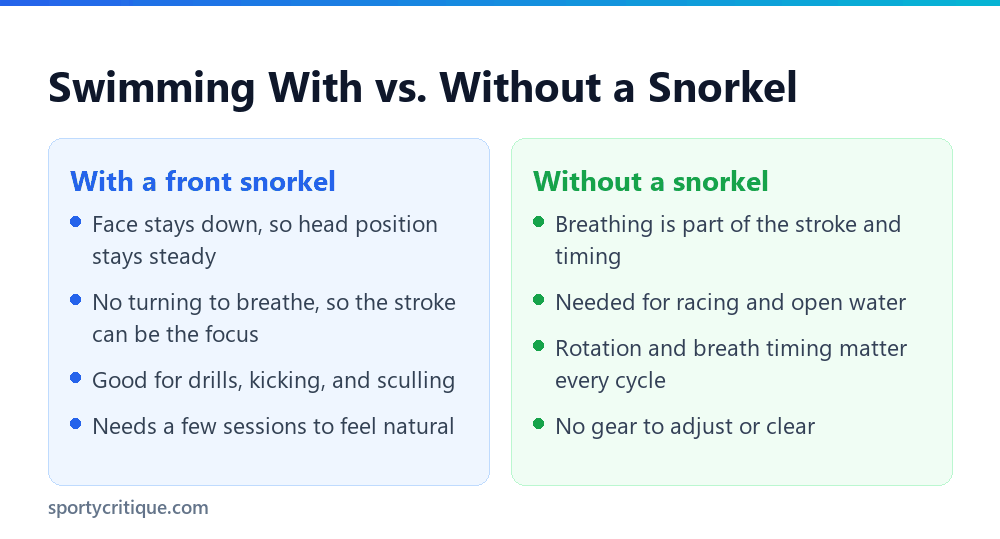
A swim snorkel is a training tool, not a shortcut. It removes the part of freestyle that gets in the way of fixing the rest: the turn of the head to breathe. With your face down and air available, you can concentrate on where your hand enters, how you catch the water, and how your body holds a line.
U.S. Masters Swimming describes the same benefit. Its article on why swimmers need a snorkel says removing the need to turn or lift the head for air lets swimmers concentrate more on stroke technique and can reduce breathing anxiety, and it notes the tool also helps with drilling, kicking, sculling, and even butterfly.
- →A front or center-mounted snorkel stays out of the arm path and keeps your head still
- →Fit and mouthpiece comfort matter more than any single feature on the label
- →Use it for drills and technique sets, then swim normally to train breathing
- →Give yourself a few short sessions to get used to the feel
- →Swim with supervision if you are new to the gear or to open water
Table of Contents
What a Snorkel Fixes and What It Does Not
A snorkel is good at isolating head position and the pull. Without breathing to manage, many swimmers notice their body sinks or twists less, and their catch gets more consistent.
It does not fix breath timing, because you are no longer practicing it. Swimmers who train only with a snorkel can struggle when they take it off, so treat it as a technique tool for part of a session, not the whole workout.
It also does not replace coaching. A coach or a video of your stroke tells you what to work on. The snorkel makes that work easier to do.
How to Choose a Swim Snorkel
The USMS article lists four factors that apply to most snorkels: the curve, the width of the bore, the length, and the presence of a purge valve.
Curve
USMS says new swimmers tend to do better with J-shaped snorkels, and notes that longer C-shaped snorkels allow a more relaxed head position and, for some swimmers, less water intrusion. The four models here are front mounted, so check how each tube is shaped in its listing and photos.
Bore Width and Length
Wider bores are easier for anxious or early swimmers, while narrower bores suit experienced swimmers, according to USMS. Longer tubes keep the opening drier, while experienced swimmers prefer compact designs.
Purge Valve
USMS describes a purge valve as optional. None of the four listings here mentions a purge valve in its feature text, and the Arena lists breath control caps instead, so check each listing for what it includes if a valve matters to you.
Fit and Mouthpiece
A snorkel that shifts around is worse than none. Look for an adjustable head strap, a mouthpiece in a size that suits your mouth, and padding where the bracket touches your forehead. Most listings below mention adjustable straps or padded head brackets.
4 Real Options, Compared
📊 Note: All four were in stock when checked on October 7, 2026. We did not wear or test them in a pool, so the notes reflect what each listing states. Sizing and comfort vary by face shape, so read recent reviews from swimmers with a build similar to yours.
How We Picked These Four
We checked each listing for current price, stock, and the features it states. We did not repeat performance claims from listings, such as large speed improvements, because a snorkel is a technique tool and such numbers are not backed by a source.
Getting Used to a Snorkel
Expect a short adjustment period. Adjust the head strap so the snorkel sits snug and stable, and make sure the mouthpiece sits comfortably at the front of your mouth.
Start with an easy, short swim. Breathe slowly and steadily through the tube, and exhale fully so you do not rebreathe stale air. If you feel dizzy, short of breath, or uncomfortable, stop, rest, and take the snorkel off.
⚠️ Watch out: Never use any training gear to extend breath holding or swim alone in deep or open water. If you have a medical condition, ask your doctor first, and swim where a lifeguard or a partner can see you.
Sets to Try With a Snorkel
Start with easy swim with a focus on one cue, such as a steady head position or an early catch. Do 4 x 50 at an easy pace with ten to twenty seconds of rest, and note how the stroke feels.
Add drills such as catch-up, fingertip drag, and sculling, since the snorkel removes the breathing turn. Then try a kick set with a board or streamline. Finish with a short swim without the snorkel, to check that what you learned carries over.
Snorkel Habits
- ✓Adjust the strap so the snorkel stays still
- ✓Use it for technique sets, then swim without it
- ✓Rinse it after every swim and let it dry
- ✓Start with short, easy sets
- ✕Swim a full workout in it from day one
- ✕Use it to hold your breath or push your limits
- ✕Share a mouthpiece without cleaning it
- ✕Ignore dizziness or discomfort
Who Benefits Most From a Snorkel
Swimmers working on freestyle technique are the obvious users, but they are not the only ones. U.S. Masters Swimming notes that a snorkel can be particularly helpful for swimmers with arthritis or previous neck or spine injuries, since it removes repeated head turning from the stroke. If that describes you, check with your doctor or physiotherapist before changing your routine.
Newer swimmers who feel anxious about breathing can also use a snorkel to relax and focus on kicking and body position. A snorkel also makes it easier to work on one cue at a time without breath timing getting in the way.
Common Problems and Simple Fixes
Most problems come from fit rather than the snorkel itself. Take a minute before the first length to adjust the strap and bracket, and recheck it after a couple of lengths, since a wet strap can loosen.
Using a Snorkel With Flip Turns
Some snorkels are designed with flip turns in mind, and the Arena listing, for example, describes a fixed center mount it says suits flip turns and fin swimming. Others work better for straight swimming, and flip turns with a snorkel need practice.
Try a few turns slowly before adding speed. Exhale gently through the tube as you tuck and push off, so water does not push back into the mouthpiece, and expect to tweak the strap until the snorkel stays in place through the turn.
Adult and Youth Fit
Most of the models here are listed for adults. Children and smaller swimmers may need a snorkel made for their size, because a tube that is too large can sit awkwardly and a mouthpiece that is too big is uncomfortable. Check the size range on any listing before buying for a younger swimmer.
Younger swimmers should use a snorkel only under adult or coach supervision, and should start with short, easy swims to get used to the feel.
Pool Etiquette With a Snorkel
A snorkel changes your field of view and your head position, so be extra aware of other swimmers in a shared lane. Circle swim when the lane is shared, signal at the wall, and give faster swimmers room to pass.
Check with the pool or your team on any rules about training equipment. Some pools allow snorkels only in certain lanes or at certain times, and it is better to ask than to be asked to stop mid set.
Caring for Your Snorkel
Rinse it in fresh water after every swim, especially after a chlorinated pool, and let it dry out of direct sun. Check the mouthpiece for tears, the strap for stretching, and the valve, if there is one, for debris.
Replace a mouthpiece that is cracked or worn, since a poor seal lets in water and makes breathing harder. Store the snorkel where the tube will not bend or flatten.
Snorkel With Other Training Gear
A snorkel pairs well with fins for kick sets, a pull buoy for upper body work, and paddles for strength. Add one new tool at a time, so you can tell what is helping. Our guides on swim fins, pull buoys, and swim paddles cover those.
Avoid stacking too much gear at once. A snorkel, paddles, and a pull buoy together change the stroke a lot, and the result may feel unlike your normal swimming.
Frequently Asked Questions
What is the best swim snorkel for beginners?
A front-mounted model with a comfortable mouthpiece and an adjustable strap. USMS says new swimmers tend to do better with J-shaped snorkels, so check each tube’s shape.
Does a swim snorkel help freestyle?
It can, by letting you keep your face down and focus on your catch and body position without turning to breathe.
Can I race with a snorkel?
No. Snorkels are training tools. Swim without one for races and for practicing breath timing.
How tight should the strap be?
Snug enough that the snorkel does not move, while staying comfortable.
Is a swim snorkel safe for open water?
Use extra caution. Swim with a partner or supervision, and do not use training gear to push your limits.
How often should I use a snorkel?
In a few technique sets per week, with the rest of the workout swum normally.
A good snorkel is one you forget you are wearing. Pick a model that fits your face, use it for focused technique sets, rinse it after each swim, and keep your normal breathing in the rest of your training, and it will make your drills cleaner and your stroke steadier.
As an Amazon Associate, we earn from qualifying purchases through links on this page.