How to Do a Proper Flip Turn in Freestyle

A flip turn looks like one motion from the pool deck, but it’s really four separate skills stacked together: the approach, the tuck, the wall contact, and the push-off. Get any one of them wrong and the whole turn slows down, which is why so many swimmers who can technically do a flip turn still lose time on every single one. Here’s how each part actually works, broken down so you can practice them separately before putting them back together.
A proper freestyle flip turn has four parts: finish your last stroke with hands at your hips instead of taking an extra reach, tuck your chin and somersault using your core rather than your arms, plant both feet flat on the wall at roughly knee-to-hip depth, and push off on your back into a tight streamline before rotating to your stomach. Most swimmers lose speed by slowing into the wall to set up the turn instead of carrying speed through it.
- →Don’t breathe on your last stroke into the wall; it slows your head position and throws off timing
- →The somersault comes from your core snapping forward, not from pulling with your arms
- →Feet should land flat on the wall at roughly knee-to-hip depth, not near the surface or too deep
- →Push off on your back first, in a tight streamline, then rotate to your stomach while kicking
- →Most speed is lost by decelerating into the wall, not by a badly executed somersault itself
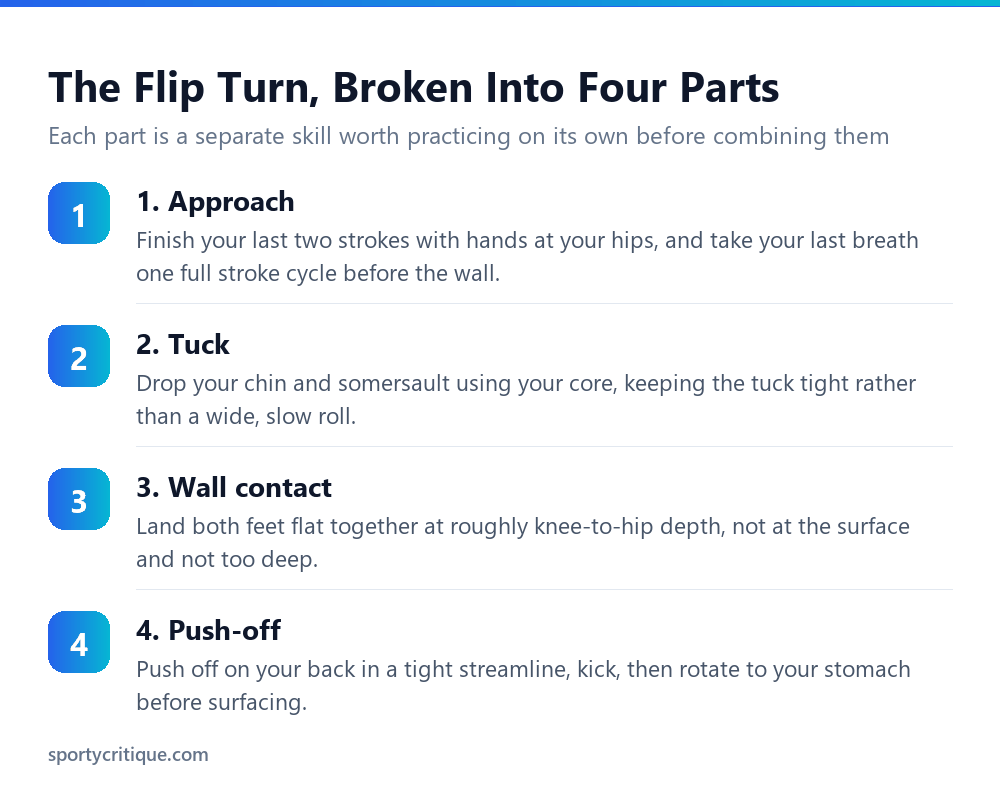
Table of Contents
The approach: what happens before you even reach the wall
The turn actually starts two strokes before you touch the wall, not at the wall itself. As you close the final distance, finish your last two strokes with your hands ending at your hips rather than out in front, which is a change from normal freestyle stroke mechanics but sets up the somersault correctly. Most swimmers learning flip turns keep reaching for the wall the way they would for a touch-and-go turn, which leaves the arms in the wrong position to help initiate the tuck.
Do not take a breath on that last stroke. Lifting your head to breathe raises your hips and drops your legs, which throws off both your speed into the wall and the timing of the tuck. This is the single most common beginner mistake, and it’s an easy one to fix once you’re aware of it: plan your breathing pattern so your last breath comes one full stroke cycle before the wall, not on it.
⚠️ Watch out: Slowing down on approach is the biggest speed leak in a flip turn, bigger than a sloppy somersault. Swimmers unconsciously ease off in the last few feet because the wall is coming up fast and it feels safer to control the speed. That instinct costs more time than it saves. Practice swimming full speed into the wall and trust the turn to handle the impact.
The tuck: a somersault, not an arm pull
Once your hands reach your hips, drop your chin toward your chest and initiate a tight forward somersault. The power for this comes from your core snapping your hips and knees toward your chest, not from your arms pulling or pushing against the water. Swimmers who try to muscle the rotation with their arms end up with a wide, slow tumble instead of a tight, fast one, and often come up disoriented about which way is up.
Keep the tuck as tight as you can, knees pulled close to the chest rather than swung wide. A tighter tuck rotates faster for the same amount of effort, the same way a figure skater spins faster by pulling their arms in. Think about tucking into a small ball rather than doing a slow, sweeping roll.
Your legs should follow the rotation naturally and end up swinging over the top, heading toward the wall, while your hands stay roughly in place near your hips or extend slightly to help balance. This is the part that takes the most repetition to feel automatic, since it inverts your sense of which way is up for a fraction of a second.
Wall contact: foot placement actually matters
As your legs come over the top of the somersault, both feet should land flat against the wall at roughly knee-to-hip depth below the surface, not right at the surface and not pushed too deep. Too shallow, and the push-off sends you toward the surface too early, fighting more drag on the way back down to streamline depth. Too deep, and you waste distance and time getting back up to a good swimming depth.
Both feet need to land together and flat, not staggered or on the toes. A staggered or toe-first landing gives you a weaker push-off base and often sends you off at an angle instead of straight down the lane. If you’re pushing off crooked and drifting into the lane rope, foot placement at contact is usually the first thing to check.
The push-off: back first, then rotate
Push off the wall on your back, arms extended overhead in as tight a streamline as you can hold, hands stacked and biceps squeezing your ears. This is the fastest position your body can move through water, and it’s worth holding it for a beat rather than rushing to flip onto your stomach immediately.
While still underwater in streamline, begin a few dolphin kicks to build speed, then rotate from your back onto your stomach as you transition into freestyle kicking. The rotation should be driven by your kick, not a twist of the upper body, since kicking through the rotation keeps your speed building instead of stalling mid-turn.
Stay underwater in streamline through your fastest kicking phase before breaking out into your normal stroke. Most competitive swimmers surface somewhere around 10 to 15 meters after a wall, well past most competition pools’ underwater distance limit for their level, but even recreational swimmers benefit from holding the streamline a few extra kicks longer than feels natural at first, since it’s almost always faster than the surface stroke that follows.
💡 Pro tip: Practice the push-off and underwater kick separately from the somersault. Push off the wall from a standing start in the shallow end, hold a tight streamline, and kick. Short-blade fins like FINIS Zoomers Gold Swim Training Fins are commonly used for exactly this kind of drill, since they encourage a faster, tighter kick tempo without changing the underwater body position you’re trying to build.
Common mistakes, and what they usually mean
- ✓Swim at full speed into the wall and trust the turn to handle it
- ✓Finish your last two strokes with hands at your hips, not reaching forward
- ✓Keep the tuck tight, knees pulled toward your chest
- ✓Hold streamline for a beat before starting your kick
- ✕Don’t breathe on the last stroke before the wall
- ✕Don’t try to power the somersault with your arms instead of your core
- ✕Don’t let your feet land staggered or on the toes at the wall
- ✕Don’t rush the rotation from back to stomach before building kick speed
If you’re consistently coming up off-line and drifting toward a lane rope, the cause is almost always uneven foot placement at the wall, one foot planting before the other or the feet landing at slightly different depths. If you’re surfacing too early and losing the speed advantage of the underwater phase, the cause is usually rushing the rotation instead of holding streamline through a few dolphin kicks first.
Drills to build each piece separately
Trying to learn a flip turn as one continuous motion is slower than breaking it into pieces. Start with tuck-and-roll drills in open water away from the wall: swim a stroke, tuck your chin, and somersault without touching anything, just to get comfortable with the inverted, disoriented half-second before your feet come around. Once that feels natural, move to the wall and practice the somersault into a wall touch without a push-off, just to dial in foot placement and depth.
From there, isolate the push-off and underwater kick on their own, starting from a stationary position against the wall rather than combining it with the somersault. Only once each piece feels automatic on its own is it worth stringing the whole sequence together at speed. Swimmers who skip straight to full-speed flip turns tend to develop compensating habits, like breathing too early or under-rotating the tuck, that are harder to unlearn later than they would have been to avoid from the start.
📊 Note: It’s normal to swallow water or come up disoriented the first several times you try a full flip turn. That’s a timing and comfort issue, not a sign you’re doing something fundamentally wrong. It usually resolves within a couple of practice sessions once the somersault stops feeling unfamiliar.
Flip turns during a real set, not just in isolation
Drilling a flip turn slowly in isolation is one thing; holding the technique together while breathing hard in the middle of a fast set is another. Fatigue tends to show up as the same two mistakes every time: sneaking an extra breath in on the approach because you want the air, and rushing the somersault because the wall feels like it’s arriving too fast to control. Both of those are the exact habits the broken-down drills are meant to prevent, which is why it’s worth revisiting them even after you can do a clean flip turn at an easy pace.
A useful way to build turns into real training is to add them deliberately into moderate-effort sets before pushing pace, rather than only practicing them fresh at the start of a workout. Turns that hold up at 70 percent effort with rising fatigue are the ones that will still hold up in a set that actually pushes your pace, and that transfer doesn’t happen if every turn you’ve ever drilled was done at an easy warmup speed.
Two myths about flip turns
Bottom line
A flip turn is four skills, not one: an approach that doesn’t slow down or breathe late, a tight core-driven tuck, feet landing flat at the right depth, and a push-off held in streamline before rotating to your stroke. Practice each piece on its own before chasing the full-speed version, and the turn that looked intimidating from the pool deck becomes close to automatic.
How deep should my feet be when they hit the wall on a flip turn?
Roughly knee-to-hip depth below the surface. Too shallow sends the push-off upward too soon; too deep wastes distance getting back to swimming depth.
Why do I keep coming up off to one side after a flip turn?
This usually means your feet are landing on the wall unevenly, one foot planting before the other or at a different depth, which pushes you off at an angle instead of straight down the lane.
Should I breathe right before touching the wall for a flip turn?
No. Breathing on the last stroke lifts your head and drops your legs, which throws off your approach speed and turn timing. Take your last breath one stroke cycle before the wall.
How long does it take to learn a flip turn?
Most adult beginners can put together a workable flip turn within a few weeks of focused, broken-down practice, tuck drills away from the wall first, then wall contact, then the full sequence at speed.
Do fins help with learning flip turns?
Short-blade training fins can help isolate and build the underwater kick and streamline phase of the turn, which is useful to practice separately from the somersault itself.
As an Amazon Associate, we earn from qualifying purchases through links on this page.