How Are Equestrian Horses Transported to the Olympics?


How are equestrian horses transported to the Olympics? By cargo aircraft, in individual padded stalls built for exactly one animal, with a groom and a flight vet riding in the same hold. That is the short version. This page goes deep on that one leg of the trip specifically, the aircraft, the stall design, who rides with the horses and what they do, and what a long flight actually does to a horse’s body. If you want the full trip from qualification through competition, start with our overview of how Olympic horses get to the Games, and if you want the paperwork and quarantine side, see the pre-travel documentation process. This page is just the flight.
- →Horses fly in dedicated cargo freighters, never in converted passenger cabins
- →Specialist carriers like Emirates SkyCargo, FedEx, and KLM Cargo handle much of this work
- →Each horse rides in an individual padded air stall sized to limit movement, not maximize it
- →A groom and flight veterinarian travel in the same hold, monitoring horses throughout
- →Long-haul flight causes real physical strain, which is why arrival includes a recovery buffer before competition
Table of Contents
What actually flies the horses across an ocean
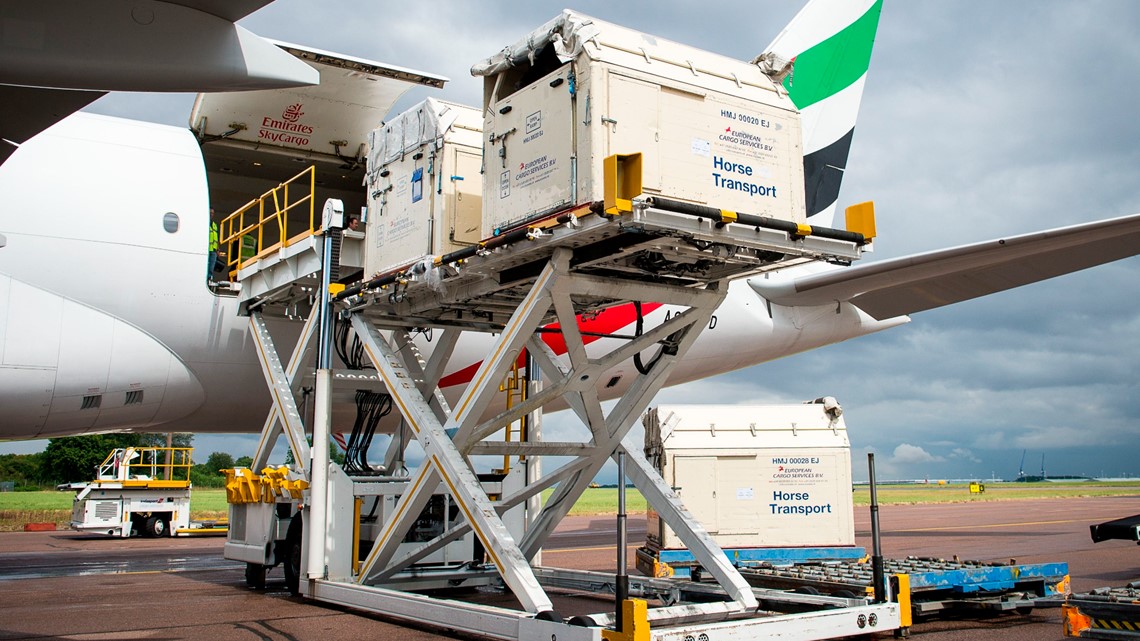
Horses do not fly on passenger aircraft, and they never have. Olympic-bound horses travel on dedicated freight aircraft, the same class of plane used for any oversized or specialized cargo, fitted out specifically for live animal transport. A handful of cargo carriers have built a real specialty in this work over the years, among them Emirates SkyCargo, FedEx, and KLM Cargo, each running scheduled or chartered flights equipped with staff trained specifically in equine air freight rather than general cargo handling.
Paris 2024 put a name on this that stuck: ‘Air Horse One,’ an Emirates SkyCargo Boeing 777 freighter that carried competition horses into the Games. It became enough of a talking point online that fact-checkers looked into whether it was real, and it was, not a marketing stunt or an invented detail. What’s worth remembering is that the specific aircraft, tail number, and operator change from Games to Games depending on where horses are flying from and which carrier wins that contract. The general setup, a freighter converted to carry stalled horses instead of pallets, is the constant.
A single flight can carry a genuinely large number of horses at once, since chartering a plane for one animal rarely makes sense. Reporting on the Paris Games described flights carrying dozens of horses in one load, plus multiple tons of tack, feed, and equipment stowed separately from the stalls themselves. Exact numbers vary by aircraft type and route, so treat any single figure as an example from one specific flight rather than a fixed capacity.
Inside the air stall: what the horse’s space actually looks like
Inside the hold, horses stand in individual air stalls, sometimes called air crates, padded compartments sized to fit one horse with enough room to plant all four feet and shift its weight as the aircraft moves, but not enough to turn around or lie down flat. That tight fit is deliberate. A horse that can brace against gentle motion in a stall built to its size is less likely to lose its footing than one with room to stumble. Depending on the configuration, some stall units are built to hold two or three horses side by side rather than one each, separated by a padded divider.
The cargo hold itself is climate-controlled, holding a steadier temperature and humidity than the outside air at cruising altitude, closer to what the horse would experience standing in a well-ventilated barn than a typical unpressurized freight compartment. That matters more for horses than it would for most cargo, since a horse regulates its body temperature poorly in a sealed, still space without airflow.

Who rides with the horses, and what they actually do
A groom, and usually a veterinarian as well, travels in the same hold as the horses rather than up front with the flight crew. Their job for the length of the flight is to watch the horses directly, checking that each one is still standing normally, still eating or at least willing to, and not showing signs of distress like sweating heavily or repeatedly pawing at the stall floor. Hay nets are usually hung within reach so horses can eat in small amounts throughout the flight, and water is offered periodically rather than left in an open bucket that would slosh during turbulence.
This is a working flight for the people on it, not a supervised waiting room. If a horse does start to show signs of stress, colic, or injury mid-flight, the vet on board is the only medical response available until the plane lands, which is exactly why an experienced flight vet, not just any equine veterinarian, usually fills that role on these routes.
Getting from the stable to the aircraft
The flight is only the middle of the journey. Before a horse reaches the airport, it typically rides in a purpose-built horsebox with air suspension and non-slip flooring, a smoother ride than a standard trailer over ordinary roads. At the airport, horses do not walk up a ramp into the plane. They load into their air stall on the ground, and the entire loaded stall is lifted into the aircraft’s cargo hold using a hydraulic loader, the same basic principle used to load oversized freight pallets, sized and adapted for a container that needs to stay level and stable with a live animal inside.
That loading step is one of the more physically stressful moments of the whole trip for the horse, more so in some cases than the flight itself, since it involves unfamiliar motion, noise, and confinement all at once before the animal has any chance to settle. Handlers experienced with air stall loading generally try to keep this part calm and unhurried rather than rushed, precisely because a horse that gets anxious at the loading stage tends to stay tense for longer into the flight.
Why flights are rarely a straight line
Very few Olympic horses fly nonstop from home stable to host city. Distance and where a workable freighter route actually exists usually force at least one stop, sometimes to refuel, sometimes to consolidate horses from several countries onto the same charter so the flight is worth running at all. A horse based in South America heading to a European Games, for example, is realistically looking at a routing built around whichever hub airports have the right cargo infrastructure and quarantine facilities on the ground, not a straight line on a map.
Ground transport fills every gap in that routing. A multi-leg trip means multiple loading and unloading cycles, not just one, which is part of why federations plan these trips with buffer time built in rather than scheduling a horse to land and compete within days.
What a long flight does to a horse’s body
Long-haul flight is not neutral for a horse’s body, and nobody in this industry pretends it is. Veterinary reporting on Olympic travel has flagged the same cluster of effects after long transport: dehydration, some muscle inflammation, and elevated muscle enzyme levels that show up on bloodwork, all consistent with the physical strain of standing braced for hours in a moving container. None of that is unique to air travel specifically, a long road trip produces similar signs, but a long-haul flight compresses more hours of standing and motion into less total trip time than the equivalent distance by road.
That’s the direct reason horses are not flown in and rushed straight to the competition arena. A commonly cited benchmark has horses arriving in the host city area at least five days before they’re due to compete, giving time to rehydrate, eat and drink normally again, and recover from the muscle strain before anyone asks the horse to perform. Some federations build in more buffer than that if the trip involved multiple legs or an unusually long single flight; five days functions as a floor, not a fixed rule every team follows exactly.
Why the flight usually isn’t a horse’s first time flying
Most horses that reach Olympic-level competition are not flying for the first time when they board that freighter. Horses campaigning on the international show circuit already travel constantly by road and often by air for other FEI events well before the Games, so the flight itself is rarely a brand-new experience by the time it matters most. That prior exposure is part of why national federations lean on experienced championship horses rather than gambling on a talented but well-traveled newcomer for a single Olympic trip.
Handlers who specialize in this work also spend time on practice loading before a real flight, walking a horse into a stationary air stall on the ground so the space and the process feel familiar before it’s combined with actual engine noise and motion. It’s a small step compared to the flight itself, but skipping it is one of the more preventable ways a horse ends up distressed at the one moment, loading, where a calm horse matters most.
- ✓Individual or small-group padded air stall sized to the horse
- ✓Climate-controlled hold with steady temperature
- ✓Groom and flight vet actively monitoring throughout
- ✓Hay and water offered periodically, not left to slosh loose
- ✓Practice loading completed before the real flight
- ✕Oversized stall with room for the horse to lose its footing
- ✕No temperature control in the hold
- ✕No one checking on horses between takeoff and landing
- ✕Feed and water withheld for the entire flight
- ✕First-time loading attempted on the actual travel day
Flight logistics at a glance
💡 Pro tip: If you’re looking for the full door-to-arena journey rather than just the flight, the overview guide ties qualification, paperwork, and travel together in one place.
Frequently asked questions
Do horses fly standing up the whole time?
Yes. Air stalls are built to let a horse stand and brace against motion, not to lie down or turn around. That’s a deliberate safety choice, not a lack of space to spare, since a horse with more room to move has more room to lose its footing.
How long is a typical flight to the Olympics?
There’s no single answer. It depends entirely on where the horse starts and where the Games are being held, and multi-leg routings are common enough that total travel time, including ground transport and any stopovers, can run well beyond the length of the actual flight segment.
Who is legally responsible for the horse during the flight?
The cargo carrier handles the aircraft and loading, but the traveling groom and veterinarian are the ones actively monitoring the horse’s welfare in the hold. Ownership and overall responsibility for the horse stays with its owner and national federation throughout, the same as on any other leg of the trip.
Is ‘Air Horse One’ a real, specific flight or just a nickname for any horse flight?
For Paris 2024 specifically, it referred to a real Emirates SkyCargo freighter that carried competition horses, confirmed by fact-checkers after it circulated widely online. It is not a permanent, official name for equine cargo flights in general; other Games have used different carriers and aircraft entirely.
Can a horse refuse to load and get left behind?
It happens, though it’s uncommon with horses selected for this level of competition, since part of preparing a horse for international travel involves practice loading well before the actual trip. A horse that can’t be safely loaded on the day would be held back rather than forced, which is one more reason federations build contingency plans around a reserve combination.