How to Choose the Right Hockey Stick Flex

This hockey stick flex guide starts with a common baseline: roughly half a player’s body weight in pounds, so a 160-pound player might start around an 80 flex, though this is a general guideline rather than a strict formula. Position and shot style shift the ideal number from there: defensemen and players relying on hard slap shots often prefer a slightly stiffer flex, while forwards using quick wrist shots and snapshots often prefer a slightly softer flex for faster loading and release.
Flex describes how much a stick’s shaft bends under load, measured as the force in pounds needed to deflect the shaft one inch, and getting this number right affects shot power, release speed, and puck feel more than almost any other single equipment specification a player chooses. Too many players guess at flex based on what a favorite pro player uses rather than their own body weight and shooting style.
- →Roughly half a player’s body weight in pounds is a common general starting guideline for flex
- →Position and shot style shift the ideal flex from that general body-weight baseline
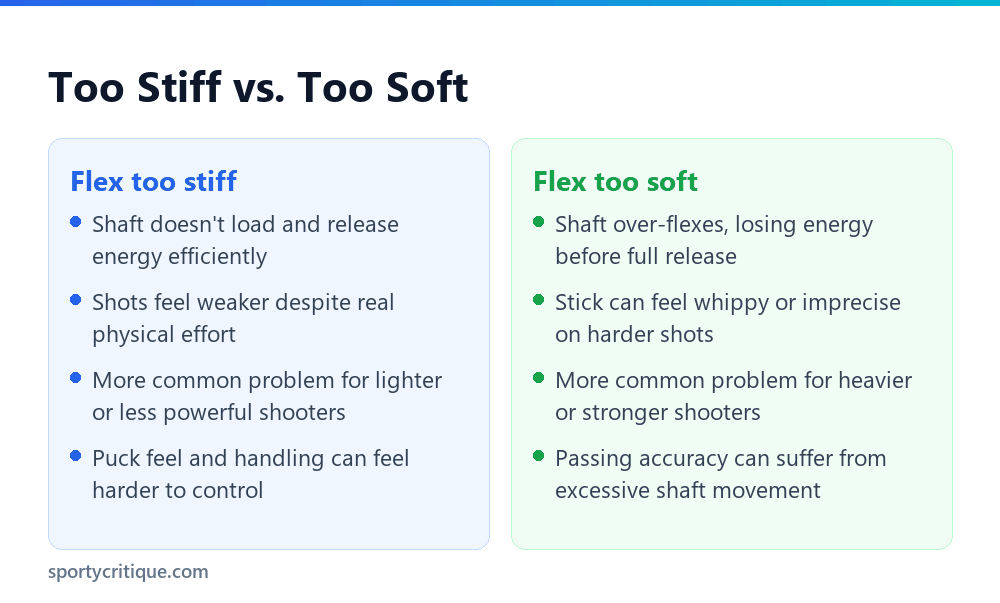
- →A flex too stiff for a player’s strength reduces shot power despite full effort
- →A flex too soft for a player’s strength can feel whippy and hurt passing accuracy
- →Cutting down a stick’s length increases its effective stiffness, changing the flex you actually get
Table of Contents
The Body Weight Guideline
The most commonly cited starting point for flex selection is roughly half a player’s body weight in pounds, meaning a 140-pound player might start around a 70 flex and a 200-pound player around a 100 flex. This guideline works reasonably well as a starting reference point, but it’s a general rule of thumb, not a precise formula that accounts for individual strength, technique, or shooting style differences between players of the same weight.
⚠️ Watch out: Two players of identical body weight can have meaningfully different ideal flex numbers based on actual upper-body and core strength, shooting technique, and personal preference. Treating the body-weight guideline as an absolute rule rather than a reasonable starting point to adjust from leads some players toward a flex that technically matches their weight but doesn’t actually suit their game.
How Flex Actually Affects Shot Power
A correctly matched flex allows the shaft to bend and load energy during the shot’s downswing, then release that stored energy efficiently as the shaft snaps back straight at the moment of puck contact, adding to the power generated by the player’s own physical effort. This loading and release mechanism is the entire reason flex matters as a specification in the first place.
A stick too stiff for a given player’s strength doesn’t load and flex enough during the shot, meaning the player’s effort translates less efficiently into the shaft’s spring-like energy release, producing a shot that feels weaker than the effort put into it deserves. A stick too soft over-flexes, bending more than necessary and losing energy before it fully releases at the correct moment, which can also make the stick feel imprecise and whippy on harder shots.
Position and Shot Style Considerations
Defensemen, who rely more heavily on hard slap shots from the blue line, often prefer a slightly stiffer flex than the body-weight guideline suggests, since a stiffer shaft handles the higher-force loading of a full slap shot windup more effectively than a softer one built for quicker, lower-force releases.
Forwards emphasizing quick wrist shots, snapshots, and fast releases in tight spaces often prefer a slightly softer flex, since a more flexible shaft loads and releases energy faster with the shorter, quicker motion these shot types require, compared to the fuller windup a slap shot uses to load a stiffer stick effectively.
💡 Pro tip: A player who uses a truly balanced mix of shot types, rather than heavily favoring one style, often does best starting with the standard body-weight guideline and adjusting only slightly from there based on direct on-ice feel rather than committing hard toward either the stiffer defenseman or softer forward-leaning adjustment.
How Cutting a Stick Changes Its Effective Flex
Cutting down a stick’s length to fit a player’s height increases its effective stiffness, since a shorter shaft flexes less under the same amount of force than a longer one, meaning the flex number printed on the stick reflects its uncut length, not necessarily the effective flex a player actually experiences after cutting it down to their preferred length.
A general rule some equipment specialists use is that cutting roughly one inch off a stick increases its effective flex by about 3 to 5 points, though this varies somewhat by manufacturer and specific stick model. A player who cuts a stick down significantly should factor this stiffening effect into their flex selection, sometimes choosing a slightly softer printed flex than the body-weight guideline suggests specifically to compensate for this expected increase after cutting.
Choosing the Right Flex
- ✓Start with the body-weight guideline, then adjust based on actual on-ice feel
- ✓Consider a stiffer flex for slap-shot-heavy defensemen, softer for quick-release forwards
- ✓Account for increased effective stiffness after cutting a stick down to length
- ✓Test different flex numbers directly when possible rather than guessing from specs alone
- ✕Choosing a flex purely because a favorite professional player uses that number
- ✕Ignoring how cutting a stick down changes its effective, real-world stiffness
- ✕Treating the body-weight guideline as an absolute rule rather than a starting point
- ✕Assuming every player of the same weight and position needs an identical flex number
Kick Point: A Related but Separate Specification
Kick point, describing where along the shaft the stick bends most during a shot, low, mid, or a variable kick point, works alongside flex to determine a stick’s overall shooting feel but represents a distinctly separate specification from flex itself. A low kick point loads closer to the blade for a quicker release, while a higher kick point suits a fuller windup, similar in concept to the position-based flex preferences already discussed.
Understanding that flex and kick point are two distinct specifications, not the same thing described differently, helps when comparing sticks across brands and models that may combine these two properties in different ways. A stick with the correct flex number but a kick point poorly matched to a player’s shot style can still feel wrong despite the flex number technically being appropriate.
Flex Considerations for Youth Players
Youth sticks generally come in noticeably lower flex ranges than adult sticks, reflecting younger players’ lower body weight and strength, and choosing a youth-specific stick rather than an adult stick with an artificially low flex number typically produces a better overall fit and feel for a younger player’s proportions and strength level.
As young players grow and gain strength throughout a season or across multiple seasons, reassessing flex periodically rather than assuming a stick purchased at the start of a season remains ideal throughout a player’s entire development avoids a stick that gradually becomes mismatched to a rapidly changing body.
Shaft Material and Construction’s Role
Modern composite sticks achieve their specific flex rating through the layup and construction of carbon fiber layers within the shaft, a manufacturing process that also affects the stick’s durability, weight, and how consistently it performs the same way shot after shot compared to older wood or aluminum-shaft designs that behaved less predictably over time.
Higher-priced sticks generally use more advanced carbon layup techniques that hold their rated flex more consistently over a season of hard use, while budget sticks can sometimes drift slightly from their original flex rating as the material fatigues under repeated stress. This is one practical reason serious, frequent players sometimes justify a pricier stick beyond simple brand preference.
Testing Flex Before Committing to a Purchase
Many hockey specialty retailers allow players to test shoot with different stick flex options before purchasing, either through demo programs or in-store shooting areas, and taking advantage of this when available provides far more useful information than reading specifications and reviews alone. Actual on-ice or in-store feel reveals fit issues that numbers on a spec sheet can’t fully capture.
For players without access to a testing program, borrowing a teammate’s stick with a different flex during practice, with permission, offers a lower-cost way to get a feel for how a different flex number actually performs before committing to a full purchase. This kind of direct comparison is more valuable than any written guide, including this one, at pinpointing an exact ideal number for a specific player.
Frequently Asked Questions
What flex should I use if I’m not sure of my exact body weight guideline?
Start with roughly half your body weight in pounds as a general baseline, then adjust based on actual on-ice feel, position, and shot style rather than treating that number as a strict, final answer.
Does cutting my stick down change the flex number?
It changes the effective, real-world stiffness even though the printed flex number stays the same. Cutting a stick shorter makes it stiffer, roughly 3 to 5 points per inch cut as a general estimate.
Should defensemen use a different flex than forwards?
Often, yes. Defensemen relying on hard slap shots frequently prefer a slightly stiffer flex, while forwards emphasizing quick wrist shots and snapshots often prefer a slightly softer one.
Is flex the same thing as kick point?
No. Flex measures overall shaft stiffness; kick point describes where along the shaft it bends most. They’re related but genuinely separate stick specifications.
Why does my shot feel weak even though I chose flex based on my weight?
The body-weight guideline is a starting point, not a precise formula. Actual strength, technique, and shot style can shift your ideal flex meaningfully from that general baseline.
How often should youth players reassess their stick flex?
Periodically throughout their development, since growing strength and body weight can make a previously well-matched flex become mismatched within a season or two.
There’s no shortcut that replaces this combination of a sensible starting formula and honest on-ice feedback over several sessions of actual game and practice play. Players who skip straight to buying based on a single number, without ever testing or adjusting afterward, are the ones most likely to end up blaming their shooting technique for a problem that was actually an equipment mismatch all along, one that a little extra patience and testing could have caught early.
The body-weight guideline gives every player a sensible place to start, but real, on-ice testing and adjustment based on position, shot style, and personal feel is what actually finds the correct flex for an individual player rather than relying purely on a formula or a favorite pro’s equipment choice, and that combination is worth the modest extra effort it takes compared to simply picking a number off a chart and hoping it happens to work out well on the ice.
Switching to a new flex, even a well-researched choice, still calls for an adjustment period of several practices before drawing firm conclusions about whether it’s actually the right number. A stick that feels unfamiliar in the first few sessions isn’t automatically the wrong choice; it may simply need time for a player’s shooting motion to adapt to the new feel.
Keeping notes on how different flex numbers felt during any testing process, rather than relying purely on memory across sessions spread over days or weeks, helps a player make a more consistent, informed final decision when it’s time to commit to a full-season stick purchase.
As an Amazon Associate, we earn from qualifying purchases through links on this page.