How Scoring Works in Rugby: Tries, Conversions & Why a Try Is Worth 5

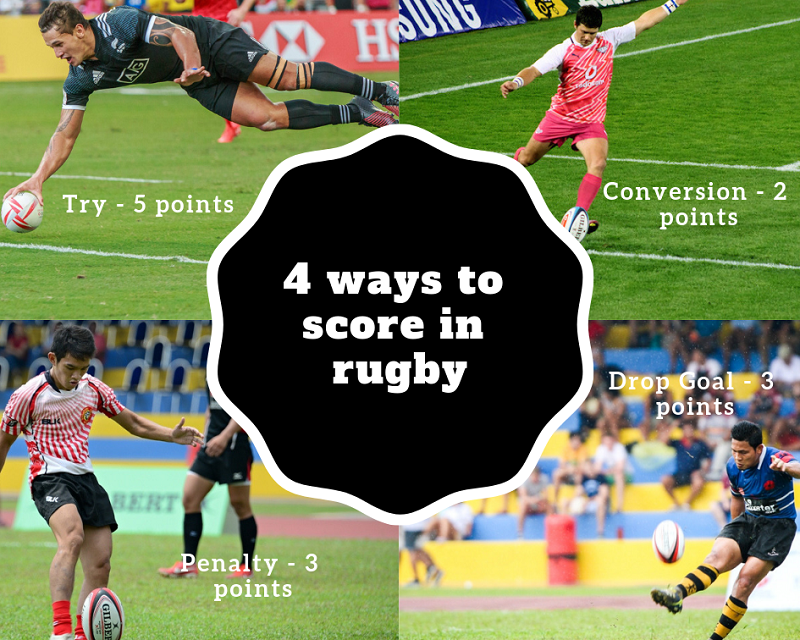
Quick Answer: Rugby union: try = 5 points, the conversion kick after it = 2, penalty goal = 3, drop goal = 3, and a penalty try = 7 with no kick taken. Rugby league is different: try = 4, conversion = 2, penalty = 2, drop goal = 1. If a scoreline looks wrong for the game you think you’re watching, check which code it is.
🏉 Rugby Hub: Explore all 35 boot reviews, rules breakdowns, and tackling guides in our Complete Rugby Resource Hub.
Rugby scoring is simpler than the scoreboard suggests — four ways to score, small numbers, and once you know them a 27–24 thriller stops being arithmetic and starts being a story. What most explanations leave out is why the numbers are what they are, and the tactical decision those numbers force on every captain roughly ten times a match.
Table of Contents
The four ways to score
| Method | Points | How it happens |
|---|---|---|
| Try | 5 | Grounding the ball with downward pressure in the opponent’s in-goal area |
| Conversion | 2 | The kick at goal awarded after a try, taken in line with where it was scored |
| Penalty goal | 3 | Kick at goal after the opposition commits a serious infringement |
| Drop goal | 3 | Drop-kicked through the posts in open play — the ball must touch the ground first |
Plus one special case: a penalty try, awarded when foul play prevents what the referee judges would have been a certain try. It’s worth a flat 7 points — the try and conversion combined, with no kick taken — and the offending team usually loses a player to the sin bin as well. It’s the most severe sanction in the sport short of a red card, and it exists precisely so that cynical defending never pays.
What ‘grounding it’ actually means
More technical than it looks, and it’s where TV replays spend most of their time. You must apply downward pressure on the ball while it’s in the in-goal area — with your hand, arm, or the front of your torso between waist and neck. Simply carrying it over the line isn’t enough; you have to put it down.
The corollaries people find surprising: you can ground the ball while diving, while being tackled, or by reaching out one-handed. The ball can be on the ground already and you can press it down. Touching the ball to the base of the post counts (the post protector is part of the goal line). And the try line itself is in the in-goal — grounding the ball on the line is a try, which is why you’ll see players stretching for a chalk line rather than beyond it.
Why conversions come from strange angles
The conversion is taken from anywhere along an imaginary line running straight back from where the ball was grounded, parallel to the touchlines. Score under the posts and the kick is a formality. Score in the corner and your kicker faces a nightmare — a narrow target at a brutal angle from 40 metres out.
This one rule creates one of rugby’s best small dramas. Watch a player who has already crossed the line: instead of grounding it immediately, they’ll often keep running sideways, toward the posts, dragging tacklers with them. They’re not showboating. They’re buying their kicker two points that a corner try would probably cost.
It also explains why a team can score four tries and lose to a team that scored two. Tries in the corner convert at maybe 50% even for professionals; tries under the posts convert at nearly 100%. Placement isn’t decoration — it’s worth points.
A worked scoreboard: how 28 points happen
| Minute | Event | Points | Total |
|---|---|---|---|
| 8 | Penalty goal | 3 | 3 |
| 21 | Try | 5 | 8 |
| 22 | Conversion missed (scored in the corner) | 0 | 8 |
| 34 | Try | 5 | 13 |
| 35 | Conversion (scored under the posts) | 2 | 15 |
| 52 | Penalty goal | 3 | 18 |
| 69 | Drop goal | 3 | 21 |
| 79 | Try + conversion | 7 | 28 |
Note the difference between minutes 21–22 and 34–35: the same 5-point try, but one converted and one didn’t — purely because of where on the line it was grounded. Over a season, that gap decides tables.
Why a try is worth 5 (and used to be worth nothing)
Here’s the part almost no scoring guide tells you, and it explains the sport’s entire modern character.
Originally, a try scored zero points. Grounding the ball earned you nothing but the attempt — the ‘try’ — at kicking a goal. The kick was the score. The name is a fossil of a game where crossing the line was merely the ticket to the thing that actually counted.
Then it climbed, deliberately, over a century:
| Year | Try worth | Why it changed |
|---|---|---|
| Early days | 0 | It only earned an attempt at goal — hence the name |
| 1894 | 3 | Raised from 2; conversion cut to 2 in the same change |
| 1971 | 4 | Rewarding attack over kicking |
| 1992 | 5 | Too many matches were being decided by expert kickers |
The 1992 change is the one that made modern rugby. Matches had become penalty-kick contests — the fastest route to points was to force an infringement and let a specialist kick three. Raising the try to five tilted the maths decisively back toward crossing the line, and the sport got faster and more expansive almost immediately.
There’s a lovely footnote to it. The last four-point try in international rugby was scored by Scotland captain David Sole against Australia at Ballymore on 21 June 1992. The first five-pointer came thirteen days later at the Sydney Football Stadium, when New Zealand’s Va’aiga Tuigamala trampled over David Campese to open the scoring in the fifth minute. Two weeks, one rule, and a different sport on the other side of it. More of the game’s evolution is in our how to play rugby guide.
Kick for goal or go to the corner? The decision every captain makes
This is the tactical layer the scoring numbers create, and it’s genuinely the most interesting thing about rugby’s points system. You’ve won a penalty in the opposition’s 22. You have three options and about fifteen seconds to choose.
| Option | Guaranteed value | Potential value | Risk |
|---|---|---|---|
| Kick at goal | 3 points (at good kicker %) | 3 | Almost none — you keep the scoreboard moving |
| Kick to the corner | 0 | 7 (try + conversion) | You might score nothing at all |
| Scrum | 0 | 7, plus more penalties | Highest risk, used when your pack dominates |
The maths is genuinely close, and it swings on three things: the scoreboard (are you chasing or protecting?), the clock (three points at minute 78 when you’re two down is the whole game; three points at minute 5 when you’re 20 behind is a waste of a possession), and your lineout (kicking to the corner is only worth it if you can actually win the throw and drive it over).
The common wisdom that captains actually use: take the three when the margin means three matters — anything inside a converted try, late. Go to the corner when you need seven, when your maul is dominant, or when the penalty count suggests the referee is about to lose patience with the defence. And take the scrum when your pack has been eating theirs alive, because a dominant scrum manufactures penalties and eventually a penalty try.
💡 Watch for the bonus point calculation. Late in a match a team already winning comfortably will suddenly turn down easy three-pointers and hammer the corner instead. They’re not showing off — they’re chasing a fourth try for the bonus point that could decide their league position months later.
Bonus points: the table math
Most leagues and the World Cup use a bonus-point system that changes how teams play even in lost causes:
- 4 points for a win, 2 for a draw, 0 for a loss.
- +1 bonus point for scoring 4 or more tries in a match, win or lose.
- +1 bonus point for losing by 7 points or fewer.
This is why you’ll see a team 30 points down in the 78th minute still attacking desperately for a fourth try, and why a team leading by 8 late will kill the clock rather than counter-attack — they’re protecting the opposition’s losing bonus point away. Some competitions use variants (a three-try margin instead of a raw four-try count, for instance), so check your league’s rules before you assume.
The kicks themselves: why they take so long
Roughly a third of all points in professional rugby come off a kicking tee, which makes the goal kicker the most quietly important player on the field — and explains the ritual you’re watching when everything stops for ninety seconds.
A place kick has a 60-second time limit from the moment the kicker indicates they’re taking it (and 90 seconds for a conversion in most competitions). Inside that window the kicker builds the tee, places the ball at their preferred seam angle, walks back a precise number of steps, and goes through a routine they’ve repeated tens of thousands of times. The routine isn’t superstition — it’s a way of making a high-pressure kick identical to a practice kick, which is the entire skill.
Drop goals are a different discipline entirely: the ball must touch the ground and be struck on the half-volley, in open play, with defenders sprinting at you. There’s no tee, no time, no routine. That’s why a 40-metre drop goal in a tight match is one of the sport’s genuine feats, and why the fly-half wearing 10 is usually the only person who attempts one.
For the record, the posts are 5.6 metres apart with a crossbar 3 metres up — and the ball must go over the bar and between the posts. It can hit a post and go over: still good. Hit a post and bounce back: no score, ball in play.
Scorelines that confuse newcomers
Some rugby results look impossible until you know the maths:
- A team scores more tries and loses. Four tries in the corner (20 points, no conversions) loses to two converted tries plus four penalties (26). Placement and discipline beat raw try count.
- 9–6 or 12–9 scorelines. Pure penalty contests — usually driven rain, a dominant defence, or two teams too scared to run. Common in northern-hemisphere winters and increasingly rare since 1992.
- A 3-point margin with no tries. Entirely possible: penalty kicks and drop goals only. Rugby’s answer to a 1–0 football match.
- Scores ending in odd numbers everywhere. Because 3, 5 and 7 are all in play, rugby produces scorelines football never can — 23–19, 31–27. The number combinations are half the fun of following it.
- A 7-point swing with no kick. That’s a penalty try — the referee decided foul play stole a certain score.
Union vs league vs sevens
| Union | League | Sevens | |
|---|---|---|---|
| Try | 5 | 4 | 5 |
| Conversion | 2 | 2 | 2 (drop-kicked) |
| Penalty goal | 3 | 2 | 3 (drop-kicked) |
| Drop goal | 3 | 1 | 3 |
League’s one-point drop goal (‘field goal’) exists to break deadlocks late without rewarding it too heavily — you’ll see it attempted in the final minutes of a tied game and almost never otherwise. Union’s three-pointer is a genuine strategic weapon a fly-half can use from 40 metres out in open play.
Sevens keeps union’s values but changes the kicking: conversions and penalties are drop-kicked, and they must be taken within 40 seconds — no tee, no ceremony, no time. It’s why sevens conversions get missed far more often, and why the format feels relentless. Details in our sevens guide.
Frequently asked questions
Why is it called a ‘try’?
Because originally it scored nothing — grounding the ball only earned you the attempt (‘try’) at kicking a goal. The kick was the score. The name outlived the logic by about 130 years.
How many points is a try in rugby?
5 in rugby union and sevens, 4 in rugby league. It was worth 4 in union until 1992, and 3 before 1971.
Can you score a drop goal from a penalty?
You can attempt one in open play any time, but from a penalty you’d normally take the place kick — same 3 points, far more reliable, and the clock stops.
Why do players run sideways after crossing the line?
To ground the ball closer to the posts and make the conversion easier. Two extra points are worth a few metres of extra risk.
What’s a penalty try worth?
A flat 7 points with no conversion attempt, and typically a yellow card for the offending team. It’s the punishment for foul play that stops a certain try.
Do I have to convert a try?
No — the conversion is optional, though teams essentially always take it. In sevens, the 40-second shot clock means a team already comfortable will sometimes decline it to save time and legs.
Why did the try go up to five points?
Because matches were being decided by kickers rather than attackers. The 1992 increase deliberately tilted the maths toward crossing the line, and modern rugby’s expansive style is a direct consequence.