
How to Watch Gymnastics Olympic Trials: TV, Streaming and Format


The U.S. Olympic gymnastics trials are a separate, U.S.-only qualifying meet held before the Games, not the Olympics themselves. NBC has carried Olympic gymnastics coverage, trials included, for decades across broadcast TV, cable and the Peacock streaming app, though the exact channel and streaming lineup shifts a bit each cycle, so confirm the current details on NBCOlympics.com or USA Gymnastics’ official site before the event.
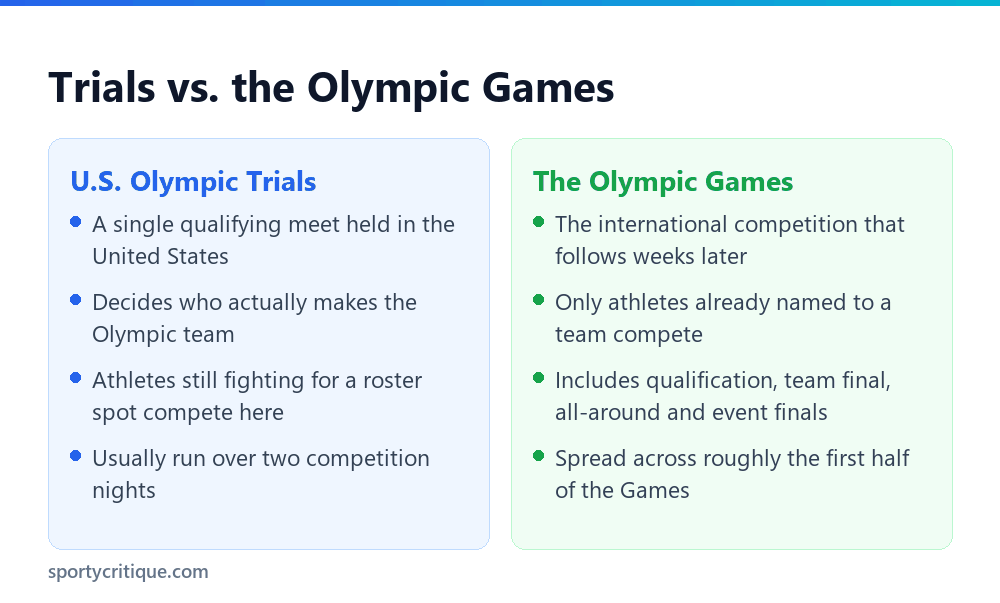
If you clicked on this looking to watch gymnastics Olympic trials for the first time, the most useful thing to know going in is that this is not a scaled-down Olympics. It is a different event, with a different purpose: deciding who actually goes. The athletes on the floor that night are not competing for medals. They are competing for a roster spot, and the difference in stakes changes how the whole broadcast feels.
Table of Contents
What the Olympic Trials Actually Are
USA Gymnastics uses the trials as the primary, though not the only, event in choosing the athletes who will represent the country at the Olympics. It’s a domestic meet, held on U.S. soil, open only to American gymnasts who have already met qualifying standards earlier in the season. There’s no international field here and no medals awarded in the sense you’d see at the Games. What’s on the line is a place on the team, and for a handful of athletes on the bubble, a single fall can be the difference between going to the Olympics and watching from home.
Because of that, trials broadcasts tend to have a different texture than Olympic coverage. Commentary leans harder into who is fighting for a spot, what a given score means for the roster math, and which apparatus a specialist needs to hit clean. If you’re used to Olympic gymnastics coverage built around medal chances, trials coverage is built around survival.
When the Trials Are Held
Trials are scheduled independently for every Olympic cycle, generally landing a few weeks before the opening ceremony so there’s enough runway to finalize the roster, run a selection camp and let athletes recover from a hard two nights of competition. Because the exact dates move from cycle to cycle and are set by USA Gymnastics and the host arena’s calendar, we’re not going to pin a specific date here that could be wrong for whichever cycle you’re reading this ahead of. USA Gymnastics’ official site and NBCOlympics.com post the confirmed schedule as soon as it’s locked in, and that’s the source worth checking rather than a generic guide.
How to Watch: TV and Streaming
NBC has held U.S. broadcast rights to the Olympics, and to the trials that precede them, for a long stretch of Olympic history. In recent cycles that’s meant coverage spread across NBC’s own broadcast network, cable outlets such as USA Network, and the Peacock streaming service, with additional streams and replays through NBCOlympics.com and the NBC Sports app.
📊 Note: Channel assignments, streaming exclusivity and pricing for Peacock and any live-TV bundle shift somewhat from one Olympic cycle to the next. Rather than repeat a specific past cycle’s schedule here as if it still applies, check NBCOlympics.com or Team USA’s official trials page once the current cycle’s broadcast plan is announced.
For viewers without a traditional cable package, live-TV streaming services that carry NBC and USA Network in your area, such as Fubo, Hulu + Live TV or DirecTV Stream, have historically been a workable substitute during past cycles. All of them run periodic free-trial promotions worth timing around a single night of trials coverage if that’s the only reason you’d sign up.
How the U.S. Team Actually Gets Picked
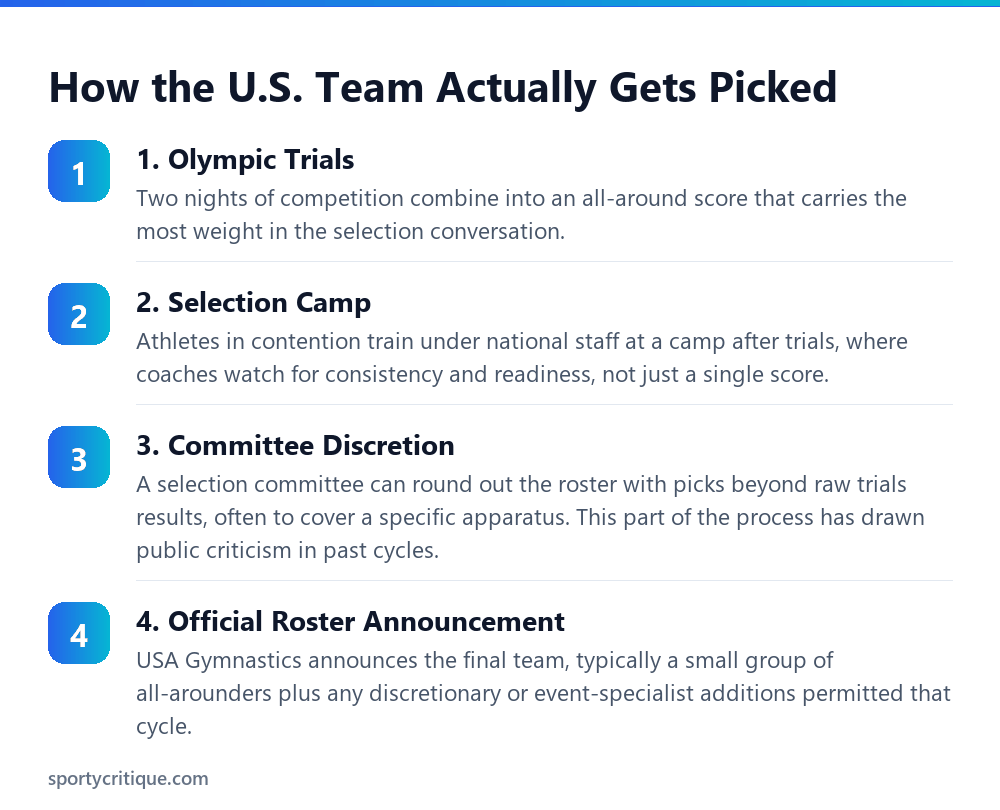
It’s a common assumption that whoever scores highest at trials automatically makes the team. That’s mostly, but not entirely, how it works. Trials results carry the most weight in the conversation, but USA Gymnastics’ selection process also factors in a training camp held after trials and gives a selection committee some discretion to round out the roster, particularly for athletes who are strong on a single apparatus rather than the all-around. That discretionary piece has been the subject of real public debate in past Olympic cycles, including arguments over specific athletes left off a team despite competitive trials scores.
Men’s and Women’s Trials: Same Event, Different Format
USA Gymnastics runs trials for both the men’s and women’s programs, usually on the same weekend or close to it, and broadcasts often split time between the two. The formats aren’t identical, which matters if you’re trying to follow both. Women compete on four apparatuses: vault, uneven bars, balance beam and floor exercise. Men compete on six: floor exercise, pommel horse, still rings, vault, parallel bars and high bar. A men’s session runs longer for that reason alone, and commentary tends to spend more time on event specialists, since the six-apparatus format leaves more room for someone to make the team on the strength of one or two events rather than the all-around.
If a broadcast schedule shows women’s trials one night and men’s the next, that’s normal, not a sign you’re watching the wrong thing. Both are real trials for real Olympic spots, just for separate teams with separate selection committees.
What Judges and Commentators Are Actually Watching For
A trials broadcast spends a lot of time on execution consistency, more than a typical regular-season meet. That’s deliberate. The selection committee isn’t just asking who has the hardest routines, it’s asking who can hit that routine clean under real pressure, twice, on back-to-back nights. A gymnast who lands a very difficult routine with a big step on night one and then hits the same routine clean on night two tells a different story than someone who is technically more difficult but shaky both times.
You’ll also hear commentators talk through return-from-injury storylines and depth at a given apparatus. Team selection isn’t only about the strongest six or seven individuals, it’s also about whether the group as a whole can cover every apparatus if someone has an off night at the Games themselves. That’s part of why a gymnast with a lower all-around score can still make a team over someone who scored higher overall, if their strongest event happens to be one the team is thin on.
If You Miss the Live Broadcast
Full replays of trials coverage are typically available afterward through NBCOlympics.com and the Peacock app for anyone with an account, and official clips usually go up on USA Gymnastics’ and NBC’s own social accounts within hours of the broadcast ending. If you’re specifically trying to catch a single athlete’s routine rather than the whole night, searching the athlete’s name plus “trials” on those official accounts is usually faster than scrubbing through a multi-hour replay.
What Actually Counts Toward Selection
It helps to see the selection factors laid out side by side rather than as one paragraph, since people often assume it’s a single number that decides everything.
- ✓Watch both trials nights if you can. All-around totals combine them.
- ✓Check NBCOlympics.com or USA Gymnastics’ official site for the confirmed channel and streaming lineup.
- ✓Pay attention to which apparatus a bubble athlete is strongest on. Team need matters as much as raw score.
- ✕Don’t assume the highest trials score guarantees a spot. Camp and discretion still apply.
- ✕Don’t rely on a generic cable guide description. Networks and streaming rights shift by cycle.
- ✕Don’t skip the warm-up coverage if it’s shown. It often previews who’s fighting an issue that night.
What to Expect From the Broadcast
Expect two competition nights, each covering all four women’s apparatuses (vault, uneven bars, balance beam and floor exercise), with all-around scores from both nights combined into the number commentators keep referencing. If the scoring system itself is unfamiliar, our separate guide on how women’s gymnastics is scored breaks down the difficulty and execution scores that make up that total.
Tips for Watching Trials for the First Time
💡 Pro tip: Watch the warm-up rotations if the broadcast or stream shows them. Coaches and commentators often flag who looks tight or off that night before a single competition score confirms it.
⚠️ Watch out: Don’t assume a fall ends someone’s chances outright, and don’t assume a clean night locks a spot in. Both trials nights count, camp performance counts, and the committee’s discretionary picks mean the roster isn’t finalized until USA Gymnastics actually announces it.
- →The trials are a U.S.-only qualifying meet, not a preview of the Olympics themselves.
- →NBC’s broadcast rights have covered trials for decades, but the exact channel and streaming lineup changes by cycle. Check the official source close to the date.
- →Trials scores matter most for the roster, but a post-trials camp and committee discretion also shape the final team.
- →Competition runs two nights, combining into the all-around scores used in the selection conversation.
- →The Olympics themselves are a separate event weeks later, covered in our companion guide.
Frequently Asked Questions
Are the Olympic Trials the same thing as the Olympics?
No. The trials are a separate qualifying competition held in the United States before the Games, where American gymnasts compete for a spot on the Olympic team. The Olympics are the international competition that follows, held in the host country weeks later.
What channel are the gymnastics trials on?
NBC has held U.S. broadcast rights to the Olympics and its trials for decades, with coverage historically spread across NBC broadcast TV, USA Network and the Peacock streaming app. The exact lineup shifts by cycle, so confirm on NBCOlympics.com or USA Gymnastics’ official site closer to the event.
Does winning the trials guarantee a spot on the Olympic team?
Not automatically. Trials results are the biggest factor, but a selection committee also weighs a post-trials training camp and can make discretionary picks, particularly for event specialists. This part of the process has been controversial in past cycles.
How many nights of competition are there at trials?
Trials are typically held over two competition nights, with all-around scores from both nights combined as part of the selection picture.
Can I watch the trials without cable?
Live-TV streaming services that carry NBC and USA Network, such as Fubo, Hulu + Live TV and DirecTV Stream, have historically carried trials coverage in past cycles. Confirm current availability and pricing directly with the provider before the event.
Are alternates named at trials too?
Yes, in most cycles a small number of traveling alternates are named alongside the main team. They train with the team and can be activated if a roster athlete is injured before or during the Games, though the exact rules around alternates have varied by cycle.
Do men’s and women’s trials happen at the same event?
Often on the same weekend or in the same arena, but they’re scored and selected separately. Women compete on four apparatuses, men on six, and each program has its own selection committee.
The short version: the trials decide who goes, the Olympics decide who medals, and they’re worth watching for different reasons. If you’re set on catching both, bookmark the official broadcast schedule once it’s announced rather than relying on a fixed channel number, since that’s the one detail that moves every four years.


