
Best Ping Pong Paddle for Professionals (Usually Overkill)


Best ping pong paddle for professionals has an honest answer and a practical one. Here’s what touring pros actually play with, what properly tournament-legal equipment costs for the rest of us, and real verified products at both ends.
The paddles actual touring professionals use are almost never bought as a single product. Pros pick a blade and two rubber sheets separately and have them glued together, most commonly something like a Butterfly Timo Boll ALC blade paired with Tenergy 05 rubber, a combination sold pre-assembled as the Butterfly Timo Boll ALC Pro-Line racket for around $345. For most recreational and even serious amateur players, that’s genuine overkill. A tournament-legal racket like the Killerspin Jet 600 Spin N2 or a PRO-SPIN ITTF-approved paddle gets you real, ITTF-compliant equipment for a fraction of the price.
Searching for the best ping pong paddle for professionals usually turns up one of two answers: an expensive pre-made racket marketed with the word “professional” stamped on the box, or a wall of separate blades and rubber sheets that assumes you already know what you’re doing. Both are honest in their own way, and it’s worth being upfront about which one actually matches what professional and top competitive players use, versus what’s simply priced like it does.
The short, honest version: real professional equipment is assembled from separate parts chosen individually, and it’s expensive enough that buying it before you’ve developed a stroke that can use it is a waste of money. This guide covers both the genuine pro-assembled option and the more realistic tournament-legal tier most competitive amateur players should actually buy.
- →Most touring professionals assemble their own blade-and-rubber combination rather than buying one pre-made racket
- →Butterfly’s Timo Boll ALC blade with Tenergy 05 rubber is one of the most recognized professional-tier combinations, sold pre-assembled for around $345
- →“Tournament-legal” is a specific, checkable standard (ITTF-approved rubber, correct thickness, red/black sides), not just a marketing word
- →A $60-90 ITTF-compliant racket is fully tournament-legal; it just won’t match a $300-plus setup on raw performance ceiling
- →Most recreational and even many serious amateur players will not outplay the limits of a mid-tier tournament-legal racket before they outgrow their own technique first
Table of Contents
What “professional equipment” actually means
At the top level of table tennis, players don’t buy a single racket off a shelf. They choose a blade, usually a specific wood-and-carbon or wood-and-arylate construction tuned for their playing style, and pair it with two separate rubber sheets, often different compounds on the forehand and backhand, selected for spin, speed, and control characteristics that suit how they play. A club or specialty shop then presses the rubber onto the blade. This is closer to how a serious cyclist chooses a frame and components separately than to buying a finished bike off a showroom floor.
That means there isn’t really one “professional racket” to recommend the way there might be for other sports. What we can do honestly is point to a widely recognized professional-tier combination sold pre-assembled, and separately, to real, ITTF-checkable rackets at a price a serious amateur can actually justify.
The real professional-tier option
The Butterfly Timo Boll ALC Blade & Tenergy 05 Rubber Pro-Line Racket pairs an Arylate-Carbon blade, developed with and named for former world number one Timo Boll, with Tenergy 05 rubber, one of the most widely used high-tension rubber compounds in top-level competition. Sold together as Butterfly’s own Pro-Line assembly, it’s marketed explicitly as recommended for aspiring professional players, and at roughly $345, the price reflects real premium materials rather than just a professional-sounding name.
⚠️ Watch out: Be clear-eyed about this price point before buying. A blade and rubber combination at this tier rewards a stroke that’s already fast and technically consistent. On an underdeveloped swing, the same combination can actually feel harder to control than a slower, more forgiving mid-tier racket, since high-tension rubbers amplify small technical errors along with intentional spin and speed.
The realistic tournament-legal tier
The Killerspin Jet 600 Spin N2 Ping Pong Racket is a far more practical recommendation for most players who want real tournament-caliber equipment without the full professional price tag. It uses a 5-layer wood blade with Killerspin’s Nitrx-4Z rubbers, marketed specifically as advanced, tournament-level equipment, and at around $90 it’s roughly a quarter of the Pro-Line combination’s price while still meeting the specs that matter for sanctioned play.
The PRO-SPIN ITTF Approved Professional Table Tennis Racket pushes the price down further while still claiming ITTF-approved rubber on a 7-ply carbon fiber blade, explicitly marketed for tournament play at roughly $60. It’s a fair entry point if you want to confirm your racket meets tournament rubber standards without committing to a $300-plus setup you may not be ready to use to its full potential yet.
The JOOLA Infinity Balance Ping Pong Paddle, at around $45, rounds out this list as a “competition ready” option positioned for serious training and match play just below the tournament-specialty tier above it, useful if you’re building toward tournament play but not entering sanctioned events yet.
What makes a racket tournament-legal, specifically
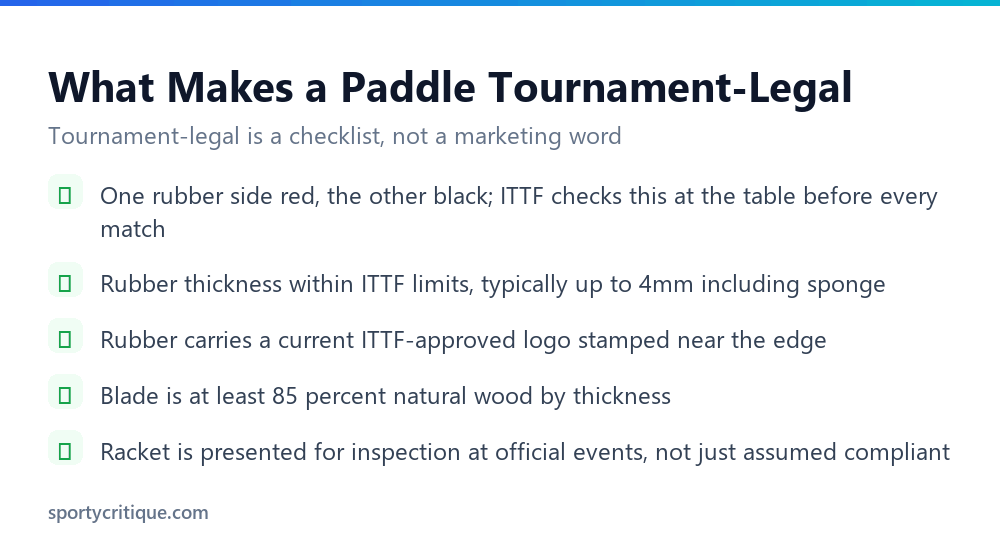
“Tournament-legal” isn’t a vague marketing phrase, it’s a checkable ITTF standard. One side of the racket’s rubber must be red and the other black, so opponents and umpires can see which surface is which during play. Rubber thickness, including the sponge layer underneath, is capped, generally around 4mm total depending on the exact rubber type. The rubber itself has to carry a current ITTF-approved stamp near the edge, and the blade has to be at least 85 percent natural wood by thickness, which rules out some heavily reinforced composite blades from official play even if they’re legal for casual games.
📊 Note: At actual sanctioned tournaments, rackets get physically inspected before matches, officials check the rubber stamp and colors directly rather than taking a manufacturer’s word for it. If you’re planning to compete, don’t assume a listing’s “tournament approved” claim is enough on its own; verify the specific rubber model against the current ITTF-approved rubber list before an event, since approvals do occasionally get revoked or updated.
- ✓Buy a properly tournament-legal racket (checked rubber, correct thickness) if you’ll compete
- ✓Start at the $45-90 tier unless you already know your stroke can use a higher-tension setup
- ✓Verify a specific rubber’s current ITTF approval before a sanctioned event, not just the racket’s marketing
- ✓Consider a separately assembled blade-and-rubber setup only once you know your exact playing style
- ✕Buy a $300-plus pro-tier combination before your technique is fast and consistent enough to use it
- ✕Assume “professional” in a product title means it’s actually ITTF tournament-legal
- ✕Skip checking rubber thickness and stamp requirements if you plan to enter sanctioned events
- ✕Copy a specific pro’s exact equipment expecting it to fix technique gaps in your own game
Blade speed ratings and why professionals split forehand and backhand rubber
Most serious players run different rubber on each side of the blade, typically a faster, higher-tension rubber on the forehand for attacking shots and a slightly softer or more control-oriented rubber on the backhand for blocking and setting up points. That asymmetry is one of the clearest signs of a fully custom-assembled setup, and it’s part of why a single pre-made racket, even a good one, is a simplification of what actual professionals play with. Pre-made rackets use the same rubber on both sides for manufacturing simplicity and cost, which is a reasonable trade-off for recreational and club-level play but a real limitation compared to a fully custom build.
When it actually makes sense to build a custom setup
Moving from a pre-made racket to a separately chosen blade and rubber combination is worth it once you have a consistent enough stroke to notice specific limitations, wanting more spin on your loop, more control on your block, that a pre-made racket’s fixed rubber choice can’t address. For most players, that point arrives well into regular club or league play, not in the first year of picking up the sport. If you’re not sure whether you’re there yet, that uncertainty is itself a reasonably reliable sign you aren’t, since players who’ve hit a specific equipment ceiling usually know exactly which shot is being held back and why.
💡 Pro tip: If you’re seriously considering a custom blade-and-rubber build, borrow or demo a club-mate’s racket with a similar spec first if you can. Rubber and blade combinations are expensive enough, and personal enough in feel, that a five-minute test hit is worth more than any spec sheet comparison.
Caring for high-tension rubber once you own it
A detail that gets lost in most buying advice: high-tension rubbers like Tenergy 05 degrade faster than the harder, cheaper rubbers found on entry-level rackets. Tackiness fades with exposure to air, dust, and UV light, not just from ball contact, so a $80 rubber sheet left uncovered on a shelf for six months can lose a meaningful share of its spin performance before it’s ever been played on regularly. Serious players use a rubber protector sheet between matches specifically to slow this down, and if you do invest in a premium blade-and-rubber combination, budgeting for a protector sheet and occasional rubber cleaner is part of the real cost of ownership, not an optional extra.
This is also a practical reason not to buy the top tier before you’re playing often enough to justify it. A premium rubber sitting mostly unused doesn’t hold its performance in storage the way a cheaper, harder rubber does, so infrequent play and expensive rubber are a poor financial combination, on top of the technique mismatch already covered above.
Bottom line
The best ping pong paddle for professionals, in the literal sense of what touring pros actually play with, is a custom-assembled blade and rubber combination costing $300 or more, exemplified by the Butterfly Timo Boll ALC and Tenergy 05 pairing. For nearly everyone reading this, though, the honest answer is a properly tournament-legal racket in the $45 to $90 range, which gets you real, checkable compliance with ITTF standards without paying for a performance ceiling your current stroke can’t reach yet.
See also: Best Ping Pong Paddle for the Money for what each price tier buys below the tournament level, or Best Brand for Ping Pong Paddle to compare how Butterfly, STIGA, JOOLA, DHS, and Yasaka actually specialize.
What racket do professional table tennis players actually use?
Most touring professionals assemble their own blade and separate forehand/backhand rubber sheets rather than buying one pre-made racket. A widely recognized example is Butterfly’s Timo Boll ALC blade paired with Tenergy 05 rubber, sold pre-assembled for around $345.
Do I need a $300 racket to play in a tournament?
No. A properly tournament-legal racket, meaning ITTF-approved rubber at the correct thickness with proper red/black sides, is available for $45 to $90. The $300-plus tier is about performance ceiling, not tournament legality.
What makes a paddle tournament-legal specifically?
Red rubber on one side, black on the other, rubber thickness within ITTF limits (typically around 4mm including sponge), a current ITTF-approved stamp on the rubber, and a blade that’s at least 85 percent natural wood by thickness.
Will a professional-tier racket make me play better right away?
Not necessarily, and it can backfire. High-tension professional rubber rewards a fast, consistent stroke; without that foundation it often plays harder to control than a more forgiving mid-tier racket matched to your current level.
As an Amazon Associate, we earn from qualifying purchases through links on this page.


