Best Grip Socks for Soccer: 4 Verified Picks and What They Actually Do

Grip socks solve one specific, real problem: your foot sliding around inside a boot during hard cuts and sprints. Here’s how the pads actually work, and four listings we verified are currently in stock, with real pricing.
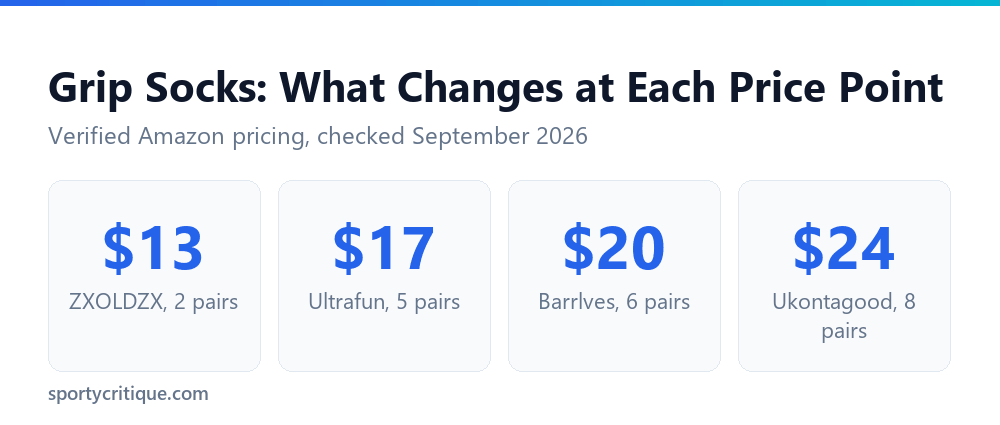
A grip sock is a regular soccer sock with rubber traction pads printed onto the footbed, usually under the arch and toes, so the foot stops sliding around inside the boot during hard cuts and sprints. We checked pricing and stock on Amazon in September 2026 for four widely sold options ranging from about $13 to $24 for a multi-pair pack. None of them eliminate the need for a properly fitted boot, and none of them are a substitute for lacing your boots correctly, but they do measurably cut down on the foot-inside-the-shoe slip that causes blisters and a mushy, delayed feel on the ball.
If your foot moves inside your boot when you plant and cut, that half-second of slip is the actual problem grip socks for soccer solve, not “performance” in some vague sense. We priced and checked availability on four grip sock listings currently sold on Amazon, all verified in stock at the time of writing, and we’re being upfront that we didn’t test them on a field ourselves. What we can tell you honestly is what’s actually for sale, what it costs right now, and what the grip-pad technology in all of them is mechanically capable of doing.
- →Grip pads work by increasing friction between your foot and the sock, and between the sock and a snug boot, not by gripping the ground
- →They only help if the boot already fits snugly; a loose boot will still let the whole foot-and-sock unit slide
- →Multi-pair packs (5 to 8 pairs) are usually the better per-pair value than buying a single pair repeatedly
- →Grip pads wear down with washing over months of use; expect the effect to fade, not disappear overnight
- →None of this replaces correct lacing technique, which fixes more slip than any sock will on its own
Table of Contents
What a grip sock actually does
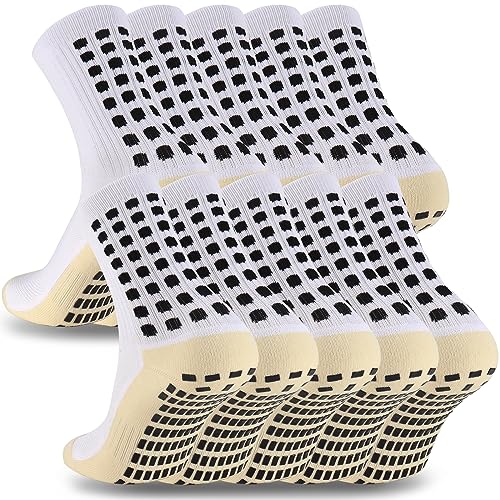
Standard socks are smooth on both sides. Inside a boot, that smoothness lets the foot shift slightly with every hard push-off, plant, or direction change, and that tiny shift is where blisters, hot spots, and a slightly delayed feel on the ball tend to come from. A grip sock adds a textured rubber or silicone print, usually running under the arch and across the ball of the foot, on the outside of the sock. That texture increases friction in two places at once: between the sole of your foot and the sock, and between the sock and the inside of the boot’s footbed.
That’s the entire mechanism. It’s a friction fix, not a magic performance upgrade, and it only works as well as the boot around it. A boot that’s a half-size too big will still let the whole foot-sock unit slide inside the shell, because the grip sock has nothing to lock against. If your boots already fit snugly and you’re still noticing slip, a grip sock is a genuinely useful, low-cost fix. If your boots are loose, buy socks second and fix the fit problem first.
⚠️ Watch out: Grip pads are printed onto the sock, not woven in, so they wear down with repeated washing and drying over a season. Expect the traction to noticeably soften after several months of regular use and machine washing, not because the product is defective, but because that’s how printed rubber behaves on fabric. Air-drying instead of tumble-drying slows this down.
Four verified options and what they cost right now
We checked live pricing and stock status for four grip sock listings on Amazon. All four were in stock at the time of writing, and prices for pack-based products like these do shift, so treat the numbers below as a snapshot rather than a guarantee.
Ultrafun 5-Pair Grip Socks

The Ultrafun 5-Pair Grip Socks was listed at $16.59 for 5 pairs at last check, verified in stock. (list price $22.99, about 28% off at last check) It’s the largest-brand listing of the four and sits in the middle of the price range once you divide by pair count, which is a reasonable default if you don’t have a strong preference either way.
ZXOLDZX Grip Socks

The ZXOLDZX Grip Socks was listed at $12.99 for 2 pairs at last check, verified in stock. It’s the cheapest way to try grip socks without committing to a large pack, useful if you’re not sure whether the grip-pad feel works for you before buying in bulk.
Barrlves 6-Pair Grip Socks

The Barrlves 6-Pair Grip Socks was listed at $19.99 for 6 pairs at last check, verified in stock. The larger pack size brings the per-pair cost down compared to buying single pairs repeatedly over a season.
Ukontagood 8-Pack Grip Socks

The Ukontagood 8-Pack Grip Socks was listed at $23.99 for 8 pairs at last check, verified in stock. It’s the highest total price of the four but also the largest pack, which usually means the lowest cost per pair if you go through socks quickly.
Sizing and fit matter more than the sock itself
A grip sock only works if it’s snug against your foot and your foot is snug inside the boot. A sock that’s too loose bunches at the toe or heel, which creates a new slip point instead of removing one. Most of the listings above run true to standard shoe-size charts, but sizing on any sock brand can run generous or tight depending on the manufacturer, so check the specific size chart on the listing rather than assuming your regular shoe size translates directly.
💡 Pro tip: Try the sock with the actual boot you play in before a match, not just around the house. A grip sock that feels fine in a running shoe can bunch differently inside a tighter, lower-volume soccer boot, and you want to find that out in practice, not during a game.
Grip socks versus regular socks versus compression socks
These three get confused often enough that it’s worth separating them plainly. A regular athletic sock is smooth on the outside and offers no extra friction against the boot; its job is cushioning and moisture management, nothing more. A compression sock uses graduated elastic pressure up the calf, mainly aimed at circulation and reducing muscle fatigue over a long match, and most compression socks have no grip texture on the sole at all. A grip sock is usually a standard-weight sock with rubber or silicone pads printed on the footbed, and it isn’t built for compression benefits. Some products on the market do combine grip pads with some compression through the arch, but the four listings we checked here are grip-focused, not compression products, and we’re not going to claim compression benefits for socks that don’t advertise or demonstrate that feature.
If you’re shopping and see a listing that claims both compression and grip in one sock, read the product description carefully. Manufacturers sometimes use “snug fit” and “compression” interchangeably in marketing copy even when the sock has no true graduated compression, so a snug-feeling grip sock isn’t automatically a compression sock in the medical or athletic-recovery sense of the term.
Who actually benefits from grip socks
- ✓Players who notice their foot sliding forward inside the boot during hard braking or cuts
- ✓Anyone who gets blisters on the ball of the foot or under the toes during matches
- ✓Players whose boots already fit snugly but still feel a slight lag between foot and ball
- ✓Coaches outfitting a full team, where a multi-pair pack lowers the per-player cost
- ✕Expecting grip socks to fix a boot that’s actually the wrong size
- ✕Buying the thickest pair you can find without checking it fits under a tight-fitting boot
- ✕Assuming grip pads last as long as the sock’s fabric; they wear down faster
- ✕Skipping proper lacing technique because the socks are “handling” the slip instead
Common misunderstandings about grip socks
How long the grip actually lasts
Because the texture is a printed layer rather than a woven-in fiber, it degrades with wash cycles and heat. A pair washed in cold water and air-dried will hold its grip noticeably longer than one that goes through a hot dryer every time. None of the four listings above publish an exact wash-cycle lifespan, and we’re not going to invent one; the honest answer is that grip-pad socks are a consumable that needs replacing periodically, which is part of why the multi-pair packs make practical sense over buying a single expensive pair.
📊 Note: None of the four listings above claim a specific number of washes before the grip fades, and we didn’t find independent third-party testing that verifies one either. If a listing you’re considering elsewhere claims an exact wash-count lifespan, treat that as a marketing number rather than a verified spec.
What to check before you buy
A few minutes of checking before you add a grip sock to your cart saves a return later. First, confirm the size chart on the specific listing rather than assuming your regular shoe size carries over; sock sizing varies more between brands than shoe sizing does. Second, check whether the pack includes more than one color or is a single fixed color, since some listings sell in a five-pair set that’s entirely one shade while others mix colors. Third, look at how recently the listing has reviews mentioning the grip pads specifically, since a product can be well reviewed overall while the traction feature itself gets mixed feedback.
Finally, decide how many pairs you actually need before comparing prices across packs. A player training four or five times a week goes through socks faster than someone playing one weekend match, and buying the larger pack up front is usually cheaper per pair than restocking a small pack repeatedly over a season.
Bottom line
Grip socks are a legitimate, low-cost fix for one specific problem: foot slip inside a boot that already fits well. They’re not a performance product beyond that, and they won’t rescue a boot that’s the wrong size. Of the four listings we verified, the multi-pair packs make more financial sense than buying single pairs unless you just want to test whether the grip-pad feel works for your foot before committing.
Do grip socks actually work for soccer?
They work for one specific problem: foot movement inside a boot that already fits snugly. The rubber pads increase friction between your foot, the sock, and the boot’s footbed, which cuts down on slip during hard cuts and sprints. They don’t improve traction against the ground and won’t fix a boot that’s the wrong size.
Can I wear grip socks with any soccer cleats?
Yes, they work with any boot, but the benefit depends on the boot fitting snugly to begin with. A loose boot will still let your whole foot slide, grip sock or not, because there’s nothing for the sock’s texture to lock against.
How long do the grip pads on soccer socks last?
None of the listings we checked publish an exact wash-cycle lifespan, and we didn’t find verified independent testing on it either. Cold washing and air drying instead of a hot dryer will extend how long the printed texture holds up, but expect it to fade gradually over a season of regular use rather than lasting indefinitely.
Are more expensive grip socks actually better?
Not necessarily in a straight line. Price differences among the four listings we checked mostly track pack size (2 pairs versus 8 pairs) rather than a fundamentally different grip technology. Compare the per-pair price, not just the sticker price, before deciding.
Do grip socks help prevent blisters?
They can, specifically for blisters caused by the foot sliding inside the boot during play. If your blisters come from a different cause, such as a boot that’s simply too small or a seam rubbing in one spot, a grip sock won’t address that underlying issue.
As an Amazon Associate, we earn from qualifying purchases through links on this page.