College Soccer Scholarships: How the Recruiting Process Actually Works


| Collegiate Athletic Division | Men’s Max Full Scholarships | Women’s Max Full Scholarships | Scholarship Type (Equivalency vs Headcount) | Typical Average Athletic Aid Award |
|---|---|---|---|---|
| NCAA Division 1 | 9.9 scholarships per team | 14.0 scholarships per team | Equivalency (Split into partials across roster) | 25% to 65% tuition and fees coverage |
| NCAA Division 2 | 9.0 scholarships per team | 9.9 scholarships per team | Equivalency (Can combine with academic merit aid) | 30% to 50% tuition package |
| NCAA Division 3 | 0 athletic scholarships | 0 athletic scholarships | Non-athletic (Need-based & academic merit grants only) | Academic merit grants can cover up to 100% need |
| NAIA (National Association) | 12.0 scholarships per team | 12.0 scholarships per team | Equivalency (Higher cap than NCAA D1 men) | 40% to 75% aid package |
| NJCAA (Junior Colleges) | 18.0 scholarships (D1 JUCO) | 18.0 scholarships (D1 JUCO) | Full rides available (Tuition, room & board, books) | Full to partial two-year development pathway |
There’s no honest list of “best” colleges for college soccer scholarships that fits every player, since the right fit depends on level, academics, and a coaching staff’s specific roster needs. What this guide covers instead: how NCAA divisions, scholarship rules, and the recruiting process actually work for a typical high school player.

There is no single list of “best” colleges for college soccer scholarships that holds up honestly, because the right program depends on a player’s level, academic goals, and the specific roster needs of a coaching staff in a given recruiting cycle, none of which a general guide can know in advance. What we can explain reliably is how the system actually works: the difference between NCAA Division I, II, and III, why most soccer scholarships are partial rather than full rides, and what the recruiting process realistically looks like for a typical high school player, male or female.
A lot of recruiting content online leans on specific college rankings or exact scholarship dollar amounts that are either outdated by the time you read them or were never verified in the first place. Scholarship policy at the NCAA level has also changed meaningfully in recent years, including a shift toward roster-limit rules following a major legal settlement, so numbers that were accurate a few years ago may no longer apply. Rather than repeat unverifiable specifics, this guide focuses on the structure of the system and the recruiting process itself, the parts that stay useful regardless of which season you’re reading this in.
- →NCAA Division I and II soccer programs can offer athletic scholarships; Division III cannot
- →Soccer has historically been an equivalency sport, meaning scholarships are usually split into partial awards across a roster, not full rides for everyone
- →NCAA scholarship and roster rules changed substantially in the mid-2020s; verify current rules directly with the NCAA and a target school’s compliance office rather than trusting an older article
- →Recruiting realistically starts with the player’s own outreach and video, not with coaches finding players unprompted
- →A walk-on spot at a school without athletic scholarships can still come with strong academic or need-based aid worth pursuing
Table of Contents
NCAA Division I, II, and III: what actually differs
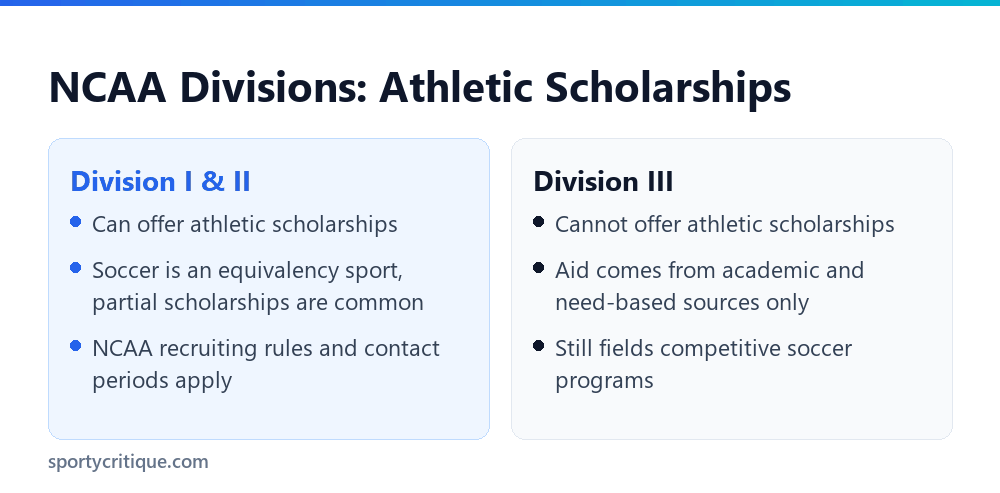
Division I and Division II schools are permitted to offer athletic scholarships. Division III schools are not permitted to offer athletic scholarships at all, by NCAA rule, though Division III athletes can still receive academic scholarships, need-based financial aid, and merit aid through the same channels as any other student. This is a common point of confusion: a Division III soccer program can be highly competitive and well coached while offering zero athletic scholarship money, because the division’s entire structure is built around that restriction.
Within Division I, soccer is what the NCAA classifies as an equivalency sport rather than a headcount sport. Headcount sports, like FBS football or Division I women’s volleyball and basketball, award only full scholarships, so every scholarship athlete on the roster is on a full ride. Equivalency sports work differently: a coaching staff has a pool of scholarship value to distribute and can split it across more players than there are full scholarships, meaning most scholarship soccer players receive a partial scholarship, not a full one. This equivalency structure for soccer has been standard for a long time, though the exact scholarship limits and now roster-size rules have been in flux following recent NCAA governance changes, so check the NCAA’s current rules and a specific school’s compliance office for numbers rather than relying on older sources, including older editions of recruiting guidebooks.
⚠️ Watch out: NCAA scholarship and roster-limit rules changed significantly starting around the 2025-26 academic year following a major legal settlement affecting college athletics broadly. If you’re reading older recruiting material, including guidebooks published before that change, treat any specific scholarship-count numbers in them as potentially outdated and verify current rules directly with the NCAA or the target school.
Why “full ride” is the exception, not the rule, in soccer
Because soccer is an equivalency sport, a coaching staff managing a limited scholarship pool across a full roster usually spreads it thin. A player offered a scholarship might receive it covering a fraction of tuition, room, or board rather than the full cost of attendance. This isn’t a sign of a lesser program or a lesser player; it’s how the sport’s scholarship structure works across essentially all Division I and II soccer programs. Families budgeting for the recruiting process should plan around partial aid as the realistic outcome and treat a full scholarship offer as a genuinely rare exception rather than the target to expect.
What the recruiting process actually looks like
Recruiting rarely starts with a college coach discovering a player by chance. In practice, it usually starts with the player and family doing outreach: filling out a program’s recruiting questionnaire on its athletics website, emailing coaches directly with an introduction, academic information, and a highlight or full-match video, and attending camps or showcases where college coaches are actually present to evaluate players in person. Coaches have limited time and a limited recruiting budget, so making it easy for them to find and assess a player’s information matters more than waiting to be found.
From there, the process typically moves through stages: initial contact, coach interest and further evaluation (often at camps or via game film), unofficial visits (paid for by the family) and, for some recruits, official visits (partially funded by the school within NCAA rules), and eventually a verbal commitment followed by a formal offer and, for many Division I and II athletes, a National Letter of Intent. Timelines vary a great deal by division and by how competitive a specific program is, and NCAA rules govern exactly when coaches can contact recruits at different ages, so check the current NCAA recruiting calendar for the specific rules that apply during a player’s actual recruiting window.
Building a basic recruiting profile
A workable recruiting profile usually includes an up-to-date highlight video (a few standout minutes rather than one long match), academic information including GPA and test scores if available, position and physical measurables, club and high school team information, and contact information for current coaches who can speak to a player’s character and work ethic. None of this needs to be expensive to produce; a phone camera and basic video editing is enough for an initial outreach video, and polish matters far less than coaches seeing enough game action to judge decision-making and technique honestly.
NAIA and junior college routes, briefly
The NCAA isn’t the only path into college soccer. The NAIA (National Association of Intercollegiate Athletics) governs a separate set of member schools, generally smaller institutions, with its own recruiting rules and its own scholarship structure, and it can be a genuine option for players who don’t land an NCAA offer or who prefer a smaller school environment. Junior colleges (often organized under the NJCAA) offer another route, sometimes used by players who want more development time and game experience before transferring into a four-year NCAA or NAIA program. Each of these paths has its own eligibility and scholarship rules distinct from the NCAA’s, so treat them as separate systems to research on their own terms rather than assuming NCAA rules apply.
Budgeting for the recruiting process itself
Recruiting has real costs beyond tuition: travel to showcases and camps, tournament and camp registration fees, video production if you hire outside help rather than filming yourself, and unofficial campus visits paid for by the family. These costs add up over a multi-year recruiting process and are worth planning for as part of the overall financial picture, not just the scholarship outcome at the end. Some families find that a smaller number of well-chosen showcases, ones with strong college coach attendance specifically, produces better results than attending every available event on a tight budget.
It’s also worth having a direct conversation with target programs about what a realistic aid package looks like before assuming a scholarship offer will cover most costs. Given that soccer scholarships are usually partial, the combination of athletic aid, academic aid, and financial aid together determines the real out-of-pocket cost, and that combined number is what actually matters for a family’s decision, not the scholarship figure in isolation.
Walk-on paths and non-scholarship options
- ✓Considering Division III programs seriously if academic fit and roster competitiveness matter more than athletic scholarship money
- ✓Asking a target program directly about walk-on tryout opportunities if a scholarship offer doesn’t come through
- ✓Applying for academic and need-based aid at every school regardless of athletic scholarship status, since that aid is separate
- ✓Verifying current NCAA scholarship and roster rules directly rather than trusting an older article or guidebook
- ✕Assuming Division III means a lesser soccer program just because athletic scholarships aren’t offered there
- ✕Expecting a full scholarship as the default outcome in a sport that’s structured around partial awards
- ✕Waiting passively for a coach to discover a player without any outreach on the family’s part
- ✕Relying on specific dollar-amount or scholarship-count claims from outdated sources
A common myth about recruiting
How this differs from the women’s college soccer recruiting picture
This guide covers the general, largely co-ed structure of the recruiting process and the NCAA division system that applies to men’s and women’s soccer alike. Women’s college soccer has its own specific context worth understanding separately, including Title IX’s effect on athletic opportunity distribution and a showcase and ID-camp culture that often starts earlier in a player’s high school career than is typical on the men’s side. We cover that separately in our companion guide on the best colleges for women’s soccer, rather than repeating the same general process information twice.
Bottom line
There’s no shortcut list of “best” schools that fits every player’s situation honestly. What actually helps is understanding that Division I and II programs can offer scholarships (usually partial, since soccer is an equivalency sport) while Division III cannot, that recruiting mostly starts with the player’s own outreach rather than passive discovery, and that NCAA rules around scholarships and roster limits have changed recently enough that current verification matters more than trusting an older source.
Do all college soccer scholarships cover full tuition?
No. Soccer is classified by the NCAA as an equivalency sport, which means most scholarship offers are partial rather than full rides, since coaching staffs split a limited scholarship pool across more players than there are full scholarships available.
Can Division III schools offer soccer scholarships?
No. NCAA Division III schools are not permitted to offer athletic scholarships at all. Division III athletes can still receive academic scholarships and need-based financial aid through the same channels available to any student.
How does college soccer recruiting actually start?
In most cases, recruiting starts with the player and family reaching out: filling out a program’s recruiting questionnaire, emailing coaches directly with video and academic information, and attending camps or showcases where coaches are present to evaluate players in person, rather than a coach discovering a player unprompted.
Have NCAA scholarship rules changed recently?
Yes. NCAA scholarship and roster rules changed substantially starting around the 2025-26 academic year following a major legal settlement affecting college athletics. Older articles or guidebooks may reference outdated numbers, so verify current rules directly with the NCAA or a target school’s compliance office.
What should be in a basic soccer recruiting video?
A short highlight reel showing clear game action and decision-making, position and physical information, academic details like GPA and test scores if available, and contact information for current coaches. It doesn’t need to be professionally produced to be useful to a college coach evaluating a prospect.