Lacrosse Positions Explained (Attack, Midfield, Defense & Goalie)

Lacrosse positions break down into four core roles: attack (3 players, stay in the offensive half, focus on scoring), midfield (3 players, play the entire field on both offense and defense), defense (3 players, stay in the defensive half, focus on stopping attackers), and the goalie (1 player, defends the goal and is the only player allowed inside the crease). A face-off specialist — often a midfielder — battles for possession at the draw that starts each segment of play.
Table of Contents
The four core positions
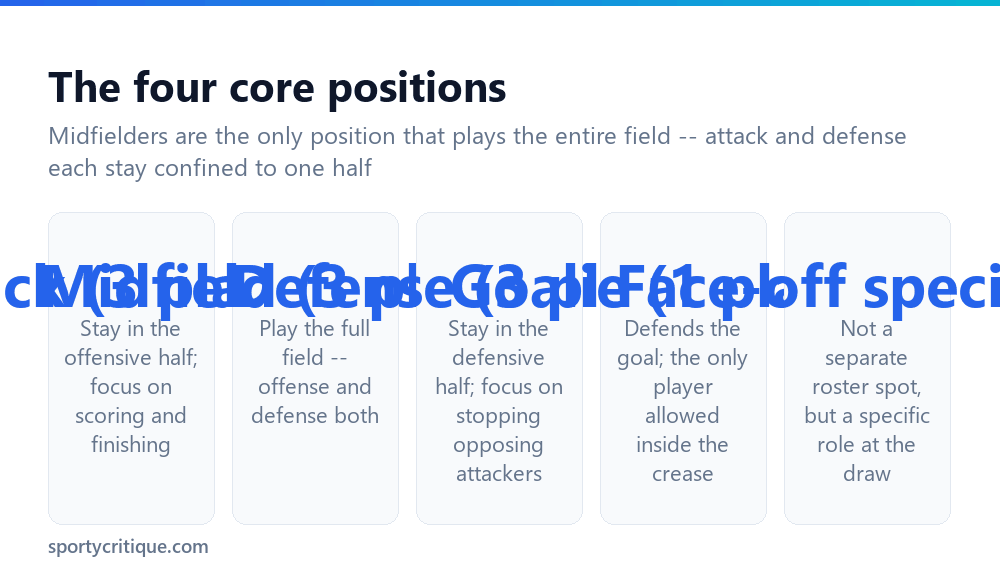
Attack (3 players) — confined to the offensive half of the field, attackers focus on creating and finishing scoring opportunities through passing, cutting, and dodging defenders.
Midfield (3 players) — the only position that plays the entire field, transitioning between offense and defense as possession changes, which demands genuinely different conditioning than the other positions.
Defense (3 players) — confined to the defensive half, focused on stopping opposing attackers through positioning, stick checks, and physical play rather than scoring.
Goalie (1 player) — defends the goal directly and is the only player on the field allowed inside the crease, the marked area immediately surrounding the goal.
Face-off specialist — not a formally separate roster position, but a specific role at the draw that restarts play, often filled by a midfielder with specific face-off training rather than a dedicated position of their own.
Midfielders are the connective tissue of a lacrosse team — they’re the only position that plays the full field, which is exactly why conditioning and stamina matter more for that role than for attack or defense, both of which stay confined to one half.
How the positions work together
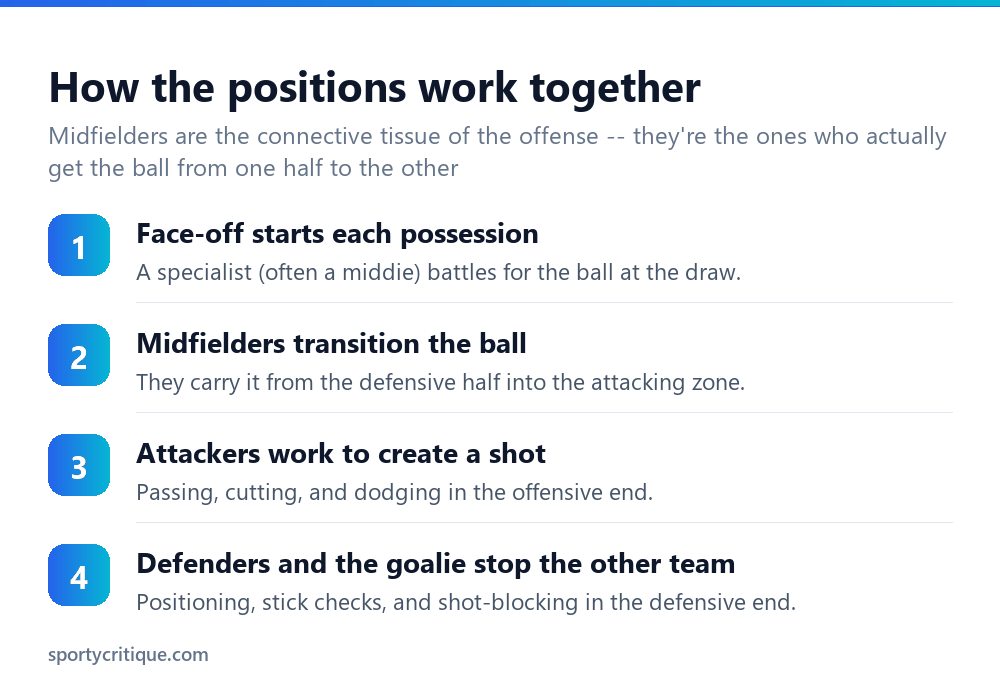
Face-off starts each possession — a specialist, often a midfielder, battles directly for the ball at the draw in the center of the field.
Midfielders transition the ball — carrying possession from the defensive half into the attacking zone, the genuine bridge between the two ends of the field.
Attackers work to create a shot — using passing, cutting off the ball, and one-on-one dodges to break down defenders in the offensive end.
Defenders and the goalie stop the other team — through positioning, legal stick checks, and shot-blocking, working together to prevent the opposing attack from getting a clean scoring chance.
What makes each position genuinely different
Beyond just field position, each role demands a different physical and mental skillset. Attackers need sharp stick skills and finishing composure under pressure since their entire job centers on the small window between creating and converting a scoring chance. Defenders need genuine physicality and positioning discipline, since a single lapse can turn directly into a goal against. Midfielders need real conditioning above almost anything else, since they’re expected to sprint the length of the field repeatedly across a game. Goalies need a specific mental toughness — facing shots traveling at high speed and needing to reset mentally after every goal allowed, since dwelling on a previous goal tends to affect the next save.
Getting started at a new position
For a new player still developing basic stick skills, having reliable, properly fitted gloves genuinely matters regardless of which position ends up being the best fit — STX Stallion 75 gloves is a well-reviewed beginner option worth having before committing serious practice time to learning any specific role, since comfortable, protective gloves make the actual stick-handling repetitions genuinely more comfortable to put in.
As an Amazon Associate, we earn from qualifying purchases through links on this page.
What new players actually struggle with early on
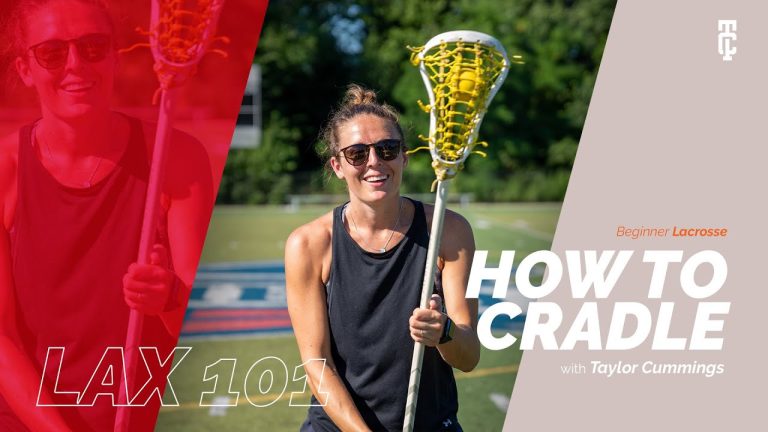
Regardless of eventual position, nearly every new player struggles with the same early hurdle: cradling the ball securely enough to run at full speed without losing it, since that single skill underlies everything else a position-specific role builds on top of. Attackers can’t finish plays they never receive; defenders can’t clear the ball out of their own end without controlling it first; even goalies benefit from comfort handling a stick when initiating a clear after a save.
This is worth keeping in mind when a new player seems to be struggling with a specific position — the actual problem is often the underlying stick-handling fundamental, not a mismatch with the position itself, and more repetitions with basic cradling and passing tend to resolve position-specific frustration faster than switching positions repeatedly looking for an easier fit.
How positions differ between boys’ and girls’ lacrosse
The core four positions — attack, midfield, defense, and goalie — exist in both boys’ and girls’ lacrosse, but the rules governing contact and stick checking differ meaningfully between the two versions of the sport, which changes how aggressively a defender in particular can actually play the position. Girls’ lacrosse restricts stick checking and body contact considerably more than the boys’ game, meaning defensive positioning and footwork matter proportionally more than the physical checking that boys’ defenders rely on more heavily.
This distinction matters for anyone researching position-specific technique content online, since a boys’ lacrosse defensive drill emphasizing hard stick checks isn’t directly transferable to the girls’ game, where the same defensive outcome has to be achieved through positioning and anticipation instead.
How coaches typically evaluate players for each position
At tryouts or early practices, coaches generally aren’t just watching raw talent — they’re watching for signals specific to each role. For midfield, that means genuinely watching who’s still moving well and covering ground in the final minutes of a conditioning drill, since that stamina is the position’s defining requirement. For attack, coaches watch decision-making under pressure — who recognizes a genuine passing lane versus who forces a low-percentage shot. For defense, footwork and body positioning relative to an attacker matter more at this stage than physical size, since positioning can be taught and improved while raw size largely can’t. For goalie, coaches often specifically look for a player who doesn’t visibly rattle after allowing a goal, since that emotional recovery is arguably a bigger predictor of goalie success than raw reflexes alone.
Understanding what’s actually being evaluated at each position can help a new player focus their practice time more effectively — rather than generically practicing “lacrosse skills,” a player interested in midfield benefits more from conditioning work specifically, while a player interested in goalie benefits more from repetitions that build composure under repeated shots, not just raw shot-stopping technique alone.
This same logic applies to attack and defense too: a player targeting attack genuinely benefits more from small-space passing and decision drills against live pressure than from isolated shooting practice alone, since the actual bottleneck for most attackers is decision-making speed, not shot mechanics. A player targeting defense benefits more from footwork and positioning drills against a live dodger than from stick check repetitions in isolation, since positioning is what actually determines whether a check opportunity exists in the first place.
None of this means specialized drills are useless — shot mechanics and check technique still matter — but for a new player with limited practice time, prioritizing the skill that actually gates progress at a chosen position produces faster, more visible improvement than spreading effort evenly across everything at once during those early practice sessions.
A simple takeaway for anyone unsure where to start: pick the position that matches how you’re already naturally trying to play in early practices, then commit to the specific drills that actually move that role forward, rather than chasing every skill at once.
Choosing a position as a new player
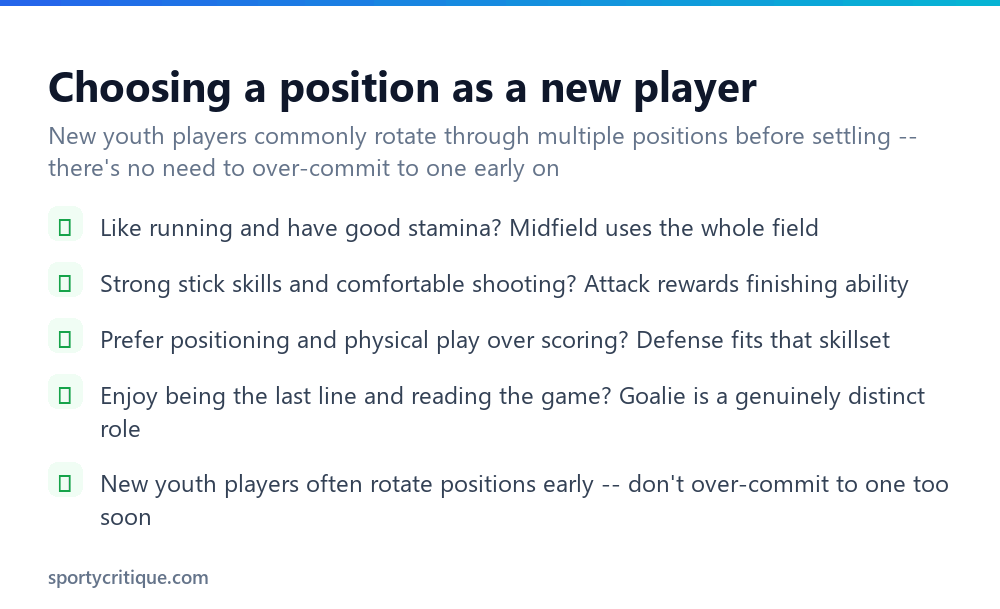
Like running and have good stamina? — midfield uses the whole field and rewards genuine conditioning above raw stick skill.
Strong stick skills and comfortable shooting? — attack rewards finishing ability and creative offensive play in a confined space.
Prefer positioning and physical play over scoring? — defense fits a player who’d rather stop a play than create one.
Enjoy being the last line and reading the game? — goalie is a genuinely distinct role requiring a specific mindset most other positions don’t demand.
New youth players often rotate positions early — there’s genuinely no need to over-commit to one position too soon, since many players discover their actual best fit only after trying more than one role.
- ✓Understand that midfield is the only position playing the full field
- ✓Consider conditioning level and playing style when trying a new position
- ✓Let new, especially youth, players rotate through positions before settling
- ✓Recognize goalie demands a genuinely different mental approach than field positions
- ✓Get properly fitted, protective gloves before committing to serious practice reps
- ✕Assuming all three field positions (attack/mid/defense) demand the same skillset
- ✕Locking a new player into one position before they’ve tried multiple roles
- ✕Underestimating the conditioning demands of midfield specifically
- ✕Treating goalie as just ‘another position’ rather than its own distinct skillset
- ✕Practicing extensively with poorly fitted or uncomfortable gloves
Frequently asked questions
What are the main positions in lacrosse?
Attack, midfield, defense, and goalie, each with a genuinely different role and skillset on the field.
Which lacrosse position plays the whole field?
Midfield. Attack and defense each stay confined to one half; midfielders transition between both.
How many players are at each position in lacrosse?
Typically 3 attackers, 3 midfielders, 3 defenders, and 1 goalie for a standard field lacrosse lineup.
What does a face-off specialist do?
They battle for possession at the draw that restarts play, often a midfielder with specific face-off training rather than a separate formal position.
Which lacrosse position is best for a beginner?
There’s no single best starting position — many youth players rotate through multiple positions early on before settling into their best fit.
What makes the goalie position different from field positions?
Goalies are the only player allowed inside the crease and face a genuinely different mental demand, needing to reset after every goal allowed.
- →Learn the basic rules that govern every position: lacrosse rules for beginners
- →Get properly geared up first: best lacrosse gloves
- →Master the fundamental skill every position needs: how to throw a lacrosse ball