Badminton Leg Workout: 7 Exercises That Actually Help

A good badminton leg workout builds three things: explosive push-off, fast side-to-side movement, and the endurance to stay low for a whole match. The best exercises are lunges, split jumps, lateral bounds, calf raises, and wall sits. Do 3 sets of each, 3 times a week. Most players see faster court coverage within a month.
Table of Contents
Why leg strength wins badminton points
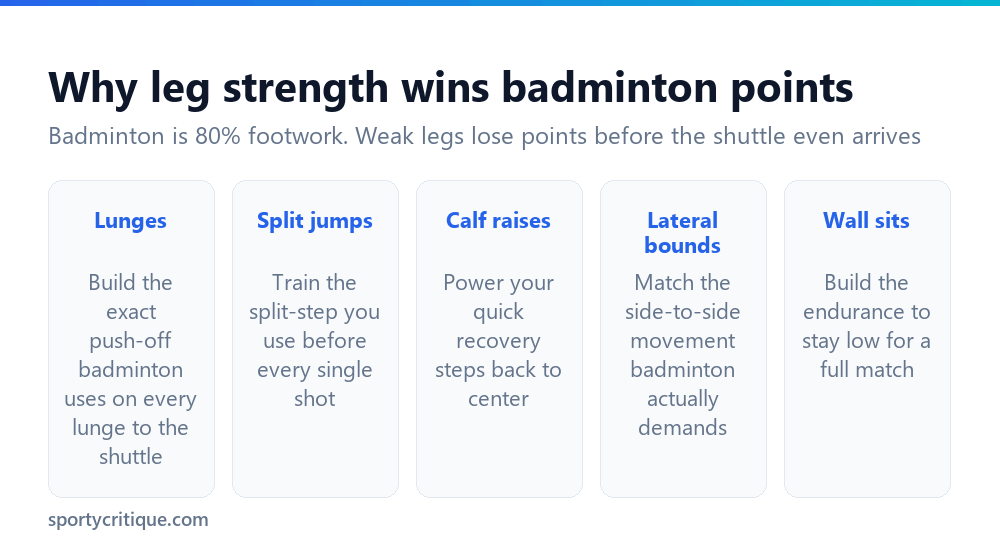
Badminton looks like an arm sport. It isn’t. Your legs get you to the shuttle. Your arm just finishes the job.
Lunges build the exact push-off you use lunging for a drop shot. Split jumps train the split-step every good player does before each opponent’s shot. Calf raises power your quick recovery back to center court. Lateral bounds match badminton’s side-to-side movement. Wall sits build the endurance to stay low through a long rally.
Weak legs lose points before the shuttle even arrives. You can have the best swing in the world. It won’t matter if you’re a step late.
The 7-exercise routine
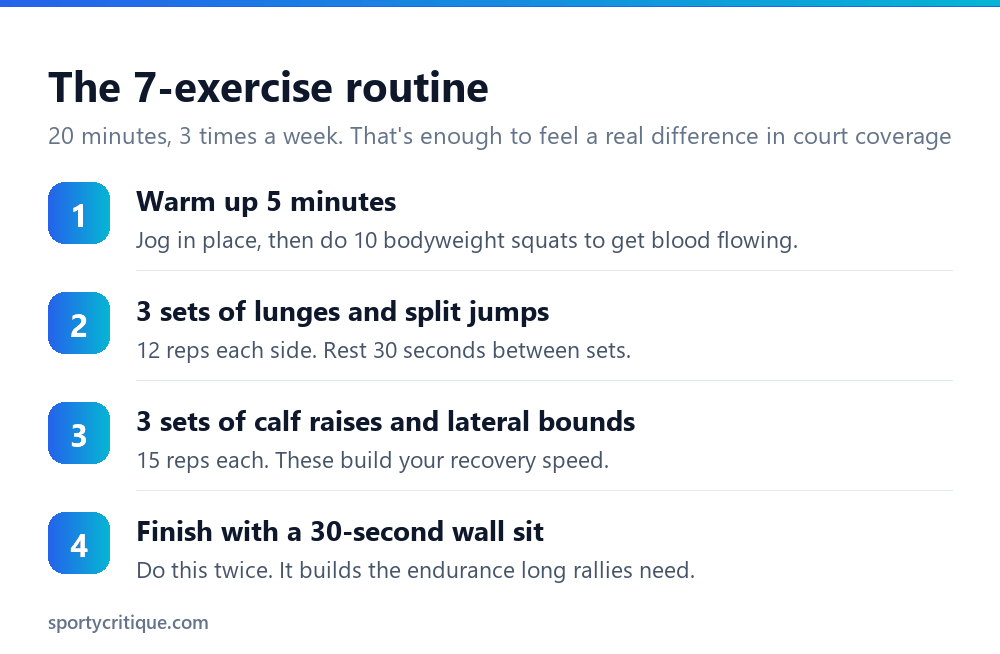
Warm up for 5 minutes first. Jog in place. Then do 10 bodyweight squats. This gets blood into your legs before anything explosive.
Do 3 sets of lunges and split jumps. 12 reps each side. Rest 30 seconds between sets. Keep your front knee behind your toes on every lunge.
Do 3 sets of calf raises and lateral bounds. 15 reps each. These two build the recovery speed you need after every shot.
Finish with a 30-second wall sit, twice. This last one is boring. It’s also what lets you still move fast in the third game of a match.
One more note on gear. Train barefoot or in regular shoes at home if you want. But once you take this into actual footwork drills on court, wear real court shoes. Running shoes grip the floor wrong for the fast side-to-side stops badminton demands, and that mismatch shows up as slipping right when you need traction most, often at the worst possible moment in a rally, right as you’re pushing off for a wide shot.
How often to do this leg workout
Three times a week is the sweet spot. Any less and you won’t build real strength. Any more and your legs won’t recover in time for your next match.
Never do this workout the day before a match. Sore legs the day after training means slower reaction time on court. Train hard, then rest a day before you play.
What to do if your legs feel too sore to train
Sore legs happen, especially in your first few weeks. Don’t just push through sharp pain. There’s a real difference between normal soreness and an injury warning.
Normal soreness feels dull and even on both legs. It fades within a day or two of light movement. Sharp pain on one side, or pain that gets worse instead of better, means stop and rest. Pushing through that kind of pain turns a minor issue into weeks off the court.
If you’re just generally tired, not hurt, a lighter session still helps. Cut every set in half and skip the wall sits. Some movement keeps the routine going without overloading legs that need a break.
Adding resistance for faster results
Bodyweight is enough to start. But once lunges feel easy, add resistance. An agility ladder ($10, 4.6 stars, 3.9K+ reviews) is the cheapest way to add real speed training. Set it on the floor and run through it for 5 minutes before your leg sets. It trains fast, precise footwork the same way badminton actually demands.
As an Amazon Associate, we earn from qualifying purchases through links on this page.
Warming up properly, step by step
A rushed warm-up doesn’t do much. Take the full 5 minutes. It’s worth it.
Start with a slow jog in place for 2 minutes. Get your heart rate up first. Then do 10 bodyweight squats, nice and controlled. Follow that with 10 walking lunges, no weight, just to wake up the exact muscles you’re about to train.
Finish with 30 seconds of ankle circles, each foot. Badminton puts a lot of stress on ankles during quick direction changes. This small step genuinely helps prevent rolled ankles later in the workout.
Signs your legs are actually improving
You’ll notice it on court before you notice it in the gym. Watch for these three signs. You reach wide shots without lunging off-balance. You recover to center faster after a smash. Your legs don’t burn out in the third game anymore.
If none of that shows up after a month, check your form first. Bad form on lunges and jumps wastes the workout. A knee going past your toes, or a jump that lands hard instead of soft, means you’re building the wrong habit.
A sample week of leg training
Here’s how to fit this into a normal training week. Say you play matches on Tuesday and Saturday.
Do this leg workout Monday, Wednesday, and Friday. That gives you a full rest day before each match. Sunday and Thursday are for light stretching only, nothing heavy.
New to leg training? Start with just 2 sets instead of 3. Add the third set after two weeks, once your legs adapt. Jumping straight to 3 full sets in week one is how people end up sore for a week and skip the next session entirely.
Track your reps in a notes app. It sounds small. But seeing your own progress, even just 12 reps becoming easy, is what keeps most people showing up in week three when motivation naturally dips.
What real players notice after a month
Ask any coach and they’ll tell you the same thing. Leg strength shows up on court before it shows up anywhere else.
Players who stick with this routine report reaching net shots they used to miss by inches. They also recover faster between rallies, which matters most late in a third game when legs usually give out first.
One more thing worth knowing. The split jumps translate almost directly to your split-step timing on court. Players who train split jumps regularly describe their split-step becoming automatic, something they no longer have to think about mid-rally.
Should you train legs on an off day or a game day?
Always train on an off day. Never on a day you have a match or serious practice session.
Your legs need at least 24 hours to recover from this kind of training. Play a match on tired legs and two things happen. You move slower. And you’re genuinely more likely to roll an ankle or pull a muscle, since fatigued muscles react slower to a bad landing.
If your only free days are right before a match, do a lighter version instead. Cut the sets in half. Skip the wall sits entirely. A little training beats none, but protect your legs for the match that actually counts.
Common mistakes in leg training
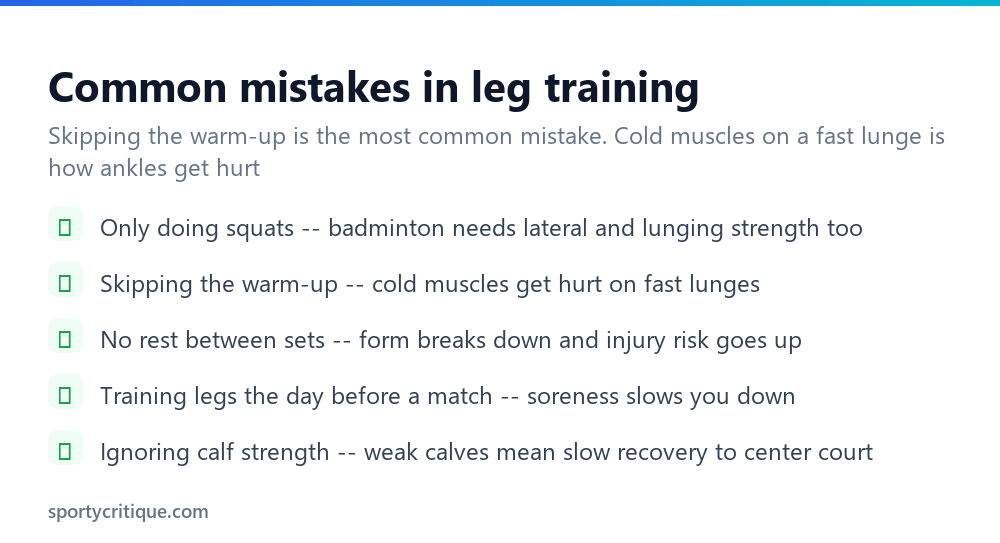
Only doing squats. Squats build straight-up-and-down strength. Badminton needs lateral and lunging strength too. Squats alone won’t cut it.
Skipping the warm-up. Cold muscles on a fast lunge is how ankles get hurt. Five minutes of warm-up prevents most of this.
No rest between sets. Rushing through sets breaks down your form. Bad form under fatigue is exactly when injuries happen.
Training legs the day before a match. Soreness slows you down when it matters most. Train hard, then give yourself a rest day.
Ignoring calf strength. Weak calves mean slow recovery to center court after every shot. Don’t skip the calf raises.
- ✓Warm up 5 minutes before any explosive leg work
- ✓Train legs 3 times a week, never the day before a match
- ✓Mix lunges, jumps, and lateral moves — not just squats
- ✓Rest 30 seconds between sets to keep your form clean
- ✓Add an agility ladder once bodyweight feels easy
- ✕Jumping straight into lunges with cold muscles
- ✕Training legs hard the day before you play
- ✕Doing only squats and calling it a leg day
- ✕Rushing through sets with no rest between them
- ✕Skipping calf raises because they feel boring
Frequently asked questions
What is the best leg workout for badminton?
Lunges, split jumps, lateral bounds, calf raises, and wall sits. Do 3 sets of each, 3 times a week, for the biggest improvement in court coverage.
How often should I do a badminton leg workout?
Three times a week. That’s enough to build real strength without leaving your legs too sore to play well.
Should I train legs before a badminton match?
No. Train the day before your rest day, not the day before a match. Sore legs slow you down when you need speed most.
Are squats enough for badminton leg strength?
No. Squats build straight strength, but badminton needs lateral and lunging strength too. Mix in lunges, split jumps, and lateral bounds.
How long until I see results from leg training?
Most players notice faster court coverage within a month of training 3 times a week.
Do I need equipment for this leg workout?
No, bodyweight is enough to start. An agility ladder helps once lunges feel easy, but it’s optional, not required.
- →Fix your backhand next: how to hit a badminton backhand
- →Clean up your grip too: common badminton grip mistakes
- →Master the footwork this workout supports: badminton footwork basics