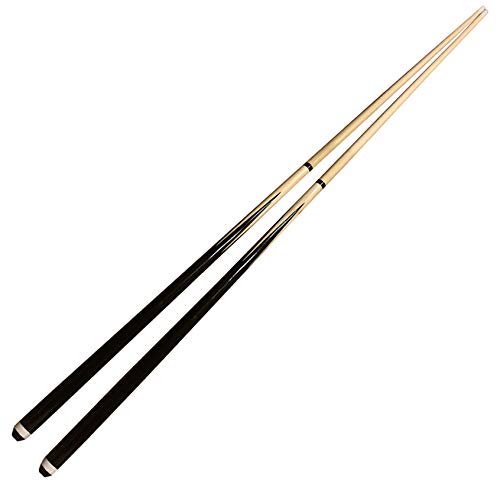
Best Jump Cues for Recreational Players


The best jump cue for most recreational players isn’t a dedicated jump stick at all, it’s a jump/break combo cue, and some leagues won’t even let you use a dedicated one. Here’s what a jump cue really does, what your league rules allow, and which sticks are worth buying at each price point.
For most recreational players, a jump/break combo cue in the $60-130 range is the better buy: it does the job when a ball actually gets frozen behind an obstacle, and it doubles as a hard-break cue so you’re not paying for a stick that sits in the case except twice a month. A dedicated jump cue, lighter and shorter, only makes sense once you’re jumping often enough to want the extra control a purpose-built stick gives you.
Jump cues get more attention online than they get use at the table. Most recreational players hit maybe one or two legitimate jump shots a night, if that, and a lot of bar-table “jumps” are really just a cue ball hopping off a mishit massé anyway. That doesn’t mean the category isn’t worth understanding. When a ball is genuinely snookered with no legal path around it, a jump cue is the only clean way out, and owning the wrong one, or owning one your league doesn’t even allow, wastes money you could have spent elsewhere.
- →A jump/break combo cue covers recreational play better than a dedicated jump cue for most players
- →APA league play bans dedicated jump cues outright; you jump with your break-down shooting cue instead
- →BCA rules cap jump cue weight at 25 oz and require a minimum 40-inch length with a leather or synthetic tip
- →Tip hardness, not weight, is what actually makes a ball pop; a hard phenolic or bakelite tip is standard
- →A true jump cue under 10 oz is a specialist tool, not a starter purchase for someone who jumps rarely
Table of Contents
Check your league’s rules before you buy anything
⚠️ Watch out: If you play APA league nights, a dedicated jump cue is not legal equipment. APA rules require you to jump with your regular shooting cue, broken down to the shaft if it’s a two-piece, rather than a separate jump stick. BCA league and tournament play allows dedicated jump cues, but caps the weight at 25 oz, sets a 40-inch minimum length, and requires the tip to be leather or synthetic leather rather than a hard phenolic puck. Bar leagues and casual room rules vary further still. This is the first thing to check, not the last, because it can make the entire purchase moot.
What a jump cue actually does
A legal jump shot works by striking down and through the cue ball at a steep angle, so the tip drives the ball into the table bed and the bed’s rebound pops it airborne over whatever is blocking your path. The cue itself doesn’t do anything magical, physics does the lifting, but a cue built for this has two things a normal playing cue doesn’t: a hard, low-friction tip that grips the ball cleanly at a steep downward angle instead of miscuing, and enough stiffness in the shaft that the energy of your stroke transfers instead of flexing away.
Weight matters less than people assume. A very light cue, under 10 oz, is easier to snap downward with a short, controlled stroke, which is why true jump cues run that light. But a heavier jump/break combo, 21 oz and up, still jumps a ball fine with the right technique; it just takes a more deliberate stroke to control, and it’s not going to feel effortless the way a 7-ounce dedicated stick does.
Jump cue vs. jump/break combo: which one you actually need
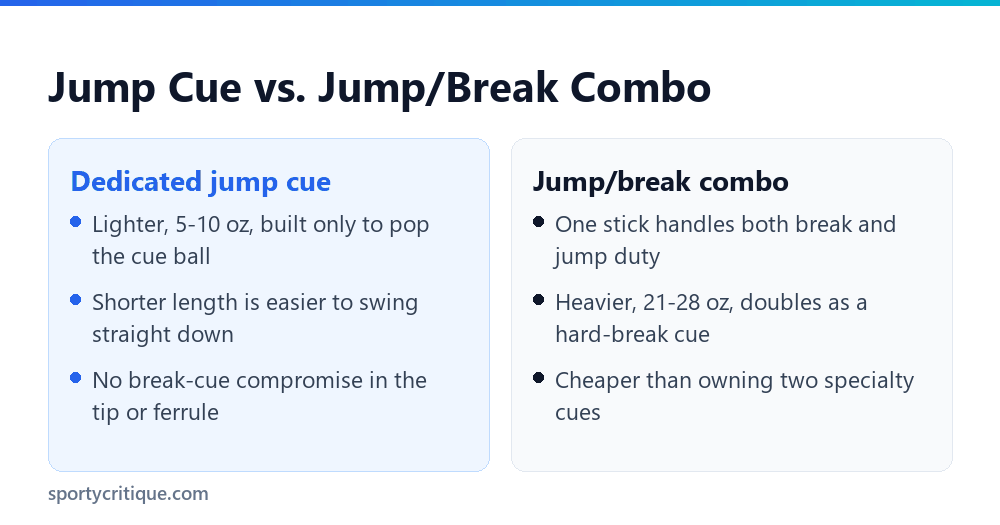
This is the real decision for most recreational players, and it’s not really about budget, it’s about how often you’d use each one. A combo cue earns its keep because it replaces two specialty purchases with one: a hard break and an occasional jump shot, covered by a single stick that lives in your case instead of gathering dust. A dedicated jump cue is the better tool once jump shots stop being rare, once you’re in leagues or run-out games often enough that the lighter weight and shorter length genuinely improve your success rate, not just your gear collection.
💡 Pro tip: If you already own a hard-hitting break cue, a dedicated jump cue is the better second purchase, since you’d otherwise be paying for break performance you don’t need twice. If you don’t own either yet, start with a combo cue and upgrade later once you know how often you actually reach for it.
Our picks across price tiers
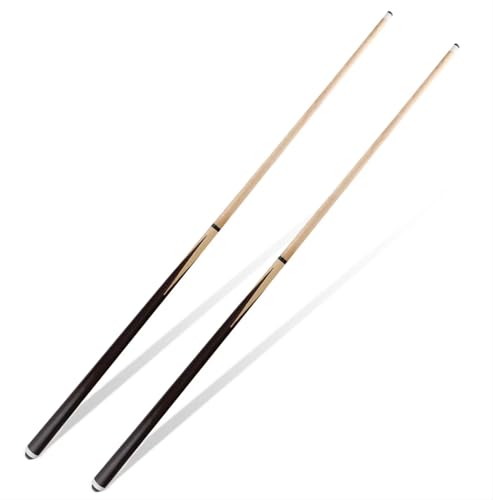
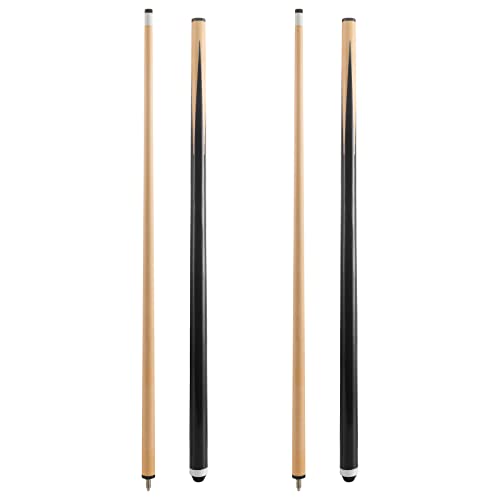
The AKLOT Heavy Hitter Jump Break Cue is the clearest budget pick. It’s a 3-piece Canadian maple combo cue with a 14mm bakelite tip and weight options between 21 and 28 oz, which covers both a hard break and a usable jump shot without asking you to learn a second cue’s balance point. At this price it won’t out-jump a dedicated stick, but it’s a legitimate first jump/break cue rather than a novelty.
A step up, the CUEELF Heavy Hitter 3-Piece Break Jump Pool Cue uses the same combo format with a 13.5mm tip and tighter build tolerances, which shows up mostly in straightness and joint fit rather than in raw jump performance. Worth it if you play often enough that a warped shaft would actually bother you.
For players ready to commit to a dedicated jump cue, the RHINO Carbon Fiber Jump Cue is a 3-piece carbon fiber stick with a 13.9mm bakelite tip and a stainless steel 3/8-8 joint, built specifically for jump performance rather than as a break/jump hybrid. Carbon fiber construction also means it’s close to immune to the warping that plagues cheaper wood jump sticks left in a hot car or trunk.
At the top of the category, the Lucasi Hybrid Air Hog 2 Jump Pool Cue is a purpose-built jump cue from a brand with a long track record in the cue industry, not a newer overseas import. It’s the pick for players who jump often enough in serious league or tournament settings, under BCA rules, that they want a name-brand stick with resale value and known consistency, not just a functional one.
What actually separates a good jump cue from a bad one
Tip hardness is the single biggest factor. A soft leather tip, the kind on your regular shooting cue, absorbs energy and mushrooms against the ball instead of driving it down cleanly, which is exactly why APA requires you to use your normal cue for jumps rather than letting a hard-tipped specialty stick into the mix. Phenolic and bakelite tips are hard enough to transfer nearly all of the stroke’s energy into the ball instead of the tip.
Shaft stiffness is the second factor, and it’s why carbon fiber has become common in this category even on relatively affordable sticks. A flexible wood shaft loses energy to flex on a steep, hard downward stroke, the exact stroke a jump shot requires, while a stiffer shaft transfers more of that energy straight into the ball.
Length and weight both affect how easy the cue is to control on a short, steep stroke. Shorter and lighter is generally easier to snap down cleanly without throwing off your aim, which is the whole reason true jump cues run 7-10 oz and well under standard playing-cue length. A heavier combo cue can still do the job, it just asks more of your technique to control that extra mass through a short, sharp motion.
Technique matters more than the cue
No cue fixes bad jump-shot mechanics. The stroke is short, steep, and driven mostly by the forearm and wrist rather than a full pendulum swing, striking down into the cue ball at roughly a 30 to 45 degree angle so the tip drives the ball into the bed and lets the rebound do the lifting. Elevating the butt too high or trying to muscle the shot with a long stroke is the most common way recreational players either miscue or send the ball flying somewhere they didn’t intend.
📊 Note: A legal jump shot lifts the cue ball off the table with the tip contacting only the cue ball, not the table bed. Scooping under the ball with the tip, or striking the table felt directly, is an illegal jump shot in essentially every rule set, house rules included. Practice the downward-strike motion on a cheap or practice table before trying it in a real game.
Do you even need one right now
- ✓You’ve been legitimately snookered more than once or twice a month recently
- ✓You already play in a league or room where jump shots are common and legal
- ✓You have a hard-hitting break cue already and want a lighter, purpose-built jump stick
- ✓You’re buying a combo cue that replaces a break cue you needed anyway
- ✕You play mostly APA league nights, where dedicated jump cues aren’t legal equipment
- ✕You’ve never actually attempted a jump shot and aren’t sure you’ll practice the technique
- ✕You already own a working break cue and rarely get snookered enough to justify a second stick
- ✕You’re buying one purely because it looked impressive online, not because you need it
Storage and care
Jump cues get less use than a main playing cue, which paradoxically makes them more prone to warping if you’re careless, since a cue that sits untouched in a hot trunk or a damp closet for weeks has nothing correcting a slight bend before you notice it. Store it the same way you’d store your primary cue, in a case, away from direct heat and humidity swings, and check it for straightness every few months by rolling it on a flat table the way you would any other cue.
Bottom line
Most recreational players are better served by a jump/break combo cue than a dedicated jump stick, both because it does double duty and because leagues like APA won’t let you use a dedicated jump cue anyway. Once jump shots stop being rare for you, and your league’s rules allow it, a lighter dedicated jump cue like the RHINO carbon fiber or Lucasi Air Hog 2 is a real upgrade in control, not just a more expensive way to do the same thing.
Are jump cues legal in pool leagues?
It depends on the league. APA bans dedicated jump cues entirely and requires you to jump with your regular shooting cue instead. BCA allows dedicated jump cues under specific rules: 25 oz maximum weight, 40-inch minimum length, and a leather or synthetic leather tip. Check your specific league or room’s house rules before buying.
Do I need a separate jump cue and break cue?
Not necessarily. A jump/break combo cue covers both roles in one stick and is the more practical choice for most recreational players. A separate dedicated jump cue makes more sense once you’re jumping often enough, and your league allows it, that the lighter weight and shorter length become a real control advantage.
What tip hardness works best for jumping a ball?
A hard phenolic or bakelite tip, not a soft leather tip. The hard tip transfers stroke energy into the ball instead of absorbing it, which is what actually pops the cue ball off the table when you strike down at the right angle.
Is scooping under the ball a legal jump shot?
No. A legal jump shot lifts the cue ball using only tip-to-ball contact at a steep downward angle. Scooping under the ball, or contacting the table bed with the tip, is illegal under essentially every standard rule set.
As an Amazon Associate, we earn from qualifying purchases through links on this page.