How to Play Straight Pool (14.1 Continuous): Rules and Strategy

Straight pool doesn’t end when the rack clears, because the rack never actually clears. Here’s how the 14.1 continuous format works, and the strategy that separates a two-ball run from a twenty-ball one.
Here’s how to play straight pool 14.1: rack all 15 balls with the 1-ball on the foot spot and the 5-ball in the opposite lower corner, then pocket any called ball in any order for one point each. When only one ball remains on the table, the other 14 are re-racked and play continues without a new break, as long as the cue ball and the last object ball aren’t touching or blocking the new rack. First player to 150 points wins.
Straight pool, also called 14.1 continuous, is the format 8-ball and 9-ball grew out of, and it plays nothing like either of them. There’s no group of balls assigned to you, no rotation order to follow, and the game doesn’t end when the rack runs empty, because the rack never actually runs empty. It just keeps refilling until someone hits 150 points.
That difference is also why straight pool has a reputation as the format that separates players who can run a table from players who can only run a few balls at a time. Position play matters more here than in any other common pool variant, since a poorly placed shot doesn’t just cost you the current rack, it can strand the cue ball against the new rack before you’ve even finished the old one.
- →Any ball can be pocketed in any order, as long as you call the ball and the pocket before shooting
- →When 14 balls are down and one remains on the table, the other 14 get re-racked and play continues without a new break
- →One point is scored per legally pocketed, called ball; the match runs to 150 points
- →Three consecutive fouls in a row costs 15 points, on top of the 1-point penalty for each individual foul
- →Position play and safety shots matter more here than in 8-ball or 9-ball, since a bad leave can strand you against the fresh rack
Table of Contents
Setting up a legal rack
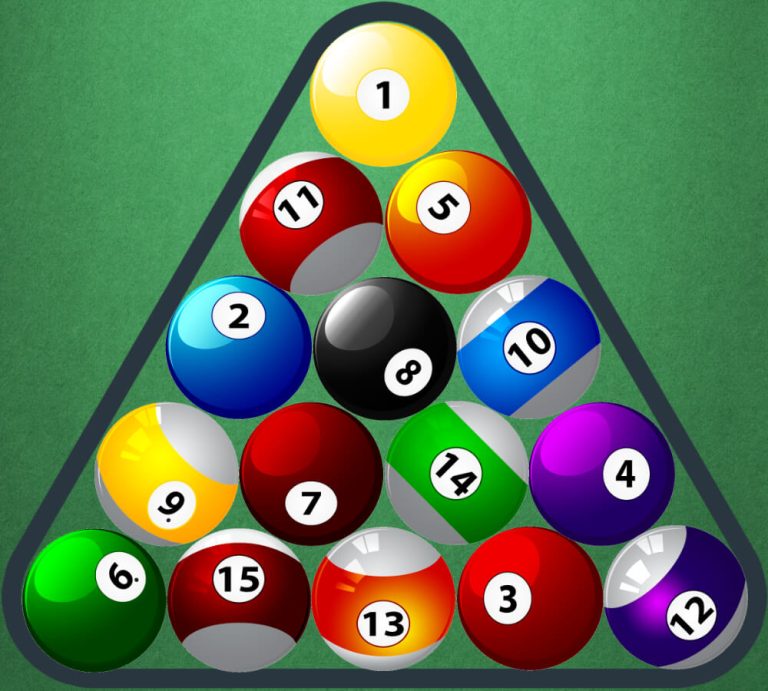
All 15 balls go in the triangle, but unlike 8-ball, the order inside the rack isn’t random. The 1-ball sits on the foot spot at the front of the rack, and the 5-ball goes in the back corner opposite the head string, on the side away from where the breaker is standing. Every other ball can go anywhere else in the triangle, racked as tightly as possible.
A loose rack is a bigger problem in straight pool than in other pool games, because a spread-out break makes it harder to keep the rack compact for the many re-racks that follow over the course of a single game to 150. A A sixx Triangle Magic Ball Rack earns its keep here specifically because you’re racking far more often in one sitting of straight pool than you would in a single game of 8-ball, and a template that seats the balls tight every time saves real minutes over a full match.
What counts as a legal shot
Every shot in straight pool is a called shot. Before you shoot, you name the ball and the pocket. Combinations and caroms count if they’re the ball and pocket you called, but obvious shots don’t need elaborate verbal detail; a ball clearly headed straight into a corner pocket doesn’t require you to announce it the way a thin cut off the rack into a bank shot would.
On the opening break specifically, the rules require a legal attempt: at least two object balls must reach a rail, or the breaker fouls and can be forced to re-break by the opponent’s choice. This exists because straight pool’s opening break isn’t meant to scatter balls for a run the way it does in 8-ball, it’s meant to open the rack just enough to get the game moving without handing the incoming player an easy runout.
The 14-ball re-rack rule, explained step by step
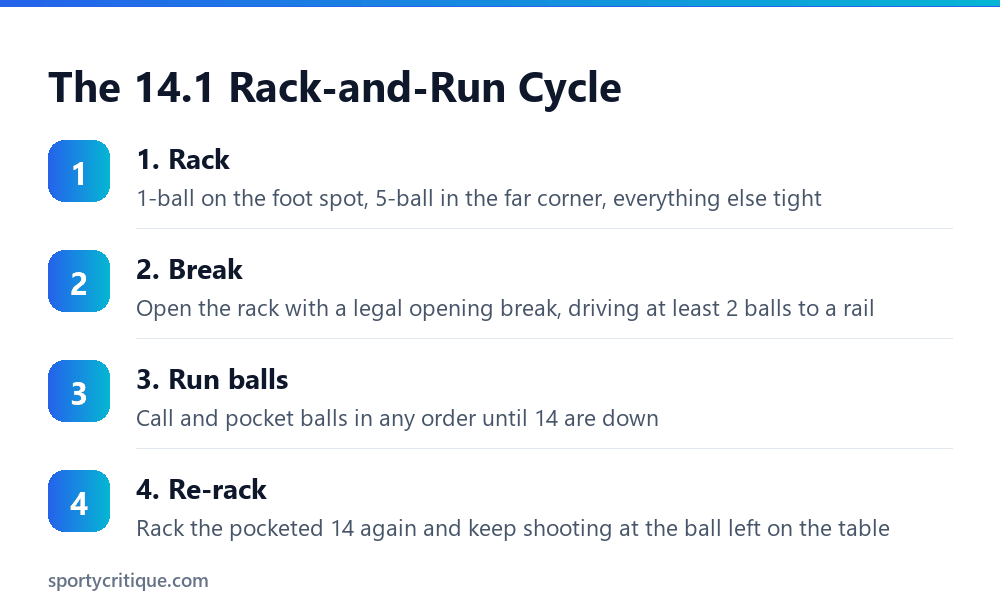
This is the rule that makes straight pool what it is. Once 14 of the 15 balls are pocketed and only one object ball remains on the table, play pauses. The pocketed 14 balls go back into the triangle in the standard rack position, minus the ball at the head of the rack, since the fifteenth ball, the one still sitting on the table, effectively takes that spot in the sequence.
If the cue ball and the last remaining object ball are both clear of the new rack, the shooter simply continues, using that last ball to break into the fresh rack while still shooting on the same turn. There’s no new opening break, no change of innings, nothing that interrupts a run in progress. A skilled player can, in theory, run rack after rack in a single turn until they reach 150 points or make a mistake.
⚠️ Watch out: If the cue ball or the last object ball ends up touching the new rack, or so close that a normal stroke can’t be played without disturbing it, the shooter has to attempt a legal break of the fresh rack instead of a regular shot, following the same two-balls-to-a-rail requirement as the opening break of the game. Getting this wrong, by treating it as a normal shot when it should have been a break, is one of the most common rules disputes in casual straight pool.
Scoring and winning the game
The 150-point target is standard for tournament play, but it’s a long game, often well over an hour between two evenly matched players. For casual play at home or in a bar, most players shorten the target to 50 or 100 points, which keeps the core rules and strategy intact while trimming the length of a single game to something closer to a typical 8-ball or 9-ball match.
Strategy: why position play matters more here
In 8-ball or 9-ball, a bad position leave usually just costs you the next shot. In straight pool, a bad leave near the end of a rack can strand the cue ball against the fresh triangle after the re-rack, forcing an unplanned break shot at exactly the moment you wanted to keep running balls. Good players plan the last two or three shots of every rack specifically around where the cue ball needs to sit relative to the new rack, not just the next pocket.
Protect the break ball
The single object ball left on the table when 14 go down, often called the break ball, is the whole reason the re-rack cycle can continue uninterrupted. Skilled players choose which ball to leave for that role early, well before the rack thins out, positioning it somewhere it won’t get accidentally pocketed and won’t end up too close to where the fresh rack will sit.
Use safeties when a runout isn’t there
Straight pool allows defensive safety shots the same way 9-ball does. If you don’t have a clean shot and don’t want to risk leaving your opponent an easy runout, playing a safety, tucking the cue ball behind a cluster of balls, or leaving nothing hittable, is a completely normal part of the game and often the smarter play over a low-percentage attempt.
Break clusters apart early, not late
Watch for balls sitting in tight clusters early in a rack and clear them out while there’s still room to maneuver around the table. Waiting until only a cluster and a couple of loose balls remain usually means you’re forced into a low-percentage break-up shot right when precision matters most for setting up the re-rack.
- ✓Call every shot clearly, even ones that look obvious to you but not to your opponent
- ✓Plan your last two or three shots of a rack around where the cue ball lands relative to the fresh triangle
- ✓Break up loose clusters early in the rack while you still have room to work with
- ✓Use a safety when a runout attempt is genuinely low-percentage
- ✕Treat the re-rack shot as a normal shot if the cue ball or break ball is touching the new rack
- ✕Ignore the two-balls-to-a-rail requirement on the opening break or a forced re-break
- ✕Rush the rack itself; a loose triangle causes bad break-ins on every re-rack for the rest of the game
- ✕Assume straight pool is scored the same way as 8-ball; it isn’t, it’s points, not pockets cleared
📊 Note: If you haven’t played much beyond 8-ball, our guides to
cover the basics that carry over into straight pool, before you add the re-rack rule on top.Where beginners lose points that experienced players don’t
New straight pool players almost always lose points to fouls rather than to missed shots. Scratching the cue ball into a pocket, failing to hit any object ball, or making the wrong ball on an uncalled combination all cost a point each, and those add up fast over a 150-point game in a way they don’t in a single 8-ball rack where the game just ends.
The other common leak is treating every shot as a runout attempt. A rushed, low-percentage shot that misses doesn’t just cost you the point, it usually hands your opponent a wide open table with balls scattered in easy position. Slowing down and taking the safety when the shot truly isn’t there is what separates a player who can run 20 balls from one who tops out around 5 or 6 before handing the table back.
Bottom line
Straight pool comes down to three things once the rules click: call your shots honestly, keep the rack tight for every re-rack, and plan your position two or three shots ahead instead of one. The 150-point target rewards patience over the kind of low-percentage runout attempts that work fine in a single rack of 8-ball but fall apart over a full straight pool game.
What’s the difference between straight pool and 8-ball?
In 8-ball, you’re assigned solids or stripes and must clear your group before legally pocketing the 8-ball. In straight pool, there are no groups; any called ball can be pocketed in any order, and the rack refills automatically once 14 balls are down instead of the game ending when the table clears.
How many points do you need to win a game of straight pool?
Tournament play runs to 150 points. Casual and home games commonly shorten that to 50 or 100 points to keep a single game closer in length to 8-ball or 9-ball, while keeping the same rules and re-rack mechanics.
What happens if I foul three times in a row in straight pool?
Three consecutive fouls costs 15 points, applied after a warning following the second consecutive foul. Each individual foul also costs 1 point on its own, separate from that penalty.
Do you have to break like in 8-ball at the start of every rack?
No. Only the very first rack of the game requires a full opening break. After that, as long as the cue ball and the last remaining object ball are clear of the fresh rack, the shooter continues without a new break. A forced re-break only happens if the cue ball or that last ball ends up touching the new rack.
Is straight pool harder than 9-ball?
Most experienced players consider it more demanding on position play specifically, since a poor leave near the end of a rack can strand you against the fresh triangle. The shot-making itself isn’t harder than 9-ball, but the planning required to keep a run going across multiple re-racks is a different skill than running a single rack.
As an Amazon Associate, we earn from qualifying purchases through links on this page.