Best Swim Goggles for Open Water Swimming

The short answer: the best goggles for open water swimming are not the same pair that works well in a chlorinated lap pool, and buying based on brand name alone is how most people end up with a leaky seal or a lens too dark to sight a buoy at seven in the morning. What actually matters is lens curvature, gasket size, and tint, in that order.
For most open water swimmers, a wide-lens goggle with a polarized or lightly mirrored tint and a soft, oversized silicone gasket is the right call. A budget pick like the ZIONOR G1 Air covers casual lake swims for under $25. Swimmers doing regular ocean or river sessions get more out of a dedicated open water design such as the Aqua Sphere Kayenne or ZONE3 Vapour, both built with a wider field of view and a seal made to survive hours of wear, not just a 45-minute pool workout.
- →Open water goggles need a wider lens and gasket than pool goggles; the difference isn’t marketing
- →Polarized or mirrored lenses cut glare off open water, but too dark a tint is a real problem before sunrise or on overcast days
- →Fit beats features: a $20 goggle that seals your eye socket beats a $70 goggle that leaks
- →Budget, mid-range, and performance tiers land at roughly $20-25, $50-60, and $55-65
- →Replace the silicone gasket (or the whole goggle) once it stops holding a seal without over-tightening the strap
Table of Contents
What Actually Separates “Open Water” From “Pool” Goggles
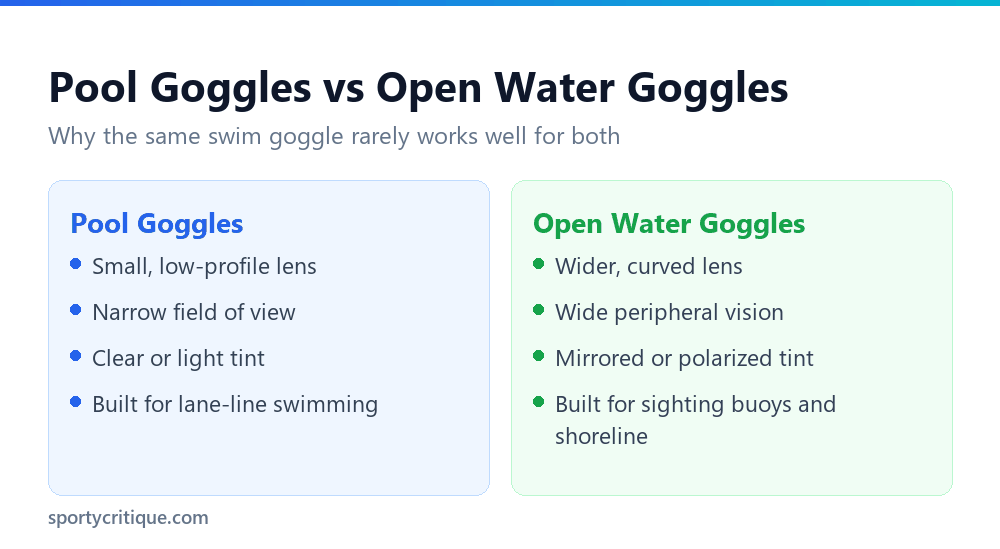
A standard pool goggle is built around a small, low-profile lens because a lap swimmer only needs to see the black line on the bottom of the pool and the wall coming up. Open water swimming asks for something different: you need to lift your head, find a buoy or a landmark on the shore, and get back into stroke without losing rhythm. That’s the whole reason open water lenses sit wider and curve further around the temple.
The gasket matters just as much as the lens. Pool goggles are typically worn for 30 to 90 minutes in still, warm water. Open water swims run longer, involve colder water, and often include chop from wind or boat wake that can work a loose-fitting goggle open mid-stroke. Open water models use a thicker, softer silicone gasket specifically so the seal holds without needing the strap cranked down hard enough to leave a headache.
Lens Tint, Matched to When You Actually Swim
Tint choice is where most first-time buyers get it backwards. A dark mirrored lens looks fast and aggressive on the shelf, and it does cut glare well on a bright midday swim. It’s also close to useless at dawn, dusk, or under cloud cover, where it darkens an already dim sightline until you can barely make out the next buoy.
⚠️ Watch out: If you only own one pair and swim at inconsistent times, a polarized lens with a moderate (not black-mirror) tint is the safer all-around choice over a heavily mirrored racing lens.
Fit Comes Before Every Other Feature
None of the tint or lens-shape advice matters if the goggle doesn’t seal. Press the goggles gently onto your closed eyes without using the strap at all. A properly fitted pair should hold light suction for two to three seconds before falling away. If it drops immediately, the gasket doesn’t match your face and no amount of strap tension will fix it long-term, it’ll just leave a ring around your eyes and still leak by the second buoy.
💡 Pro tip: Try goggles on before a swim, not just in the store mirror. Blink hard, shake your head side to side, and tilt your chin up the way you would to sight a buoy. If the seal breaks during that motion on dry land, it will absolutely break in chop.
Nose bridge sizing is the second most common leak point. Most open water models ship with two or three interchangeable nose pieces specifically because face width varies more than goggle manufacturers can solve with a single mold. Swap the nose piece before assuming the whole goggle is a bad fit.
Field of View and Sighting
Sighting is the skill of lifting your eyes just above the waterline to check your line without stopping your stroke. A narrow pool lens forces you to lift your entire head higher to see anything useful, which kills your rhythm and burns energy over a long swim. A wider, more curved open water lens lets you sight with a smaller, quicker head lift because more of your peripheral vision is already usable at a low angle.
This is also where a well-fitted gasket earns its keep. Goggles that shift slightly every time you lift your head to sight will eventually rotate the lens out of alignment, and you’ll spend the second half of a swim adjusting a leaky goggle instead of finding your next landmark.
Three Real Picks Across Price
For a genuinely low-cost entry point, the ZIONOR G1 Air comes in under $25 with a polarized lens, which is unusual at that price; most goggles this cheap skip polarization entirely and just tint the lens dark. It won’t hold up to daily distance training, but for someone swimming a lake once or twice a week it’s a legitimately reasonable starting point rather than a compromise pick.
In the middle tier, the Aqua Sphere Kayenne is built specifically to bridge pool and open water use, with a mid-size lens and Aqua Sphere’s known-comfortable gasket material. It’s a sensible pick for someone who swims both venues and doesn’t want two separate goggle bags.
At the performance end, the ZONE3 Vapour is purpose-built for open water and triathlon, with a wide curved lens and a polarized coating aimed at glare off open water specifically, not just general sun protection. It’s the pick for someone doing regular ocean, lake, or river swims where sighting conditions vary swim to swim.
What to Skip, Even at a Good Price
- ✓Buying a polarized or lightly mirrored lens if you swim at variable times of day
- ✓Testing the seal with a dry suction check before every new pair’s first swim
- ✓Keeping a spare nose piece or backup goggle in your swim bag for open water events
- ✓Rinsing goggles in fresh water after every ocean or lake swim to protect the gasket
- ✕Buying the darkest mirrored lens you can find without checking your typical swim time
- ✕Assuming a pool goggle’s narrow lens will work fine for buoy sighting
- ✕Over-tightening the strap to compensate for a gasket that doesn’t actually seal
- ✕Leaving goggles in a hot car, which warps the gasket and shortens its useful life fast
Anti-Fog Care That Actually Works
Every open water goggle ships with an anti-fog coating, and every anti-fog coating degrades with touch. Rubbing the inside of the lens with a towel or your thumb, even once, strips enough of the coating to notice fogging within a few swims. Rinse with fresh water only and let goggles air dry; skip the reflex to wipe them dry like sunglasses.
📊 Note: If fogging returns after the coating wears down, a drop of anti-fog spray or diluted baby shampoo rubbed thin on the inside lens and rinsed lightly (not scrubbed off) restores some clarity, though it won’t match a fresh factory coating.
Common Myths About Open Water Goggles
Swim Caps, Wetsuit Hoods, and Strap Compatibility
A goggle that fits fine bare-headed can pull tight and leak once you add a swim cap or a wetsuit hood, since both push against the strap and change the angle it sits at on your skull. If you swim open water in cold conditions with a hood, test the goggle fit with the hood on before race day or a long training swim, not after. Some swimmers run the goggle strap under the cap for a more stable seal, others run it over; there’s no universal right answer, only whatever holds for your particular head shape and gear combination.
Strap material is a smaller factor but still worth checking. A silicone strap holds tension better in cold water than a fabric or rubber strap, which can stretch out over a season of regular use. If your current goggles keep slipping loose partway through a swim and the gasket itself still seals fine on land, a replacement strap is a cheaper fix than a whole new pair of goggles.
When to Replace Your Goggles
Silicone gaskets lose elasticity with UV exposure and chlorine or saltwater contact, typically somewhere between six months and a year of regular use. The tell is needing to tighten the strap progressively over a few weeks just to get the same seal you had when the goggles were new. At that point, replace the whole goggle rather than fighting a stretched gasket with a tighter strap, since over-tightening just adds pressure headaches without restoring the seal.
What’s the actual difference between pool goggles and open water goggles?
Open water goggles use a wider, more curved lens for a bigger field of view when sighting buoys, plus a larger and softer silicone gasket built to hold a seal for longer swims in colder, choppier water. Pool goggles prioritize a low profile and minimal drag over a wide sightline, since lap swimmers don’t need to look far ahead.
Do I need polarized lenses for open water swimming?
Not strictly, but they help. Polarized lenses cut glare reflecting directly off open water in a way that simple tinting doesn’t, which makes sighting a buoy on a sunny day noticeably easier. If you only swim early morning or overcast days, a clear or lightly tinted lens works just as well and costs less.
How do I know if a swim goggle actually fits before buying it?
Press the goggles onto closed, dry eyes without using the strap. A proper fit holds light suction for two to three seconds before falling off on its own. If it falls away immediately, that gasket shape doesn’t match your face, regardless of the goggle’s price or reviews.
How often should open water swim goggles be replaced?
Most swimmers get six months to a year of regular use before the silicone gasket loses enough elasticity to leak. The sign is needing to tighten the strap more and more just to hold the same seal you had when the goggles were new.
As an Amazon Associate, we earn from qualifying purchases through links on this page.