Best Lacrosse Shoulder Pads for Attack and Midfield

A shoulder pad built for a defenseman’s job is the wrong tool for an attack or midfield player’s job. Here’s what actually matters for these two positions, and four real pads worth considering across the price range.
The best lacrosse shoulder pads for attack and midfield players prioritize mobility and low weight over maximum bulk, since both positions need a full, unrestricted shooting and dodging motion more than they need defenseman-level coverage. A budget youth-tier pad like the Warrior Burn Next covers casual and developing players for under $50. Serious attack and midfield players tend to land on a low-profile pad like the Maverik M5 EKG or STX Cell VI, both built specifically around shooting mobility rather than absorbing heavy, repeated contact.
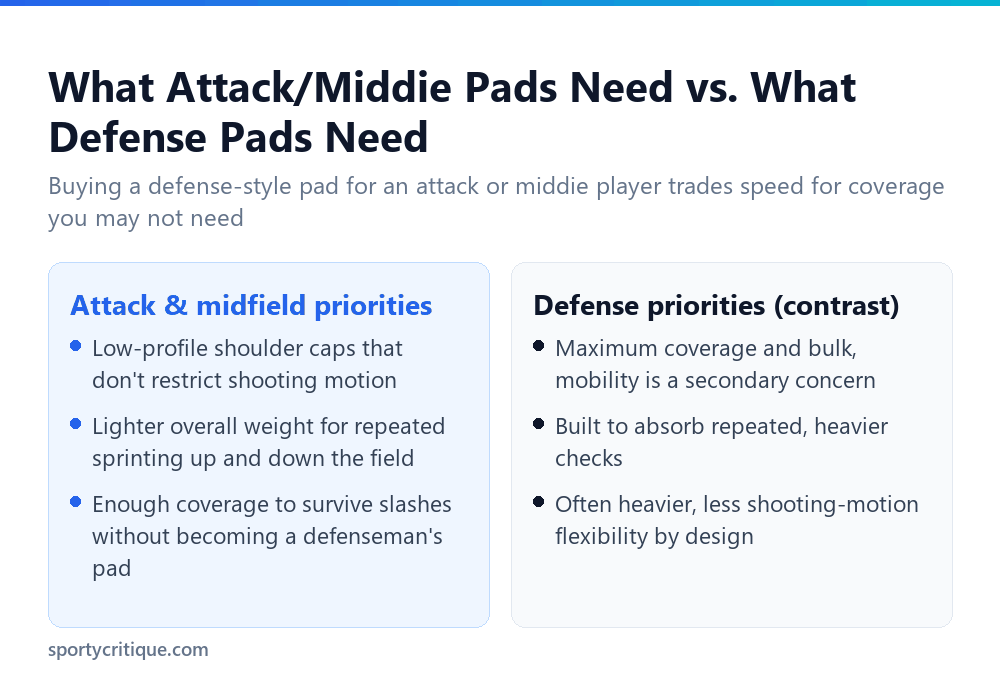
Shoulder pads are not one-size-fits-all-positions gear, even though a lot of players buy them that way. A defenseman taking repeated checks wants maximum coverage and doesn’t mind the extra bulk. An attack or midfield player taking fewer, lighter hits but needing a completely free shooting motion and enough gas left for a full game of sprinting wants the opposite tradeoff: less bulk, lower weight, and shoulder caps that don’t fight your shot.
- →Attack and midfield pads should prioritize mobility and low weight over maximum coverage.
- →A restrictive shoulder cap costs you shot power and speed on every single possession, all game.
- →Warrior Burn Next ($49.99) is a genuine entry-level option for developing or budget-conscious players.
- →Maverik MX EKG 2025 ($99.99) and Maverik M5 EKG ($124.99) both build in an External Kardiac Guard for chest-impact safety.
- →STX Cell VI ($149.99) is the premium, low-profile option built around GeoFlex-style mobility.
Table of Contents
Why attack and midfield need different pads than defense
Attack players are shooting constantly, and a shoulder pad with stiff, high-riding caps physically gets in the way of a full arm-cock on a shot, which costs real velocity over the course of a game. Midfielders run more total distance than any other position on the field, covering both ends, so extra pad weight isn’t a small inconvenience, it’s a cumulative drain by the fourth quarter. Neither position is absorbing the volume of direct checks a defenseman takes, which is exactly why the coverage-first pads built for defense are the wrong tool here.
⚠️ Watch out: Don’t buy based on brand reputation alone. Two pads from the same brand can be built for completely different priorities, a “Speed” or lightweight variant versus a standard or “Max” coverage variant, and picking the wrong one for your position undoes the whole point of shopping by position in the first place.
Our picks across four price tiers
Prices below reflect what each listing showed as of this writing; check the current price on Amazon before buying, since lacrosse gear pricing shifts with size, color, and season. All four meet the current NOCSAE ND200 standard for chest protection against commotio cordis, which any shoulder pad you buy today should.
Budget pick: Warrior Burn Next Lacrosse Shoulder Pads (Youth Medium)
The Warrior Burn Next Lacrosse Shoulder Pads (Youth Medium) covers the basics a developing player needs: pre-formed shoulder caps, a floating sternum piece, and dual-density foam protection, all under $50. It’s built in youth sizing, which makes it the right call specifically for younger or smaller attack and midfield players rather than a full-grown adult looking to cut costs; check the sizing chart carefully before ordering, since it runs in youth-specific measurements, not adult small.
Mid-tier pick: Maverik MX EKG Shoulder Pad 2025 (Large)
The Maverik MX EKG Shoulder Pad 2025 (Large) is a current-model pad that includes an External Kardiac Guard, adjustable COMFORFIT arch for personalized coverage and drape, and Dura Stretch torso panels that move with the body instead of resisting it. For a player who wants modern safety features without paying premium pricing, this is the tier that makes the most sense.
Upper-mid pick: Maverik M5 EKG Lacrosse Shoulder Pads
The Maverik M5 EKG Lacrosse Shoulder Pads is built specifically as a high-protection, lower-profile pad, which is the exact combination attack and midfield players are actually shopping for even if they don’t always describe it that way. It keeps real coverage over the chest and shoulders while staying light enough not to fight your shooting motion through a full game.
Premium pick: STX Cell VI Lacrosse Shoulder Pads
The STX Cell VI Lacrosse Shoulder Pads sits at the top of this list because it’s built around flexible, GeoFlex-style construction rather than rigid plates, which translates directly into freer shooting mechanics and less fatigue late in a game. At roughly $150 it’s a real investment, but for a serious attack or midfield player who feels restricted in a stiffer pad, the difference in actual on-field mobility is noticeable, not marketing language.
Fit and sizing: the part that actually determines protection
A shoulder pad that’s the right model but the wrong size protects worse than a cheaper pad that actually fits. Too loose and the shoulder caps shift out of position on contact, leaving a gap exactly where an impact is likely to land. Too tight and you lose the shooting range of motion these pads are supposed to preserve for attack and midfield players in the first place, which defeats the entire reason to shop by position rather than grabbing whatever pad is cheapest.
- ✓Measure chest size against the brand’s own size chart, not a generic S/M/L guess
- ✓Try a full shooting motion in the pad before deciding it fits, not just standing still
- ✓Check that the sternum piece sits centered and doesn’t shift when you raise your arms
- ✓Replace pads that no longer fit as a player grows; a too-small pad loses real coverage
- ✕Buy a size up “to grow into it”; loose pads shift out of protective position on contact
- ✕Assume all brands size the same way; a Maverik medium and an STX medium can differ
- ✕Skip trying the pad with a stick in hand; some restriction only shows up mid-motion
- ✕Ignore rub or chafing points during a fit check; they get worse, not better, over a season
💡 Pro tip: If you’re deciding between two sizes, prioritize full range of motion in a shooting and cradling motion over a snug “look.” A shoulder pad that restricts your shot even slightly costs you real velocity across a full season, which matters more for attack and midfield production than a marginally tighter fit.
Common myths about lacrosse shoulder pads
When to replace shoulder pads
Replace shoulder pads when the foam has visibly compressed or cracked, when straps no longer hold adjustment and slip during play, or when a player has grown enough that the sternum piece no longer sits centered. Foam protection degrades with repeated impacts even when the shell looks fine from the outside, so a pad that’s taken a full season or two of regular contact is worth inspecting closely rather than assuming it’s still performing like new.
📊 Note: A pad that still looks structurally fine but feels noticeably more restrictive than it did last season is often a sizing issue from growth, not a defect. Re-measure before assuming the pad itself has failed.
Ventilation and breathability matter more than the spec sheet suggests
A shoulder pad that runs hot doesn’t just feel uncomfortable, it costs actual performance late in games and tournaments where players run multiple contests in a single day. Mesh paneling and moisture-wicking liner material, features most modern pads across every price tier now include in some form, keep sweat from pooling under the pad and adding weight over the course of a long match. It’s worth checking a listing’s material description for words like “QUICKDRY” or “moisture-wicking” specifically, rather than assuming any foam-and-mesh combination performs the same.
This matters more for midfielders than any other position, since they’re the ones covering the most total ground and generating the most body heat over four quarters. A pad that traps heat effectively adds fatigue on top of the running workload midfield already demands, which is a real, measurable cost even though it never shows up on a spec sheet next to the impact ratings.
Pairing shoulder pads with the rest of your setup
Shoulder pads don’t operate in isolation. A pad that fits well under a jersey but conflicts with your arm pads at the shoulder seam creates a gap in coverage exactly where the two pieces should overlap. When you’re trying on a new shoulder pad, bring your existing arm pads and try the full combination together rather than assessing the shoulder pad on its own, since brands don’t always design their gear to interlock cleanly with every other brand’s arm and rib protection.
Rib pads deserve the same check. Some shoulder pads include an integrated rib extension; others expect you to layer a separate rib guard underneath. Buying a shoulder pad without checking which category it falls into is a common reason players end up with either redundant, bulky overlap at the ribs or an unprotected gap they don’t notice until a stick or ball finds it.
Bottom line
Attack and midfield players get more out of a lighter, lower-profile shoulder pad than a maximum-coverage defensive pad, because the mobility cost of the wrong pad shows up on every shot and every sprint for a full season. Budget starts around $50 for a solid entry pad; serious players moving up in level tend to land somewhere in the $100-150 range once they feel the difference a low-profile, mobility-focused pad makes.
Do attack and midfield players need different shoulder pads than defense?
Yes, in priority if not always in the exact model. Attack and midfield benefit more from a lighter, low-profile pad that preserves shooting motion and stamina, while defense typically prioritizes maximum coverage for absorbing frequent, heavier checks.
What’s the difference between a Speed pad and a standard shoulder pad?
Speed or low-profile variants trim bulk and weight for mobility, usually with slightly reduced coverage compared to a standard or Max variant from the same line. Attack and midfield players typically prefer the Speed-style option; defense often prefers the fuller-coverage standard version.
How much should I spend on lacrosse shoulder pads?
A genuine entry pad in the $50 range is fine for developing or recreational players. Serious club or high-level players tend to see real, noticeable mobility differences moving into the $100-150 range, where lighter materials and more flexible construction start to matter.
How do I know if my shoulder pads still fit correctly?
Raise your arms and run through a full shooting motion in the pad. The sternum piece should stay centered and the shoulder caps shouldn’t shift out of position or noticeably restrict your motion. If either happens, it’s time to check sizing against the current chart.
As an Amazon Associate, we earn from qualifying purchases through links on this page.