How to Roll Dodge in Lacrosse


A roll dodge is the answer to a defender playing you tight enough that a face dodge or split dodge has nowhere to work. Here’s the plant, pivot, and hand-switch mechanics that make it reliable, and the two breakdown points that stall it for most players.
Attack the defender’s lead foot, plant your outside foot hard just past it, and pivot on the ball of that foot so your back brushes the defender’s chest as you switch the stick to your other hand, low and tight to your body. The dodge fails almost every time at one of two points: the plant foot lands too far from the defender, or the stick swings wide during the switch and gets checked out. Fix those two and the rest of the move mostly takes care of itself.
The roll dodge is the counter to a defender who’s playing you tight and taking away your dominant-hand path. Instead of trying to blow past on speed alone, you use the defender’s own weight and positioning against them, planting, pivoting, and rolling back into your strong hand on the opposite side of where they expected you to go. Done right, it’s one of the few dodges where a slower player can still beat a faster defender, because it wins on leverage and timing rather than a straight-line footrace.
- →The plant foot has to land close to the defender, not a step or two away, or the pivot has nothing to push against
- →Pivot on the ball of your foot; don’t step around the defender in a wide arc, which gives them time to recover
- →Keep the stick low and tight to your body during the hand switch; an extended stick is an easy check
- →The roll dodge is a counter to tight, close defense; against a defender playing off you, a different dodge usually works better
- →First two steps out of the pivot should be short and explosive, not one long stride that telegraphs direction
Table of Contents
When a roll dodge beats other options
A face dodge or split dodge relies on changing direction fast enough to lose a defender who’s giving you some cushion. Against a defender playing right up on you, tight enough that you can feel their stick, those dodges don’t have room to work, there’s no gap to change direction into. The roll dodge solves exactly that problem, because it uses the defender’s own close positioning as the pivot point instead of needing open space.
It’s also the better choice when you’re already being played toward your strong hand and just need to reverse field, since a roll dodge naturally ends with the ball back in your dominant hand rather than forcing you to finish a play off-hand. Coaches who teach it early tend to frame it as the dodge you fall back on once a defender has adjusted to everything else in your bag, precisely because it depends on their positioning rather than yours.
The mechanics, checkpoint by checkpoint
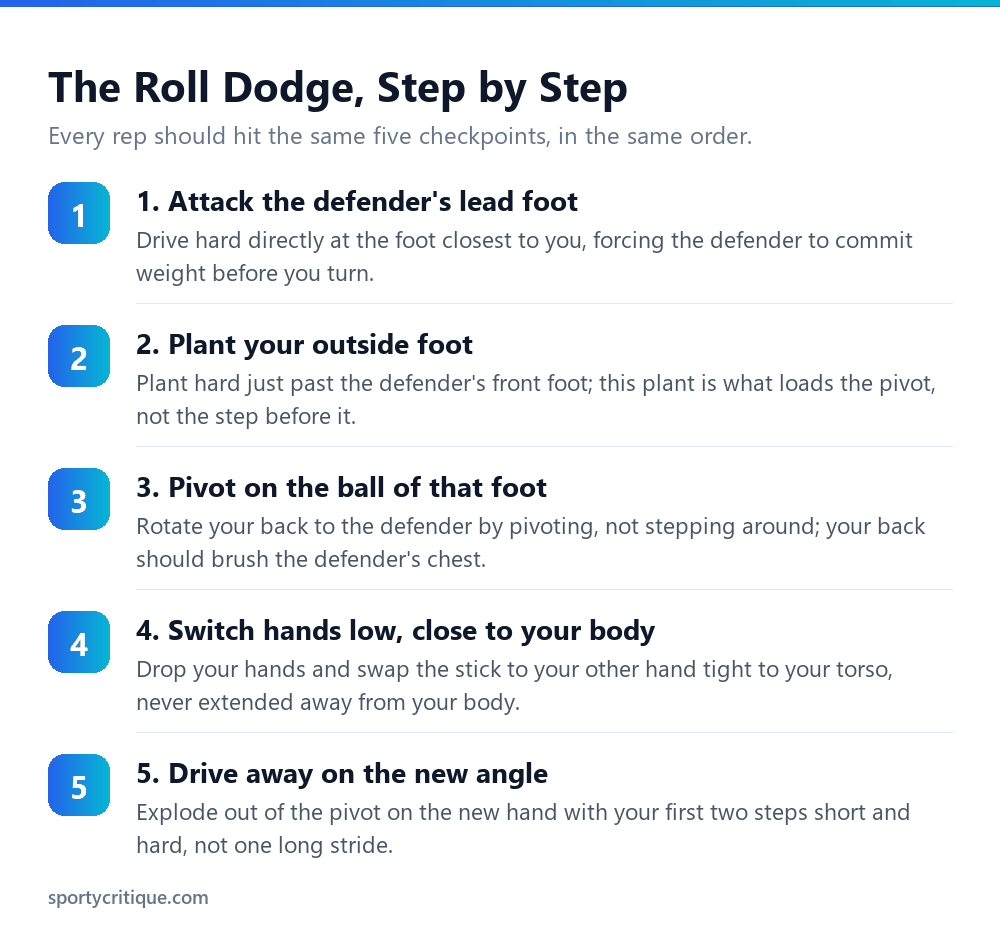
Most breakdowns happen at the plant. Players who are nervous about contact tend to plant a half-step early, which leaves a gap between their body and the defender’s for the pivot to swing through, and that gap is exactly where a good defender slides their stick in for the check. The plant needs to happen close enough that your shoulder is nearly touching the defender when you turn your back to them.
The pivot itself is a rotation on the ball of the plant foot, not a step around the defender in an arc. Stepping around instead of pivoting in place adds a half-second that a defender can use to recover and get a stick on you during the switch. Think of spinning a door on its hinge, not walking around a pole.
⚠️ Watch out: Don’t extend the stick away from your body during the hand switch to protect it from a poke check. Counterintuitively, that’s when it’s most exposed. Keep the head of the stick low and close to your torso through the entire switch; your body, not distance, is what protects it.
Using your off-hand and shoulder to shield
As you pivot, your off-hand and shoulder should be actively pushing back into the defender, not just passively turning away from them. That contact does two things: it keeps the defender’s stick further from yours during the vulnerable switch moment, and it gives you a physical read on where the defender’s weight is, which tells you whether they’re still square to you or already starting to recover. A defender who’s off balance after the plant will feel light through that shoulder contact, and that’s your cue to accelerate immediately rather than finishing the roll cautiously.
💡 Pro tip: Practice the roll dodge against a stationary dummy or wall bag first, focusing only on plant distance and pivot speed with no ball in your stick. Adding the ball and a live defender before the footwork is automatic just teaches you to rush the plant.
A note on gloves and grip during the switch
Grip matters more than most players think during a roll dodge, since you’re controlling the stick one-handed for a moment during the switch while absorbing shoulder contact at the same time. A pair like the STX Lacrosse Stallion 75 Gloves with a flexible palm and solid finger mobility makes that one-handed control noticeably easier than a stiff, overly padded glove that restricts your grip through the pivot. It’s not going to fix bad footwork, but a glove that fights your grip during the switch adds one more way for the dodge to break down.
Common mistakes that stall the dodge
Rushing the plant before actually engaging the defender’s body is the most common one. Players see the defender close and panic-plant a stride too early, well before there’s any real contact to pivot against, which leaves the whole move with nothing to push off of. Slow the approach down mentally even though the footwork itself stays fast; the plant should come at the moment of contact, not before it.
A second common issue is standing too upright through the pivot. Staying low through your base, knees bent, keeps your center of gravity under you and makes the defender feel your weight during the shoulder contact. Standing tall through the turn makes you easy to bump off balance and turns a clean roll into a stumble.
Practicing it without a live defender
- ✓Start with footwork only, no stick, walking through plant-pivot-switch in slow motion against a cone
- ✓Add the stick and ball once the pivot radius is consistently tight
- ✓Progress to a stationary defender or dummy before trying it live
- ✓Film yourself from behind to check whether your back is actually brushing the defender at the pivot point
- ✕Don’t skip straight to live 1-on-1 reps before the footwork is automatic
- ✕Don’t practice the dodge only going one direction; build it on both sides
- ✕Don’t let the plant foot drift further from the defender as you get tired in a drill
- ✕Don’t extend the stick wide during the switch even when practicing slowly
Reading the defender before you commit
A roll dodge works best against a defender playing tight, hands active, stick close, because that’s exactly the positioning the move is built to exploit. Against a defender sagging off you with space underneath, a roll dodge gives up ground for no reason, since there was already room to beat them with speed or a change of direction instead. Reading defender spacing before you decide which dodge to run is as much a part of the skill as the footwork itself.
Where on the field it works best
From behind the goal (X) or up top at the point, a roll dodge is often the cleanest way to create a shooting angle, since rolling back to your strong hand naturally opens the goal-side lane a face dodge doesn’t. From the wing, it’s more situational, since rolling toward the sideline can trap you against the boundary with nowhere to go if the pivot doesn’t fully lose the defender. Attackmen tend to use it more than middies for exactly that reason, the space around X gives the roll room to finish cleanly, while a midfielder rolling near the restraining line has less margin for error if the defender recovers fast.
Against a slide, the calculation changes again. If you can feel a second defender starting to rotate over as you begin the plant, finishing the roll dodge and looking to pass off the roll is usually the better read than trying to force a shot into a crowd. The footwork doesn’t change, but what you do with the half-second of separation it buys you should depend on whether help is already arriving.
Building the strength behind the pivot
A tight, fast pivot depends on hip and ankle strength as much as technique, since you’re decelerating your entire body weight and redirecting it in roughly a quarter second. Lateral bound drills, stepping explosively side to side and sticking the landing, build exactly that kind of single-leg control, and they translate directly to a plant foot that holds firm instead of sliding out from under you on contact. A few sets of these worked into a regular warm-up, two or three times a week, tend to show up in dodge quality faster than most players expect.
Core rotational strength matters too, since the pivot itself is a hip rotation under load while a defender is pushing back into you. Basic rotational medicine ball throws against a wall build that specific strength better than generic ab work does, because they train rotation under resistance rather than just flexion.
Bottom line
A roll dodge lives or dies on two details: a plant foot that actually lands close enough to the defender to have something to pivot against, and a stick that stays low and tight through the hand switch instead of swinging wide. Drill those two checkpoints in isolation before adding speed or a live defender, and the move becomes one of the more reliable ways to beat tight defense regardless of foot speed. It won’t replace a straight-line burst past a defender who’s giving you space, but against tight, physical coverage it’s often the only dodge in your bag that actually has something to work with, since it turns the defender’s own close positioning into the leverage that beats them.
See also: How to Cradle in Lacrosse and How to Grip a Lacrosse Stick to build the fundamentals a roll dodge depends on.
What’s the difference between a roll dodge and a face dodge?
A face dodge changes direction by swinging the stick across your face while continuing forward, used against a defender giving you some cushion. A roll dodge turns your back to the defender and pivots, used when a defender is playing tight and there’s no room to change direction into.
Why does my roll dodge keep getting checked?
Almost always the stick swinging wide during the hand switch. Keep it low and tight to your torso through the entire pivot instead of extending it away from your body, which is the most common reason a roll dodge gets stripped.
Do you need to be fast to roll dodge effectively?
No. The move works on plant timing, pivot radius, and shoulder leverage rather than straight-line speed, which is why it works even for players who aren’t the fastest athlete on the field.
Where should I practice a roll dodge first?
Footwork only, no stick, against a stationary target like a cone or dummy. Add the stick once the plant and pivot are consistent, then progress to a live defender.
As an Amazon Associate, we earn from qualifying purchases through links on this page.