Best Golf Grips for Seniors and Arthritis Relief


Arthritis doesn’t just make holding a golf club uncomfortable, it changes how much force your hands need to apply to keep control of the swing. Here are five real oversize and tacky-compound grips, checked for current price and stock, that reduce that force instead of just padding the handle.
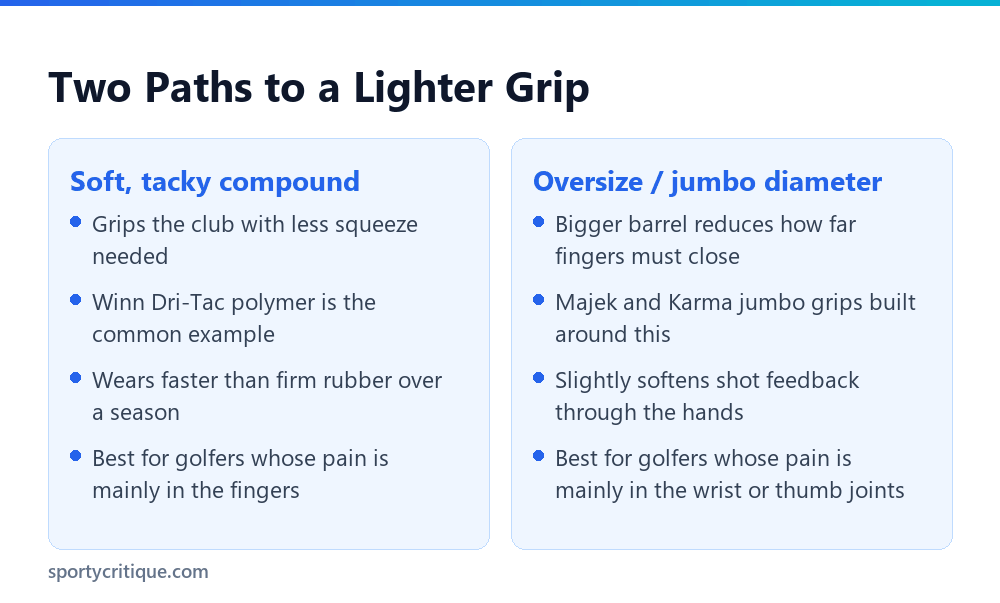
Grips built for arthritis work through two separate mechanisms: a softer, tackier compound like Winn’s Dri-Tac polymer that needs less squeeze to hold the club, and a larger oversize or jumbo diameter like Majek’s Super Jumbo line that reduces how far your fingers have to close around the handle. Try a single grip first, the $12.69 Winn Dri-Tac 2.0, before committing to a full 13-piece regrip set, since grip feel is personal enough that what works for one golfer’s hands can feel wrong for another’s.
Grip pressure is one of the few parts of a golf swing that arthritis actively works against. A death grip, squeezing far harder than the swing actually needs, is already a common fault among golfers with perfectly healthy hands. For a golfer managing joint pain in the fingers, thumb, or wrist, that same overgrip isn’t just a technical flaw, it’s the difference between playing nine holes comfortably and stopping after three because the hands have had enough.
The right grip won’t fix arthritis, nothing sold on Amazon will. What it can do is reduce how much force your hands need to apply to keep control of the club, which is a real, physical difference you can feel within a few swings of switching.
- →Two separate features help: a softer tacky compound needs less squeeze, and a larger diameter reduces how far fingers must close
- →Buy one grip first to test feel before committing to a 13-piece regrip set; grip preference is personal
- →Winn’s Dri-Tac polymer is the most common tacky-compound pick; Majek’s Super Jumbo line is the most common oversize pick
- →A full regrip job needs a grip kit, tape, solvent, and either a vise or a helper; factor that into the real cost
- →Oversize grips change swingweight slightly; expect a small adjustment period even once the hand relief kicks in
Table of Contents
Why grip size and softness matter for arthritis specifically
Standard golf grips are sized for an average adult hand assuming full, pain-free finger flexion. Arthritis in the fingers or thumb joints often means that full closure is uncomfortable or simply not available anymore, so the hand compensates by squeezing harder with whatever range of motion remains. That compensation is exactly what a bigger, softer grip removes the need for. A larger diameter means the fingers don’t have to close as far to make solid contact around the handle, and a tackier surface means the club stays put without that extra squeeze doing the holding.
Wrist pain responds a bit differently. A grip that’s too thin encourages more active wrist hinge to control the clubface, which can aggravate a wrist that’s already inflamed. A slightly oversize grip naturally quiets that extra hand action, which is part of why it’s recommended broadly for arthritis even though the mechanism is really about reduced manipulation, not just size for its own sake.
Five real options across the price range
All five were checked for live price and stock before publishing. Single grips let you test a compound or size before buying enough to regrip a full set; the 13-piece bundles cover a complete set of irons plus driver and fairway woods.
The Winn Dri-Tac 2.0 Oversize single grip is the sensible starting point for anyone who hasn’t tried a tacky-compound grip before. At under $13 it’s a low-cost way to find out whether the softer, tackier feel actually reduces your grip tension before spending on a full set. Winn’s Dri-Tac polymer feels noticeably different underhand from standard rubber, tackier and slightly softer, and that difference is the whole point of the product.
The Majek Super Jumbo Arthritic 8-pack goes further on size than most oversize grips, built with minimal taper along the barrel so the diameter stays large through the full length of the grip rather than narrowing toward the top. For golfers whose pain is centered in the finger joints specifically, that reduced taper is often the more noticeable relief than compound softness alone.
The Majek 13-Piece Senior Jumbo OverSize set is the budget path to a complete regrip, sized a standard +1/8 inch over regular grips rather than the more extreme Super Jumbo profile. It’s a reasonable middle ground for golfers who want size relief without going as large as the arthritis-specific line.
The Winn Dri-Tac Oversize 13-piece set brings the tacky-compound approach to a full bag rather than a single test grip, and at this price point you’re covering irons, wedges, driver, and fairway woods in one order instead of buying grips club by club.
The Winn Titanun Dri-Tac Oversize 13-piece sits at the top of this list using Winn’s newer Titanun compound, aimed at slightly better durability and moisture handling than the standard Dri-Tac line over a full season of play. It’s a meaningful jump in price for a compound refinement, worth it mainly for golfers who already know they like the Dri-Tac feel and play often enough to wear grips out.
⚠️ Watch out: Regripping a full set of clubs is not just the cost of the grips themselves. You’ll also need grip tape, solvent, and either a vise or a friend to hold the shaft steady. Many of the multi-piece sets include a basic kit; check the listing before assuming tape and solvent are included.
Should you regrip yourself or pay a pro shop?
Regripping is a genuinely manageable DIY job for most golfers, even without a full workshop vise setup, since double-sided grip tape and mineral spirits do most of the work. That said, for a golfer whose arthritis affects grip strength or fine motor control in the hands, the twisting and holding involved in the job itself can be uncomfortable. A local pro shop or golf retailer typically regrips a full set for a labor fee separate from the grip cost, and that’s a reasonable trade for anyone who’d rather not do the physical work of installation.
💡 Pro tip: If you’re testing a new grip size or compound for the first time, regrip just your most-used club, usually a 7-iron or pitching wedge, before committing to a full set. A few range sessions on one club tells you more about whether a grip actually helps than reading any number of reviews.
Swingweight and the adjustment period
A larger, heavier grip shifts a club’s balance slightly toward the handle, which lowers swingweight and can make the clubhead feel a touch lighter through impact. Most golfers adjust within a few range sessions, but it’s worth knowing going in rather than being surprised by it mid-round. If the weight shift bothers you after giving it a fair try, some grips can be built up with extra underlisting tape to fine-tune the balance back closer to standard, a step a club fitter can walk you through.
Who this actually helps
- ✓You notice hand or wrist fatigue well before the rest of your body tires during a round
- ✓You’ve been told by a doctor or physical therapist to reduce repetitive grip strain
- ✓You already play regularly enough that a full regrip investment makes sense
- ✓You’re open to a small adjustment period as swingweight shifts slightly
- ✕You play only a handful of rounds a year; test with a single grip before buying a full set
- ✕Your discomfort is mainly in the shoulder or lower back rather than the hands specifically
- ✕You’ve never tried an oversize grip and aren’t sure you’ll like the feel; start with one club
- ✕You have a specific swingweight your clubs are built to and don’t want it disturbed
Other habits that reduce grip strain alongside the right grip
The grip itself is one lever, but two habits multiply its effect. First, check your actual grip pressure on a scale of one to ten during a practice swing; most golfers, arthritic or not, sit around a seven or eight when a five is plenty to control the club. Second, gloves matter more than golfers with hand pain usually credit them for; a slightly thicker, well-fitted glove adds a small cushioning layer that stacks with a softer grip rather than competing with it.
Matching grip choice to where the pain actually is
Arthritis doesn’t hit every joint the same way, and the right grip changes depending on where yours is worst. Pain concentrated in the finger knuckles usually responds best to the Majek Super Jumbo approach, since the reduced taper keeps the barrel wide through the whole hand rather than narrowing where the fingers wrap tightest. Pain that’s more about the base of the thumb or the wrist tends to respond better to the Winn Dri-Tac’s softer compound, since the issue there is usually squeeze force rather than finger closure distance. If you’re not sure which describes your own hands, the single Winn grip is still the cheaper way to find out before committing to a full set built around the wrong assumption.
It’s also worth checking in with whoever manages your arthritis care before making a significant equipment change, particularly if pain has been getting worse rather than staying stable. A grip adjustment is a low-risk change on its own, but a physical therapist or rheumatologist familiar with your specific joints can sometimes point to a size or compound you wouldn’t have found through trial and error alone.
Bottom line
Start with a single Winn Dri-Tac 2.0 grip on your most-used club before committing to a full regrip. If the softer compound alone provides enough relief, a full 13-piece Dri-Tac set is the next step. If your pain is more about how far your fingers have to close around the handle, the Majek Super Jumbo line addresses that directly with a bigger, less-tapered barrel. Either way, the real fix is reducing how hard your hands have to squeeze, and both approaches get there through different mechanics.
See also: How to Hold a Golf Club to check your grip pressure and hand position before deciding how much size or softness you need.
Do oversize golf grips really help with arthritis?
Yes, for most golfers with finger or thumb joint pain. A larger diameter reduces how far the fingers have to close to hold the club securely, and a softer, tackier compound like Winn’s Dri-Tac needs less squeeze pressure to keep the club from twisting.
Should I buy a single grip or a full 13-piece set?
Buy a single grip for your most-used club first. Grip feel is personal, and testing one club for a few range sessions tells you more about whether a size or compound actually helps than committing to a full regrip up front.
Will an oversize grip hurt my golf swing?
It changes swingweight slightly, making the clubhead feel a touch lighter, and most golfers adjust within a few sessions. It can also reduce short-game feel if sized too large, which is why a moderate +1/8 to +3/32 inch oversize is the right starting point for most players.
Can I regrip my own clubs, or do I need a pro shop?
Regripping is a manageable DIY job with grip tape and mineral spirits, and many oversize grip sets include a basic kit. If arthritis affects your grip strength or fine motor control, a local pro shop or golf retailer will regrip a full set for a labor fee.
As an Amazon Associate, we earn from qualifying purchases through links on this page.