
How Humidity and Temperature Affect Shuffleboard Wax Performance


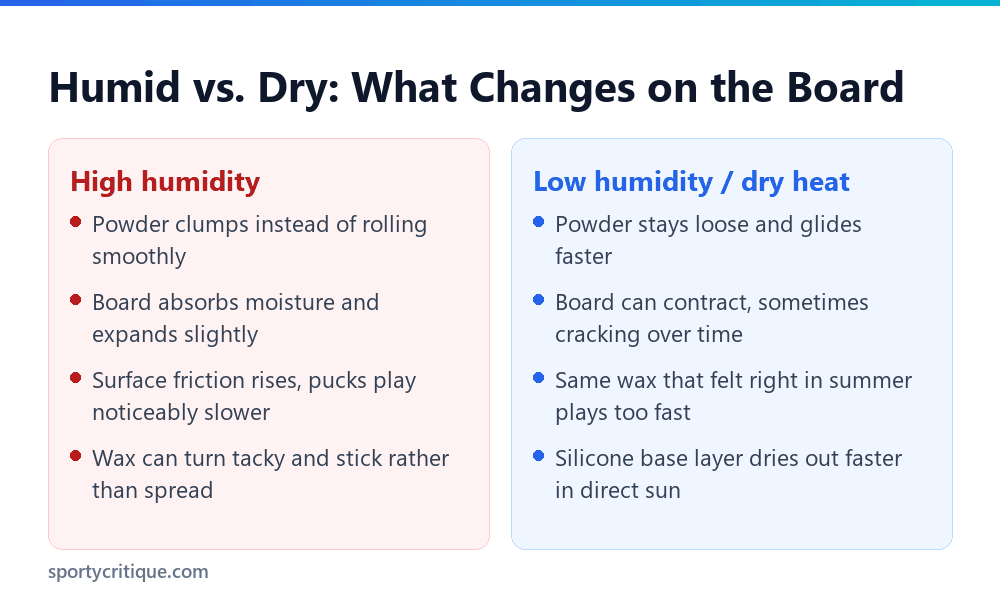
Shuffleboard humidity and wax are directly connected: high humidity makes powder clump and slows the board down, since moisture in the air causes the wood surface to absorb water and swell slightly, raising friction. Dry conditions do the opposite, speeding the same wax up and sometimes causing the board itself to contract. Keeping indoor humidity in the 40 to 50 percent range, and adjusting wax amount or speed grade seasonally, is what keeps a table playing consistently year-round.
A shuffleboard table that plays fast in July and sluggish in January isn’t a broken table. It’s wood responding to the room around it, the same way a wooden door sticks in summer and swings freely in winter. The wax matters, but the wax is only reacting to conditions the board itself is also reacting to, and treating the two as separate problems is how a lot of players end up chasing the wrong fix.
Understanding what humidity and temperature actually do, to the powder and to the wood underneath it, turns wax selection from guesswork into a repeatable process. It also explains why the exact same speed-graded powder that played perfectly last month can suddenly feel wrong without anyone changing how much was applied.
- →High humidity makes powder clump and slows play; the board itself also absorbs moisture and swells slightly
- →Dry conditions speed the same wax up and can cause the board to contract, sometimes leading to cracking over time
- →The generally recommended indoor humidity range for a shuffleboard room is 40 to 50 percent
- →Direct sunlight dries out the silicone base layer faster than ambient room conditions alone
- →Climatic adjusters built into most tables correct for seasonal crowning or cupping in the wood
Table of Contents
What High Humidity Does to Wax and the Board
Most shuffleboard powder is corn meal based, and corn meal absorbs moisture readily. In humid conditions, individual powder granules pick up water from the air and start sticking together instead of staying loose. Clumped powder can’t roll under a sliding puck the way dry, free-flowing powder does, which is the actual mechanism behind the uneven glide and inconsistent puck control players notice on muggy days.
The board reacts independently of the wax. Wood absorbs ambient moisture too, and a playfield that swells even slightly increases surface friction on its own, separate from whatever is happening with the powder on top of it. That’s why simply adding more wax during a humid stretch only partially fixes the slowdown; some of the friction is coming from the wood itself, not just from clumped powder.
⚠️ Watch out: In heavily humid rooms, wax can go beyond clumping and start sticking directly to the board instead of distributing evenly across it. That’s usually a sign the silicone base layer needs reapplying, not just that more powder is needed on top of what’s already there.
What Dry Air and Temperature Swings Do
Dry conditions, common in winter with forced-air heating running constantly, have close to the opposite effect. The same wax that played at a reasonable speed in a humid summer room will often play noticeably faster once heating season dries the air out, since the powder stays looser and the wood itself can contract slightly rather than swell.
That contraction isn’t purely beneficial even though it speeds the board up. Repeated cycles of a board drying out and contracting, then absorbing humidity and expanding again, are what eventually cause cracking or an uneven playing surface on tables that don’t get climate managed. A board kept in a reasonably stable environment year-round lasts longer than one exposed to big seasonal swings, independent of how the speed happens to feel on a given day.
Direct sunlight adds a separate variable on top of ambient humidity and temperature. Sun exposure dries out the silicone spray layer faster than room conditions alone would, which is part of why a table positioned near a window can play inconsistently even in a room that otherwise holds steady humidity.
The Target Range and How to Adjust for It
Most manufacturers and experienced players point to roughly 40 to 50 percent indoor humidity as the range that keeps a shuffleboard table’s wood stable and its wax behaving predictably. Outside that range in either direction, the same amount of the same speed-graded powder stops producing a consistent result, which is the root cause behind most complaints that a table’s speed feels random from one session to the next.
💡 Pro tip: Guessing at room humidity leads to overcorrecting in both directions. A small digital hygrometer, something like the ThermoPro TP50 Digital Hygrometer ($12.99), gives a real number to work from instead of relying on how the air feels, which makes it much easier to tell whether a slow session is actually a humidity problem or something else entirely, like a worn silicone layer or old powder.
Climatic Adjusters: The Board’s Own Correction Tool
Most quality shuffleboard tables ship with climatic adjusters, mechanisms built into the underside of the playfield that let an owner correct for seasonal crowning (the board curving upward) or cupping (curving downward) as wood responds to the room. These aren’t a wax substitute; they address the shape of the board itself, which wax and powder choice can’t fix on their own.
A board that’s crowned or cupped will cause pucks to drift toward the center or the edges regardless of how much or what grade of wax is applied, since the surface itself isn’t flat anymore. Checking and adjusting these at the start of each season, particularly the transition into and out of heating season, catches shape problems before they show up as mysteriously inconsistent shots.
Most manufacturer manuals include the adjustment procedure, and it typically takes a few minutes with a wrench or a built-in hand crank, depending on the table. Skipping this step for years at a time is common, mostly because the shape change happens gradually enough that players adjust their aim without realizing the board itself has moved, rather than tracing an inconsistent shot back to the actual cause.
Does the Type of Wax Matter Here?
Tournament-grade powder, the brown, walnut-shell-based line running from T0 through T5, is denser and generally holds up a little better in moderate humidity than the lighter, corn-meal-based regular-grade R1 through R4 line. That doesn’t make it immune to clumping; it just clumps somewhat less readily than the lighter regular-grade powder at the same humidity level, which is part of why a lot of serious players default to tournament-grade wax in rooms that run humid for part of the year.
Switching wax type isn’t a substitute for managing the room itself, though. Both lines respond to the same underlying mechanism, moisture getting absorbed into the powder, just at somewhat different rates. A room that regularly swings outside the 40 to 50 percent range will still cause noticeable inconsistency on either type of wax, even if tournament-grade buys a bit more margin before the effect becomes obvious.
Basements, Garages, and Other Problem Rooms
Basements and garages are two of the most common places a home shuffleboard table ends up, and they’re also two of the least climate-stable rooms in most houses. An unfinished or partially finished basement can sit well above 50 percent humidity for months at a time, especially in summer, while an attached garage swings with outdoor temperature far more than an interior room does. Neither problem is unique to shuffleboard, but a table is more sensitive to the swing than most furniture in the same room, since both the wood and the powder on top of it react to it.
Coastal and generally humid regions face a version of this problem even in a climate-controlled living room, since outdoor humidity that high pushes indoor conditions upward even with air conditioning running. Players in those climates tend to check humidity and adjust wax more frequently than players in drier inland regions, where the bigger seasonal swing usually runs the other direction, toward dry winter air instead of persistent summer humidity.
📊 Note: A portable dehumidifier sized for the room, not the whole house, is often a more practical fix for a basement shuffleboard setup than trying to manage humidity for the entire house. Running it specifically during the humid months, alongside regular hygrometer checks, keeps the table in a usable range without the cost of whole-house climate changes.
None of this means a table needs a dedicated climate-controlled room to play well. Most households can keep a shuffleboard table in a perfectly playable state with nothing more than seasonal wax adjustments, an occasional silicone reapplication, and a rough sense of when the room is running unusually humid or dry. The gap between a table that plays inconsistently and one that plays reliably is often just paying attention to conditions most owners never think to check.
Quick Reference: Humid vs. Dry Adjustments
- ✓Check room humidity with an actual gauge, not a guess
- ✓Reapply silicone spray if wax is sticking rather than spreading
- ✓Adjust wax amount seasonally, not just once a year
- ✓Check climatic adjusters at each season change
- ✕Assuming a slow table just needs more of the same wax
- ✕Leaving a table in direct sunlight without noticing the effect on the silicone layer
- ✕Ignoring repeated cracking as just cosmetic
- ✕Switching speed grades without first checking if humidity is the actual cause
Frequently Asked Questions
Why does my shuffleboard table play slower in summer?
Higher summer humidity causes the powder to absorb moisture and clump, and the wood surface itself absorbs some moisture and swells slightly, both of which raise friction and slow the puck. It’s a combination of the wax and the board reacting to the same conditions, not a fault in either one.
Does running a dehumidifier actually help?
Yes, if the room regularly sits above roughly 50 to 55 percent humidity. Bringing the room closer to the 40 to 50 percent target range reduces both the powder clumping and the board’s moisture absorption, which is more effective than compensating with extra wax alone.
How often should shuffleboard wax be reapplied because of seasonal changes?
There’s no fixed schedule that applies to every room, but many players check and reapply at each seasonal transition, particularly moving into and out of heating season, since that’s when humidity swings the most in a typical home.
Can dry air damage a shuffleboard table?
Extended dry conditions can cause the board to contract and, over repeated cycles of drying and re-humidifying, eventually crack or develop an uneven surface. A stable indoor environment protects the table’s longevity, separate from whatever effect it has on wax speed in the short term.
Is tournament-grade wax worth it just for humidity resistance?
If the table lives in a room that regularly runs above 50 percent humidity, tournament-grade powder’s denser, walnut-shell composition holds up somewhat better than regular-grade before clumping becomes noticeable. It’s not a full fix on its own, but it buys margin in a room that’s difficult to keep in the target humidity range year-round.
As an Amazon Associate, we earn from qualifying purchases through links on this page.